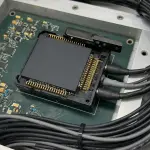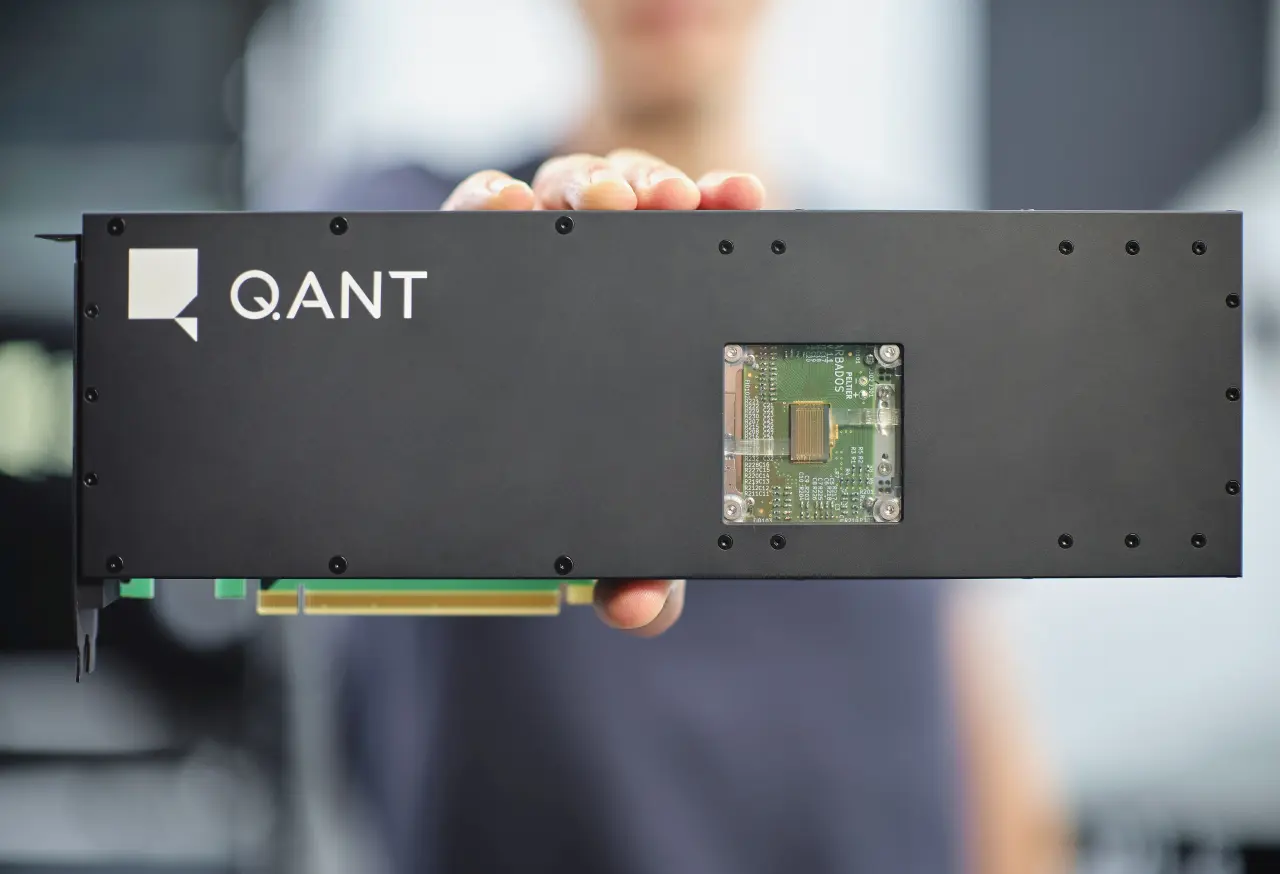
Q.ANT says it has demonstrated a 30-fold increase in energy efficiency for matrix operations compared to classical processors, which it attributes to its second-generation photonic Native Processing Unit (NPU). At ISC High Performance, the company says it ran both a diffusion model for image synthesis and a recurrent neural network, which it argues shows its architecture can handle a broad range of modern AI tasks, from generating images to predicting time-series data. According to Q.ANT, this is the first time complex, production-relevant AI workloads have operated on its photonic hardware, and earlier this year, Daisytuner compiled an object recognition model directly from PyTorch onto the processors. “Q.ANT’s photonic architecture changes the energy equation for the AI ecosystem,” says Dr. Michael Förtsch, founder and CEO of Q.ANT; “By working with light instead of transistors, you reduce energy consumption at the source.”
Photonic NPU Executes Generative Diffusion Models for Image Synthesis
According to Q.ANT, a photonic processor has, for the first time, successfully executed a complex diffusion model for image synthesis, which the company presents as a significant expansion of the technology’s capabilities beyond basic algorithms. Q.ANT says the demonstration moves photonic computing closer to practical, commercial applications, addressing a key limitation of earlier designs. The diffusion model, developed with researchers at Ludwig Maximilian University of Munich, generates images through iterative, parallelized matrix operations, a computationally intensive process ideally suited to photonic systems. “Diffusion models are widespread and computationally intensive approaches in modern generative AI,” says Professor Dr. Björn Ommer, head of the Computer Vision & Learning Group at LMU.
Diffusion models are widespread and computationally intensive approaches in modern generative AI. They are based on repetitive, very extensive computational operations to gradually generate a coherent output.
Professor Dr. Björn Ommer, head of the Computer Vision & Learning Group at Ludwig Maximilian University of Munich (LMU)
xLSTM Time Series Forecasting Demonstrates Recurrent Network Capability
The capacity of Q.ANT’s photonic processors to handle diverse artificial intelligence models extended beyond generative AI, as demonstrated at ISC High Performance with the successful execution of TiRex, a time series forecasting model developed by the Austrian Frontier AI Lab NXAI. This model utilizes the Extended Long Short-Term Memory (xLSTM) architecture, designed for enterprise applications and capable of predicting values over extended periods within sequential data. Unlike the transformer-based models currently dominating much of the AI landscape, xLSTM is a recurrent neural network, offering a structurally different approach to pattern recognition and prediction.
NXAI’s commercially optimized TiRex model, applied to areas like financial analysis and weather forecasting, ran on Q.ANT’s second-generation photonic Native Processing Unit (NPU). Lukas Fischer, Head of Applied Research at NXAI, said, “From the very beginning, we at TiRex have been working to rebalance the relationship between performance and energy consumption. Seeing it running on Q.ANT’s photonic hardware is impressive and opens a new chapter in computing.” Q.ANT says the demonstration underscores a key point: its architecture isn’t limited to specific AI tasks, but can operate across demanding classes of AI, broadening the scope of potential applications. This successful execution of xLSTM, alongside the diffusion model, highlights the NPU’s ability to handle both parallelized and sequential computations efficiently. Fischer added, “xLSTM architecture on photonic systems could redefine what energy-efficient AI even means,” emphasizing the potential for a significant reduction in power consumption for complex forecasting tasks. The ability to run such models on photonic hardware signals a move toward a more versatile and sustainable AI infrastructure.
From the very beginning, we at TiRex have been working to rebalance the relationship between performance and energy consumption. Seeing it running on Q.ANT’s photonic hardware is impressive and opens a new chapter in computing.
Lukas Fischer, Head of Applied Research at NXAI
Q.ANT Ecosystem Expands with Partnerships and HPC Installations
The expansion of Q.ANT’s capabilities is increasingly visible through strategic partnerships and installations at leading high-performance computing centers. In May, the company formalized a commercial hardware agreement with German cloud provider IONOS, signaling a move toward broader accessibility for its photonic processing units. The ability to integrate with existing tools is crucial for moving beyond purely theoretical demonstrations and establishing a pathway for wider adoption. These developments underscore a growing ecosystem around Q.ANT, with institutions like the Leibniz Supercomputing Centre Munich and the Jülich Supercomputing Centre now operating the company’s hardware in production environments. This isn’t limited to established AI techniques; Q.ANT recently showcased the execution of a diffusion model, a computationally intensive generative AI approach, on its second-generation photonic Native Processing Unit. Further demonstrating versatility, the company also ran NXAI’s commercially optimized TiRex model, an Extended Long Short-Term Memory (xLSTM) architecture, on its photonic hardware. The execution of both xLSTM and the diffusion model points to the breadth of AI applications Q.ANT’s hardware can address, reinforcing the company’s case for photonic computing as a future infrastructure component.
Source: https://qant.com/

See today’s quantum computing news on Quantum Zeitgeist for the latest breakthroughs in qubits, hardware, algorithms, and industry deals.