Researchers at the University of California, Berkeley and Lawrence Berkeley National Laboratory have demonstrated a temporally multiplexed ion-photon interface by rapidly transporting a chain of nine calcium ions across 74 micrometers within 86 microseconds. This multiplexing approach is a key technique to increase the limited entangling rates of existing long-distance quantum networking approaches.
The work verifies the non-classical nature of the multiplexed photons with a second-order correlation function averaging 0.060(13), indicating negligible crosstalk between quantum channels, and finds coherent excitation of n_α≈ 110 after transport. This proof-of-principle implementation is expected to lead to a nearly nine-fold increase and enables large-scale quantum networking with trapped ions.
Fast Ion-Chain Transport Enables Temporal Multiplexing
Moving calcium ions at high speeds is a crucial step toward building faster, more efficient quantum networks. This precise manipulation of matter-based qubits unlocks possibilities for distributing quantum information at rates previously unattainable. The core of this achievement lies in the ability to generate multiple, distinct quantum channels using a single physical system.
Conventional probabilistic schemes are hampered by photon travel time, with the maximum attempt rate limited to around 10 kHz over 10 km distances. The team’s method, however, is expected to lead to a nearly nine-fold increase in the attempt rate of entanglement generation for nodes separated by over 100 km.
Light-matter quantum interfaces, the researchers explain, “are a fundamental building block for such applications, and allow for distributed entanglement between stationary matter qubits by using ‘flying’ photons.” Verification of this multiplexing capability involved meticulous measurement of the generated photons. The researchers measured a second-order correlation function of g^(2)(0) = 0.060(13), a value indicating “negligible crosstalk between the multiplexed modes.” This low level of interference is critical because crosstalk degrades the fidelity of quantum signals, and this result demonstrates a high degree of control over the quantum channels.
Characterization of the ion chain’s movement after transport revealed coherent excitation of the center-of-mass mode to as much as nα ≈ 110. This unexpectedly high excitation level presents a challenge, as maintaining control over such a strongly driven state is vital for subsequent quantum operations.
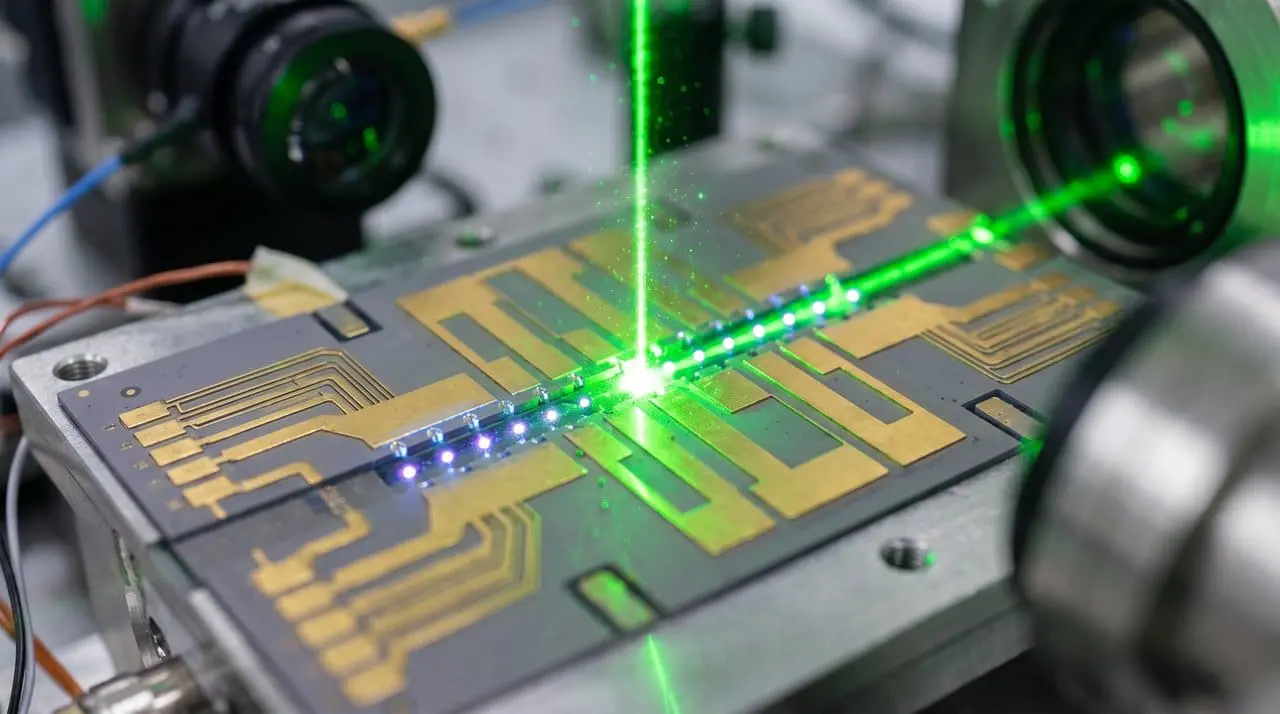
The experimental setup utilizes an RF Paul trap to confine the calcium ions, with DC endcap voltages controlling their movement. A tightly focused 866 nm laser addresses individual ions, prompting the emission of 397 nm single photons collected by an objective and directed toward single-photon detectors.
Calcium Ion System for Multiplexed Photon Generation
Advancements in distributed quantum information processing increasingly rely on the efficient generation of entanglement between distant quantum nodes, a challenge currently limited by the speed of establishing photon-matter connections. Researchers are now exploring multiplexing, combining multiple signals into a single channel, as a means to dramatically increase these rates, and a recent demonstration utilizing calcium ions represents a significant step forward. This chain was physically moved across 74 micrometers in just 86 microseconds, a remarkably swift manipulation of individual atoms crucial for accelerating quantum network operation.
This speed is enabled by precise control of radio frequency (RF) and direct current (DC) voltages within a Paul trap, confining and directing the ions with high precision. The team generates on-demand single photons by stroboscopically switching on an 866 nm beam during transport, prompting the emission of 397 nm photons from the targeted ions. Characterization of the ion crystal’s movement revealed coherent excitation of the center-of-mass mode to approximately n_α ≈ 110, an unexpectedly high level of excitation.
Second-Order Correlation Confirms Single-Photon Emission
The team’s work centers on a technique called temporal multiplexing, where multiple quantum signals are sent through the same channel in rapid succession, increasing the overall data transmission rate. Verification of these multiplexed photons relies on confirming they are truly single photons, and not faint pulses of multiple photons, which would introduce errors into quantum calculations. During this movement, they generated photons using a focused laser beam, effectively creating a series of single-photon emissions.
The researchers measured a second-order correlation function of 0.060(13). This low value, the researchers note, indicates “negligible crosstalk between the multiplexed modes,” meaning minimal interference between the different quantum channels. A correlation value approaching zero is a hallmark of single-photon emission, demonstrating high fidelity in the process. They found coherent excitation of n_α≈ 110 for the center-of-mass mode, a surprisingly high level of excitation.
The researchers acknowledge that excess excitation could introduce errors in subsequent quantum operations. Despite this, the team’s proof-of-principle implementation demonstrates a viable path toward scaling up quantum networking with trapped ions, offering a potential solution to the limitations of existing long-distance quantum communication approaches. The ability to generate and verify high-rate, single-photon emissions is a fundamental requirement for building practical quantum repeaters and distributed quantum computers.
Motional Excitation Mitigation During Ion Transport
The pursuit of scalable quantum networks hinges on efficiently linking quantum processors, and recent work demonstrates a promising technique for accelerating this process. Researchers have achieved rapid transport of a chain of nine calcium ions, a distance of 74 micrometers in just 86 microseconds, as a means of multiplexing photon emission for enhanced entanglement rates. This speed is crucial, as conventional methods are limited by the travel time of photons over long distances, restricting entanglement generation to rates of less than 10 per second over 10 kilometers.
This advance relies on shuttling the ion chain through a focused laser beam to generate single photons. The team employed a custom-built, low-noise amplifier circuit with cutoff frequencies of 1.9 MHz to facilitate the fast ion chain transport. However, the rapid movement isn’t without its challenges.
Characterization of the ion chain’s motion after transport revealed a surprisingly high excitation of the center-of-mass mode, reaching approximately n_α≈ 110. To address this, they designed a shuttling function intended to mitigate motional excitation, achieving a level of approximately 50. While this represents a significant step, further optimization of transport methods is needed to fully scale up the technique. The work demonstrates that this proposed multiplexing scheme can be scaled to higher rates, provided more optimal transport methods are applied.
The pursuit of long-distance quantum communication often envisions photons as the ideal carriers of information, yet maintaining the fragile quantum states over vast distances remains a significant hurdle. This scheme is expected to lead to a nearly nine-fold increase in the attempt rate of entanglement generation. This low level of crosstalk is particularly noteworthy, as unwanted interference between channels can destroy the delicate quantum information.
Beyond speed and fidelity, however, manipulating individual atoms at such velocities presents challenges. The team found coherent excitation of n_α≈ 110 for the center-of-mass mode, which could disrupt subsequent quantum operations.
See today’s quantum computing news on Quantum Zeitgeist for the latest breakthroughs in qubits, hardware, algorithms, and industry deals.