IQM Quantum Computers reports achieving a 1,000-fold reduction in logical error rates using a new family of quantum error-correcting codes, a breakthrough that accelerates the pursuit of fault-tolerant computing. Dubbed Directional tile codes, this approach delivers performance comparable to QLDPC codes without requiring new qubit connectivity or hardware, functioning on IQM’s existing square qubit grid. This result addresses a central challenge in quantum computing by minimizing qubit overhead while maximizing error correction efficiency, with a goal of scaling up to one million qubits.
Directional Tile Codes Reduce Logical Error Rates by 1,000x
Unlike existing methods, this improvement doesn’t necessitate new qubit connectivity or hardware; the codes function effectively on IQM’s standard square qubit grid, streamlining implementation and reducing development costs. The research, co-authored with collaborators at Freie Universität Berlin, the University of Edinburgh, and Johannes Gutenberg-Universität Mainz, addresses a core challenge in the field by minimizing qubit overhead. IQM reports achieving this performance level while maintaining a hardware footprint of around 30 physical qubits per logical qubit, a crucial metric for scalability. “Quantum error-correction codes should not only be highly efficient, they should also be implementable on scalable and manufacturable hardware architectures,” said Dr. Inés de Vega, Chief Scientist of IQM Quantum Computers.
Dr. Vincent Steffan, Senior Quantum Error-Correction Engineer at IQM Quantum Computers, explained that they have been working on tile codes because of their promising characteristics, including local checks, favorable parameters, and multiple ways to perform logical computation without adding connectivity requirements. This advancement positions IQM favorably as it prepares to list on Nasdaq via a merger with Real Asset Acquisition Corp. (RAAQ), potentially becoming the first European quantum company to do so.
Quantum error-correction codes should not only be highly efficient; they should also be implementable on scalable and manufacturable hardware architectures. A close co-design of quantum error correction and hardware is a central element of IQM’s strategy. Directional tile codes represent a breakthrough in this direction, delivering up to a 1,000-fold reduction in logical error rates on near-term-sized IQM Crystal hardware while relying only on practical nearest-neighbour connectivity.
Dr. Inés de Vega, Chief Scientist of IQM Quantum Computers
IQM’s Crystal Processors Utilize Native iSWAP Gates
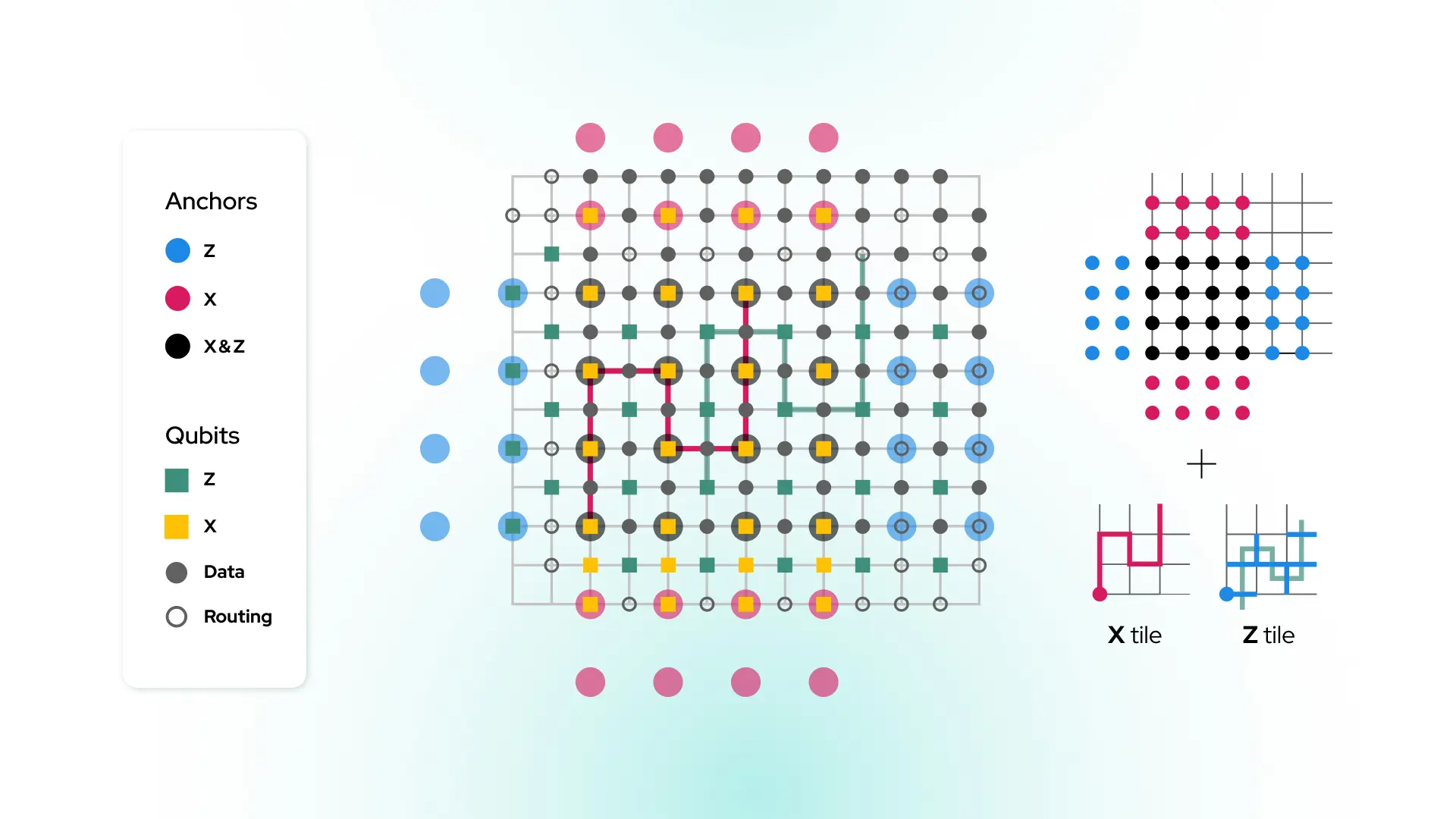
IQM Quantum Computers is demonstrating substantial progress in error mitigation through a novel approach to quantum error correction, leveraging the architecture of its existing “Crystal” processors. Rather than requiring entirely new qubit connectivity, the company’s research focuses on directional tile codes, which achieve performance comparable to QLDPC codes using a standard square qubit grid. This is significant as it circumvents the need for complex hardware modifications, accelerating the timeline for fault-tolerant computing. This advancement centers on the utilization of native iSWAP gates within IQM’s processors; these gates, already integral to the system, facilitate the implementation of directional tile codes without additional engineering. The ability to realize these gains on a square grid is crucial, directly aligning with IQM’s current capabilities and providing a foundation for future improvements. According to Dr. Inés de Vega, Chief Scientist of IQM Quantum Computers, “At IQM, we have always believed that building production-grade quantum systems and advancing the underlying science are two sides of the same mission.”
We have been working on tile codes since , as they are promising candidates due to their local checks, great parameters, and the many ways that exist to perform logical computation with them without adding connectivity requirements. The key innovation of directional tile codes is that we are using dynamic syndrome extraction circuits to implement them on a square grid,”
Dr. Vincent Steffan, Senior Quantum Error-Correction Engineer at IQM Quantum Computers
Nasdaq Listing via Merger with Real Asset Acquisition Corp.
The company has already sold 23 quantum systems globally, exceeding the sales volume of any other quantum manufacturer, serving a diverse clientele of research institutions, high-performance computing centers, and enterprises. The planned listing underscores IQM’s ambition to scale its operations and accelerate the development of fault-tolerant quantum computing. This isn’t simply a financial maneuver; the timing coincides with a significant scientific breakthrough, demonstrating the practical application of directional tile codes on existing IQM hardware. “At IQM, we have always believed that building production-grade quantum systems and advancing the underlying science are two sides of the same mission,” said Dr. Inés de Vega, Chief Scientist of IQM Quantum Computers.
Using only the nearest-neighbour iSWAP gates already native to IQM’s Crystal processors, directional tile codes can reduce the per-logical per-round error rate by up to 1,000 times compared to the widely used surface code at a comparable hardware footprint of around 30 physical qubits per logical qubit.
Source: https://iqm.tech/


See today’s quantum computing news on Quantum Zeitgeist for the latest breakthroughs in qubits, hardware, algorithms, and industry deals.