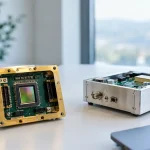
Japan’s Reimei quantum computer now boasts 56 fully-connected, high-fidelity qubits following an upgrade to Quantinuum’s System Model H2. RIKEN is pairing this enhanced quantum processing power with its Fugaku supercomputer and the ROQUO GPU supercomputer, creating a hybrid platform designed to surpass the limitations of any single technology, Quantinuum says.
This combination is already supporting frontier projects focused on mapping complex material behavior and simulating biomolecular excited states, with potential applications spanning drug discovery to solar energy. “We have been working to bring quantum computers together with classical computers,” using them as specialized accelerators, according to Quantinuum.
System Model H2 Enables Hybrid Quantum-Classical Computing
The upgraded Reimei quantum computer now uses the capabilities of Quantinuum’s System Model H2, enabling a new approach to complex material modeling by distributing computational tasks between quantum and classical processors. Researchers are assigning calculations to the hardware best suited for the task. Reimei handles classically inaccessible regions while the Fugaku supercomputer and ROQUO GPU supercomputer manage broader simulations and artificial intelligence components. This division of labor aims to overcome limitations inherent in single-technology approaches, particularly when exploring phenomena like phase transitions where computational demands escalate sharply.
This hybrid architecture extends beyond infrastructure testing with two initial “frontier projects” focused on high-value scientific applications, one of which is dedicated to materials discovery. This approach, according to the team, could establish a blueprint for studying functional biomolecules with the accuracy needed for industrial research, potentially impacting fields ranging from drug discovery to the design of more efficient solar cells.
A second project focuses on simulating the excited-state properties of complex molecules, combining quantum computing, supercomputing and AI to create a scalable hybrid workflow. The team is applying this workflow to challenges in biomolecular chemistry, with potential applications extending to advanced materials and light-harvesting systems, according to Quantinuum. The combination of Reimei, Fugaku, and ROQUO represents a world-leading platform, exceeding the capabilities of any single technology alone, and will soon enter regular operations under a Test User Program following the completion of these initial projects.
The system’s 56 fully-connected high-fidelity qubits are already being used to push the boundaries of scientific computing and validate Reimei’s capabilities in tackling previously intractable problems. Hybrid computing, once considered a future architecture, is now demonstrably operational in Japan, offering a glimpse into the next era of discovery.
Reimei Platform Integrates Fugaku, ROQUO, and Quantum Resources
This combination is currently supporting two “frontier projects” focused on material science and biomolecular chemistry, areas that are expected to benefit from the synergy between quantum and classical computation. One project uses Reimei’s quantum processing for regimes that challenge classical methods, while Fugaku handles large-scale simulations and artificial intelligence tasks. ROQUO accelerates AI training and tensor network simulations. This collaborative workflow aims to map complex material behavior by combining quantum and classical data, predicting unexplored conditions with generative models.
Researchers are building a scalable hybrid workflow, integrating quantum computing with supercomputing and AI to overcome limitations in modeling strongly correlated regions within molecules. RIKEN’s Nexus workflow management system coordinates these diverse resources, creating cohesive scientific workflows and demonstrating a principle central to the future of quantum computing.
According to the team, the true value of quantum computation will not be measured by the quantum processing unit alone, but by its integration into advanced computing environments. The platform, operational since 2025, received a substantial upgrade with the addition of the System Model H2, enhancing its high-fidelity quantum computation capabilities and solidifying its position as a leading research hub.
GenQAI Project Maps Material Behavior with Quantum Data
This approach systematically fills out a material’s phase diagram, creating a predictive ‘treasure map’ of its key behaviors under varying conditions, a process critical for advancements in electronics, sensing and energy infrastructure. Quantum computers like Reimei promise more accurate predictions of these diagrams and response functions, surpassing the limitations of classical methods alone. The addition of ROQUO extends this architecture with GPU-accelerated simulation, optimization and AI, enhancing the overall computational power available to the team, the company says.
According to RIKEN, this combination is designed to prove Reimei’s capability in tackling previously intractable problems. Researchers from RIKEN, NVIDIA, and Quantinuum are developing a scalable workflow integrating quantum processing units, graphics processing units and high-performance computing to predict realistic chemical properties of biomolecular systems.
Their initial target is zinc porphyrin, a light-absorbing molecule whose behavior is influenced by its environment, with potential applications spanning drug discovery, advanced materials and solar energy. “With Reimei, RIKEN and Quantinuum are building that future now—and building it with Japan,” the team stated.
This focus on excited states distinguishes the project from many current quantum computational chemistry efforts, which often prioritize ground state searches. The team’s goal is to create a workflow that can accurately model the electronically energized states involved in processes like light absorption, an important step toward designing more efficient materials and targeted therapies.
Hybrid Workflow Advances Biomolecular Chemistry Simulations
This isn’t simply about adding quantum power; researchers are strategically assigning computational tasks across a hybrid architecture, using the strengths of both quantum and classical systems. Fugaku and the ROQUO GPU supercomputer handle broader chemistry workflows and molecular environments, while Reimei focuses on the most computationally demanding aspects of the simulation. This division of labor is particularly important for accurately modeling excited states, the electronically energized states involved in light absorption and other key processes.
According to the researchers, the workflow assigns Reimei to concentrate on strongly correlated electronic regions and search for electron configurations that classical methods might overlook. The architecture extends beyond simply distributing workload. ROQUO’s NVIDIA GPUs are integral to optimization, configuration-interaction calculations and AI-assisted circuit design. This integration facilitates spectral reconstruction, a process vital for accurately predicting a molecule’s response to light.
This parallel project in quantum materials science mirrors the biomolecular chemistry workflow, using Reimei to predict phase diagrams and response functions. The goal is to create a ‘treasure map’ of material behaviors, helping researchers understand how materials respond to external conditions, a key factor in fields ranging from electronics to energy infrastructure.
Both frontier projects aim to move beyond infrastructure demonstrations and deliver high-value scientific applications, proving the potential of hybrid computing to tackle real-world challenges. The entire Reimei deployment is supported by the New Energy and Industrial Technology Development Organization, emphasising the national importance of this research.

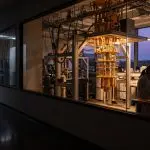
See today’s quantum computing news on Quantum Zeitgeist for the latest breakthroughs in qubits, hardware, algorithms, and industry deals.