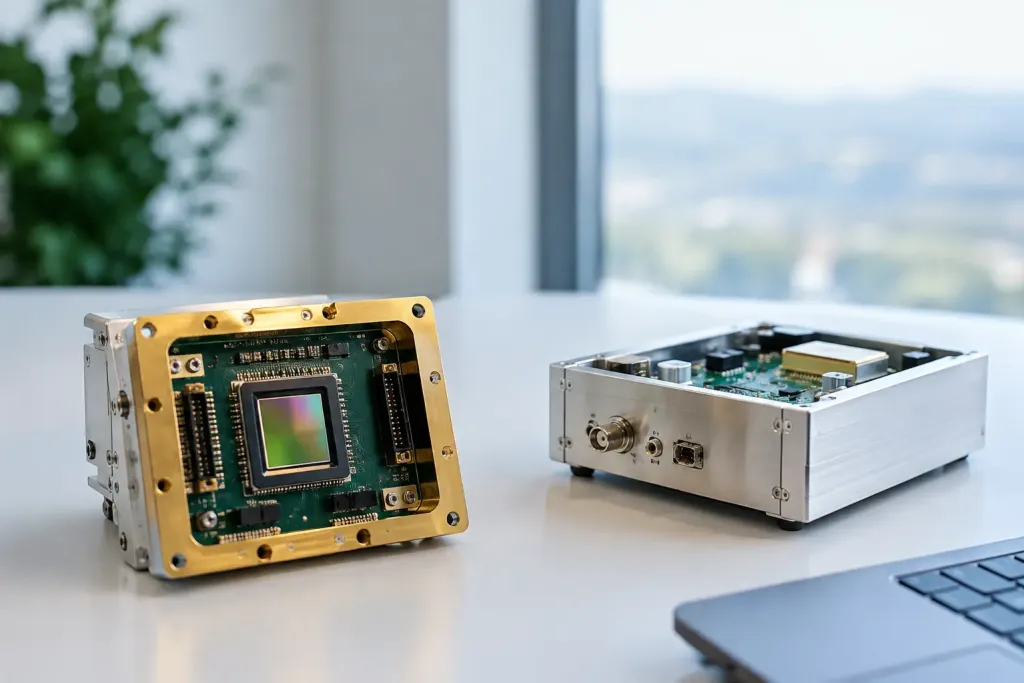
For an organization building firewalls or secure controllers, selecting a source of randomness isn’t about finding the loudest circuit, but about carefully assessing security claims and integration constraints. Crypta Labs points out that the decision between quantum random number generators (QRNGs) and traditional thermal noise generators hinges on these engineering considerations, not simply which produces more noise.
Both approaches can supply physical entropy, but differ in the underlying physical mechanisms they measure; QRNGs use explicitly quantum processes like photon arrival-time uncertainty, while thermal noise generators often rely on Johnson-Nyquist noise in a resistor. “The strongest comparison is not ‘quantum equals secure and thermal equals insecure’,” says the company, emphasizing that secure engineering remains important for both.
Thermal Noise Sources: Characterizing Analog Entropy Generation
Characterizing analog entropy generation requires careful attention to environmental factors, as board noise, grounding and shielding all influence the dependability of thermal noise sources. Crypta Labs notes that a design validated in a controlled laboratory setting can exhibit altered behavior following enclosure modifications or during production at a contract manufacturer. This sensitivity extends to installation within a noisy rack environment, highlighting the importance of meticulous source characterization and ongoing maintenance for thermal noise generators.
While seemingly simpler due to their reliance on electrically familiar components, thermal noise generators present a significant analog design burden, demanding precise calibration and stable gain to ensure consistent performance. An OEM must account for analog-to-digital converter resolution and its impact on entropy estimation, as well as the potential for drift over time or under varying operating conditions.
These factors determine whether a thermal noise generator can reliably contribute to a product’s overall security posture, particularly in applications where cost sensitivity is paramount and the operating environment is well-defined. The decision to employ thermal noise generation, or a quantum random number generator, is about a broader engineering assessment of risk tolerance and assurance requirements. According to the company, security relies on a documented entropy model, conservative min-entropy estimation, validated conditioning, and health tests that detect deviations from expected behavior.
Raw analog samples, regardless of their origin, must undergo entropy conditioning using techniques like cryptographic hashing or block ciphers to reduce bias and produce a suitable output for cryptographic applications. Effective integration also demands clearly defined states for alarm reporting, entropy quarantine, and cryptographic service restriction, with operational impacts varying based on the product’s function.
A carrier-grade appliance, for example, may prioritize availability through a controlled deterministic random bit generator reseed policy, while a key-injection device might require immediate cessation of sensitive operations upon detecting entropy source compromise. “Thermal noise can contain genuine entropy, and quantum systems still require secure engineering,” the company emphasizes, highlighting that robust security stems from comprehensive system validation, not solely from the entropy source itself.
Thermal noise generation can function as a viable solution when paired with a tightly controlled operating environment and a commitment to ongoing source characterization, and may even serve as one component within a diversified entropy architecture. However, a quantum random number generator often proves the stronger choice for applications protecting high-value keys, operating in unpredictable environments, or facing stringent formal assurance demands, offering a more defensible explanation of entropy origin to customers. The selection process, therefore, centers on aligning the entropy source with the specific risk model and security objectives of the target application.
Quantum Optics Module: Bounded Entropy from Quantum Measurement
Crypta Labs’ Quantum Optics Module addresses a critical need for predictable entropy sources in security platforms, delivering quantum-derived randomness in a form factor compatible with field-programmable gate arrays and microcontrollers. Unlike traditional thermal noise generators, which rely on characterizing analog signals like Johnson-Nyquist noise in a resistor, this module grounds its entropy claim in a defined quantum process. This approach doesn’t eliminate implementation risks, but it begins with a more clearly bounded entropy model, allowing for source monitoring focused on the observable’s operating conditions.
An adversary attempting to compromise a random number generator can exploit vulnerabilities in voltage, temperature, clocking, or the electromagnetic environment, potentially reducing entropy or introducing predictability. While a quantum random number generator (QRNG) also incorporates electronic and photonic components requiring protection, the core entropy source is tied to a quantum observable.
According to the company, a QRNG can simplify parts of the source argument by grounding it in a defined quantum process, provided the module design, interface behavior, and health monitoring are fully documented. This conditioning reduces bias, compresses the source based on a justified min-entropy estimate, and produces output suitable for deterministic random bit generators or direct cryptographic use. For thermal-noise sources, useful controls include amplitude bounds, analog-to-digital converter saturation detection, and monitoring of supply and temperature.
QRNG monitoring may encompass optical power, detector response, digitizer range and internal statistics related to the quantum measurement path. Critically, the appliance should not silently continue generating keys if health testing detects an issue with the entropy source. QRNG integration introduces additional considerations, including optical module placement, power budget, host interface, environmental specifications and supply-chain qualification.
However, a purpose-built module can reduce the need for an original equipment manufacturer (OEM) to develop and validate an analog entropy source from first principles. Procurement teams should demand more than a claim of “true random” when evaluating entropy sources. They should assess interface specifications, definitions of raw versus conditioned output, source-monitoring data, health-test behavior, operating limits, firmware control, lifecycle support and integration materials. “The decision should be made before the cryptographic architecture hardens, not after a certification review exposes an unsupported entropy assumption,” the company states.
Specifying the threat model, defining acceptable failure behavior and requiring evidence for every step from physical measurement to key generation are essential to establishing a credible hardware root of trust. The module’s design philosophy centers on providing that evidence, enabling OEMs to shift effort away from custom noise-source development and toward validating the complete security appliance.
Min-Entropy Estimation: Validating Source Security Beyond Statistical Tests
While statistical tests can reveal some failures, they cannot definitively prove sufficient entropy or confirm the absence of attacker influence, as a deterministic stream can be engineered to pass many such evaluations. Security, therefore, depends on a rigorous process of validation extending beyond basic randomness checks. A critical step in this process is conditioning, a technique applicable to both thermal and quantum sources, where raw analog samples are processed to reduce bias and compress the source.
The choice between these conditioning methods impacts verification scope, throughput, latency and potential exposure to software compromise, demanding a clear chain of custody from the raw entropy source to the cryptographic application. Continuous health testing is also paramount, extending beyond a simple power-on self-test to actively monitor source degradation, stuck behavior, and deviations from expected operating conditions.
These tests should be tailored to the specific source architecture, not derived from generic checklists and selected based on the entropy demand rather than solely on output bit rate, as conditioning can significantly compress raw samples. For organizations seeking certifications like FIPS 140 or Common Criteria, a comprehensive evidence package is essential, including a detailed source description, entropy assessment, min-entropy rationale, conditioning design, health-test specification and defined failure-state behavior.
While a thermal noise source, such as Johnson-Nyquist noise in a resistor, can support this level of documentation, its environmental dependencies may necessitate a more extensive validation process. This rigorous process transforms a simple random-bit source into a robust foundation for long-term security.
OEM Integration: Trade-offs Between QRNG and Thermal Noise Systems
The credibility of a hardware root of trust hinges on the entropy that fuels it, and for organizations integrating security into firewalls or embedded controllers, selecting an entropy source is an engineering decision extending beyond simple noise production. Both approaches require conditioning, startup controls, health testing and thorough system validation. The core difference lies in the physical mechanism measured and the confidence with which an integrator can verify and protect it throughout a product’s lifespan.
A QRNG, such as Crypta Labs’ Quantum Optics Module, is designed around a clearly bounded entropy model, beginning with a quantum process like photon arrival-time uncertainty, quantum phase noise, vacuum fluctuations, or optical shot noise. This contrasts with thermal noise generators, which typically measure electrical fluctuations in a component, and while a QRNG doesn’t eliminate implementation risk, it offers a different foundation for security arguments. However, it does not absolve the OEM of responsibility for validating the integrated appliance.


See today’s quantum computing news on Quantum Zeitgeist for the latest breakthroughs in qubits, hardware, algorithms, and industry deals.