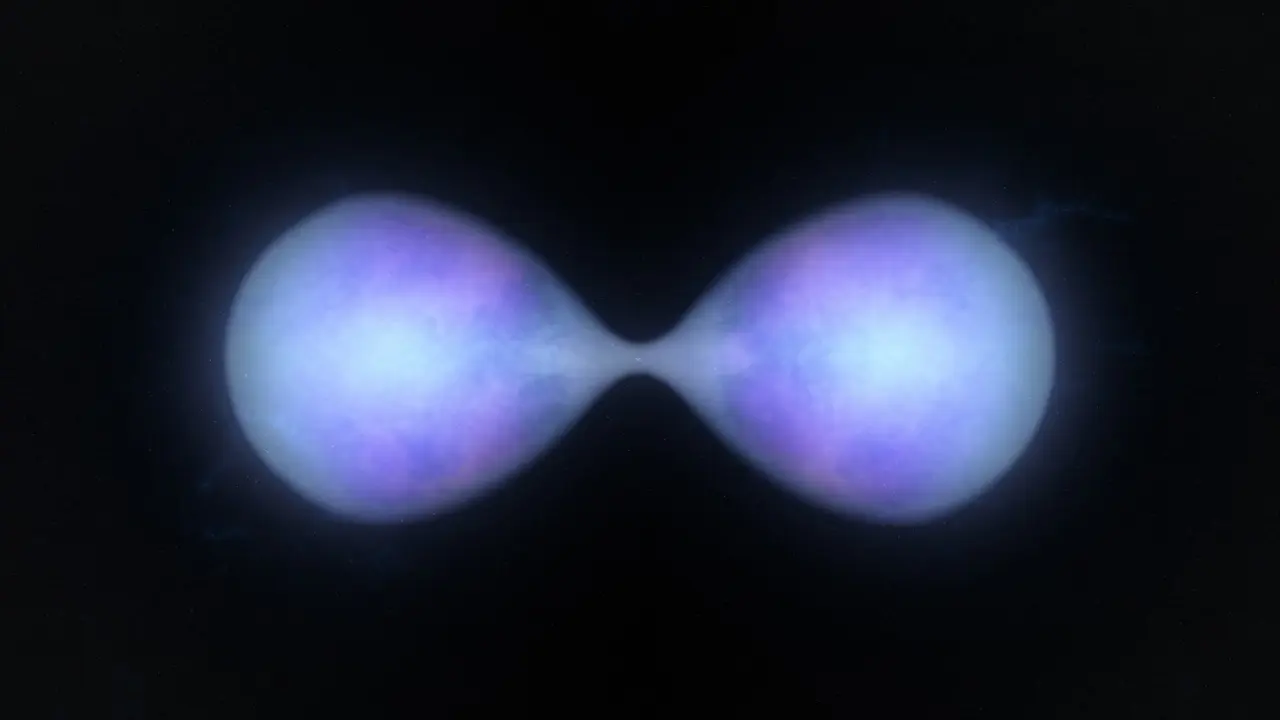
Lucas Winter of the University of Vienna and colleagues demonstrate a way to generate extensive entanglement during superradiance, a collective burst of radiation typically lacking such quantum correlations. The researchers found that adding a local kinetic constraint between quantum emitters leads to a peak intensity proportional to N squared, and a peak time proportional to the log of N divided by N, where N is the number of emitters.
This effect enables the accelerated preparation of entangled dark states, generating exponentially many long-range entangled singlet dark states through Hilbert-space fragmentation. The work offers an experimentally viable approach for engineering these entangled states in neutral-atom arrays coupled to an optical cavity, and shows the entanglement is robust against atomic decay and dephasing.
Kinetic Constraints Convert Superradiance to Entanglement
A peak intensity scaling proportionally to the square of the number of emitters, N squared, is achieved through kinetically constrained superradiance, demonstrating a pathway to accelerate the creation of entangled states as system size increases. This contrasts with standard Dicke superradiance, which produces a burst of radiation without generating entanglement in the emitter’s mixed state. This retention is significant because it allows for the preservation of key features of Dicke superradiance while simultaneously introducing entanglement.
Numerical simulations reveal that entanglement grows linearly with the number of emitters, a result traced back to Hilbert-space fragmentation and the emergence of disconnected dark manifolds containing entangled N-body states. This fragmentation creates an exponentially branching decay tree, generating a hierarchy of dark states, a surprising outcome given that standard superradiance does not produce entanglement in the mixed state.
This process avoids the slow subradiant relaxation typically hindering dark-state preparation, offering a faster pathway to achieve correlated states. “We have shown that local kinetic constraints in quantum-emitter ensembles retain Dicke superradiance while generating extensive mixed-state entanglement on a rapid superradiantly accelerated time scale,” the paper states. To detect this predicted mixed-state entanglement, the team suggests a “simple and accessible witness” based on measuring the adjacent pair count in the stationary state.
Specifically, they predict a linear growth of this count with system size, providing a direct experimental probe of entanglement. The scaling of entanglement is approximately linear in N for the EAST, OR and constraints, further solidifying the observation of extensive mixed-state entanglement.
Their results provide a general framework for engineering large entangled dark states and suggest a feasible experimental implementation based on recently demonstrated technologies, opening new directions for future research. For example, the possibility of tailoring specific dark states by programming the atom-cavity coupling beyond the symmetric Dicke model, or of controlling the resulting nonclassical properties of the emitted light, may be promising avenues for further studies. The work offers a general framework and experimentally viable approach for the dissipative engineering of entangled dark states enhanced by superradiance, a result that could significantly advance the field of quantum information science.
Superradiant Dynamics in Rydberg-Blockaded Systems
Hilbert-space fragmentation within ensembles of quantum emitters generates a surprising hierarchy of dark states, a result stemming from the interplay between Dicke superradiance and locally imposed kinetic constraints. The emergence of these disconnected manifolds fundamentally alters the system’s dynamics, creating a complex landscape of entangled possibilities. This resilience helps with practical implementation by mitigating the impact of imperfections inherent in real-world quantum systems. The exploration of kinetic constraints, specifically the AND OR models alongside the EAST model, reveals a consistent preservation of superradiant bursts, as evidenced by quantum-trajectory simulations.
The researchers emphasize that the discovered effect is robust to laser phase-noise and spontaneous atomic decay, yielding near-optimal entanglement with cooperativities achievable in current experiments. This framework extends beyond specific implementations, suggesting a broader applicability to various quantum systems where collective behavior and entanglement are desired. The results, therefore, represent a step toward using superradiance for advanced quantum technologies.
Hilbert-Space Fragmentation Generates Dark State Manifolds
This accelerated entanglement generation stems from the interplay between kinetic constraints and the system’s decay dynamics, allowing for the creation of extensive mixed-state entanglement on a superradiantly accelerated timescale. The team’s analysis reveals that the system’s behavior is consistent with the suppression of emission once the excitation density falls below a certain threshold, with more restrictive constraints arresting the decay earlier than weaker ones.
“Once the excitation density is no longer close to one, the constraint can strongly suppress emission,” the researchers write, highlighting the role of these constraints in maintaining a finite residual excitation density. The structure of these dark states is many-sided, beginning with blockade-enabled states, simple product states with no adjacent excitations, which act as absorbing leaves in the decay tree. Beyond these, collective dissipation generates a second class of dark states through destructive interference, creating a family of singlet-decorated states from a single bitstring root.
This process relies on dressing allowed pairs of sites with antisymmetric excitations, effectively shielding them from decay. “Starting from an EAST bitstring dark state, one can dress an allowed pair of sites with a local antisymmetric excitation, and obtain another dark state,” the researchers explain, detailing how this dressing can be repeated multiple times with non-overlapping support to generate a complex hierarchy. The analytical construction of this entire hierarchy is detailed in the Supplemental Material.
The team demonstrated that entanglement generation is robust against both atomic decay and collective dephasing, suggesting that these findings should be observable under recently reported experimental conditions. Numerical calculations of the stationary logarithmic negativity, a measure of entanglement, across a half-chain bipartition confirm the presence of extensive entanglement, even as the number of emitters increases. This robustness is important for the potential implementation of this approach in dissipative engineering of entangled dark states, offering a pathway toward advanced quantum technologies.
Entanglement Growth Linear with Number of Emitters
This accelerated entanglement generation, demonstrated through analytical derivations and numerical simulations, hinges on the introduction of kinetic constraints that preserve the intensity of superradiance while simultaneously supporting complex correlations between quantum emitters. The work details how any local Boolean constraint applied to the emitter ensemble does not diminish the superradiant burst, but instead retains its characteristic intensity scaling and fast timescale. Numerical simulations, performed using quantum trajectory methods, confirm that entanglement emerges during this constrained decay, growing linearly with the number of emitters and revealing a previously unobserved connection between superradiance and entanglement production.
The simulations reveal a hierarchy of states, including singlet-decorated states with finite adjacent pair excitations and more complex configurations with triple excitations. The adjacent pair count, a direct experimental probe of mixed-state entanglement, grows linearly with system size, further supporting the claim of extensive entanglement.
The researchers further quantified this entanglement using logarithmic negativity, a measure sensitive to mixed-state entanglement, and found it to scale linearly with the number of emitters. This scaling is particularly significant because it demonstrates that the entanglement is an intrinsic feature of the constrained dynamics.
The preparation time for these correlated dark states also accelerates with increasing system size, following a relationship proportional to the natural logarithm of N divided by N. This suggests that collective emission not only generates entanglement but does so on a timescale that becomes faster as the number of emitters increases. The team’s analysis extends to the robustness of this entanglement against realistic experimental imperfections. The ability to detect this entanglement is facilitated by the identification of a “simple and accessible witness,” a measurable quantity that directly indicates the presence of mixed-state entanglement.
The researchers’ results, therefore, represent an advance in the field of quantum optics, demonstrating a novel route to generating and controlling entanglement through the interplay of superradiance and kinetic constraints. The study’s findings offer a promising avenue for exploring new quantum phenomena and developing innovative quantum technologies.
👉 More information
🗞 Extensive mixed-state entanglement in kinetically constrained superradiance
✍️ Lucas Winter, Jan Kumlin, Thomas Pohl and Andreas Nunnenkamp
🧠 DOI: http://link.aps.org/doi/10.1103/h8zh-qlw5



See today’s quantum computing news on Quantum Zeitgeist for the latest breakthroughs in qubits, hardware, algorithms, and industry deals.