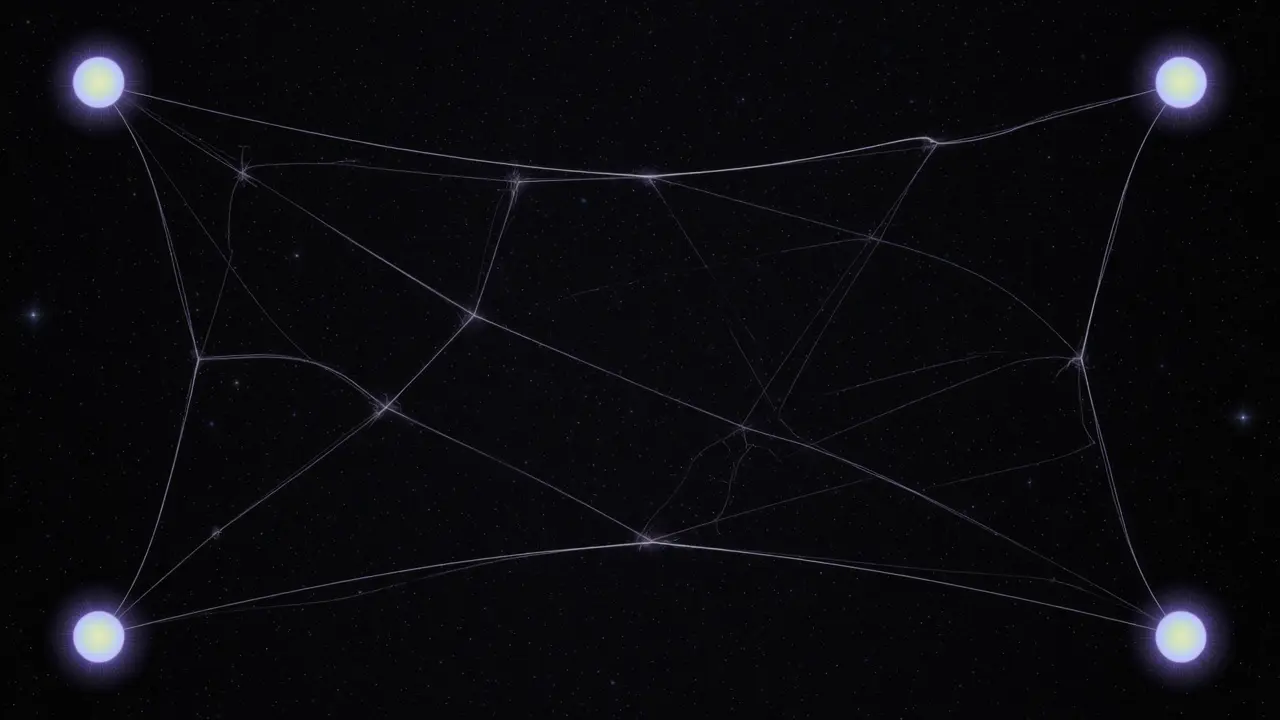
Researchers from the Walther-Meißner-Institut and Technical University of Munich in Germany, alongside colleagues at the University of St. Andrews in the United Kingdom, have demonstrated a quantum secret sharing protocol involving three players. The team implemented the protocol using superconducting microwave quantum networks, achieving reconstructed-state fidelities exceeding a key threshold for secure communication.
This experiment establishes a method where at least two of the three players must collaborate to recover an original quantum state, advancing the development of unconditionally secure networks essential for a future quantum internet. The work also reveals connections between quantum secret sharing and other quantum information processing tasks, including quantum dense coding and error correction.
Microwave Network Enables Tripartite Quantum Secret Sharing
Superconducting microwave quantum networks enabled the first demonstration of continuous-variable quantum secret sharing among three players, a configuration exceeding the limitations of two-party communication systems. This experiment used Josephson parametric amplifiers to generate and manipulate entangled microwave signals, achieving reconstructed-state fidelities exceeding the no-cloning threshold of 2/3. The threshold is a critical benchmark, ensuring the shared quantum state remains secure from unauthorized copying. Security analyses were performed to assess vulnerabilities against both local adversaries and comprehensive attacks targeting all communication channels.
Results indicate the network’s resilience, establishing a foundation for unconditionally secure communication even with a potentially dishonest player attempting to intercept information. The team’s approach differs from previous demonstrations of quantum secret sharing, which often rely on discrete variable photonic networks and graph states. “In this paper, we demonstrate for the first time the continuous-variable quantum secret sharing protocol in a microwave tripartite superconducting network,” the authors state, highlighting the novelty of their approach.
Two-Mode Squeezed States as Entanglement Resource for QSS
The experimental setup used superconducting microwave quantum networks and utilized two-mode squeezed states to distribute a quantum secret among three players. Entanglement for this protocol originated from two Josephson parametric amplifiers operating in a degenerate gain regime, generating the necessary two-mode squeezed states. These squeezed states, characterized by reduced quantum noise in one quadrature, were then distributed via microwave hybrid rings to the three players.
The experimental design included schemes for both trivial and nontrivial reconstruction of the secret state, allowing for a detailed analysis of the protocol’s performance under different conditions. The ability to share quantum information securely among multiple parties is essential for realizing a future quantum internet, and this work provides a significant step towards that goal.
((2,3)) Threshold Scheme Implementation in Superconducting Network
This implementation moves beyond two-party quantum communication by involving three distinct players in the network. The architecture uses superconducting coaxial cables to connect, forming a local tripartite microwave quantum network operating around 5 GHz. The researchers demonstrate reconstructed-state fidelities that surpass the asymptotic no-cloning threshold of 2/3 and identify a parameter regime that allows for unconditionally secure communication in the presence of an omnipotent dishonest player. we experimentally explore inherent connections between QSS and other important quantum information processing tasks, such as quantum dense coding and elementary quantum error correction of channel erasures.
Reconstructed State Fidelity Exceeds No-Cloning Threshold
The fidelity with which a reconstructed quantum state approaches the original is quantified by Equation (8) within the work, establishing a metric for protocol performance. This fidelity measure, when combined with the principles of the no-cloning theorem, allows for a demonstration of security independent of trusted communication channels, broadening the scope of secure quantum communication. A fundamental limit in quantum mechanics dictates that an unknown quantum state cannot be perfectly copied; however, imperfect cloning is possible up to a certain fidelity threshold.
Exceeding this no-cloning threshold, established at 2/3 for coherent states drawn from a broad distribution, guarantees that any adversary attempting to intercept the shared secret will possess a less informative copy. Analysis of fidelity distributions across various input coherent state displacements and reconstruction parameters, as shown in accompanying data, confirms this achievement.
Microwave QSS Security Against Dishonest Players
The experimental setup achieved reconstructed state fidelities exceeding 2/3, a threshold dictated by the no-cloning theorem and essential for demonstrating unconditional security in quantum secret sharing protocols. This surpasses previous methods reliant on comparing mutual information between parties, offering a more robust verification of security against potential eavesdropping attempts. The team’s work establishes a parameter regime where even an adversary with complete access to the shared quantum information cannot fully reconstruct the original secret without collaborating with at least one other player.
Analysis of the system’s performance revealed that collaborating players consistently achieved higher mutual information than an adversary attempting to intercept the communication, validating the security of the protocol against mode attacks. Reconstructed-state fidelities surpassed the asymptotic no-cloning threshold of = 2/3 and identified a parameter regime that allows for unconditionally secure communication in the presence of an omnipotent dishonest player.
Connections Between QSS and Quantum Dense Coding
The demonstrated quantum secret sharing protocol extends beyond secure communication, offering a pathway to enhance classical data transmission rates. This re-purposing of the same entangled resource highlights the potential for integrated quantum networks capable of performing multiple tasks simultaneously. Beyond dense coding, the protocol’s principles also translate to elementary quantum error correction, specifically addressing channel erasures.
Superconducting Josephson Parametric Amplifiers Generate Entanglement
This approach uses nonlinear superconducting circuits, specifically the JPAs, to generate the quantum-entangled resource states necessary for secure communication. Reconstructed state fidelities surpassed the no-cloning threshold for coherent states, a benchmark indicating the security of the shared information. The quality of reconstruction directly correlates with the strength of entanglement exhibited by the resource state, with EPR steering playing an important role in minimizing variance and maximizing fidelity.
Hybrid Quantum Networks Combining Microwave and Optical Regimes
The demonstrated protocol involved three players, moving beyond the more common two-party quantum communication schemes and establishing a foundation for scaling multipartite quantum networks. The experimental work demonstrates a method for distributing a quantum state among three parties, requiring at least two to collaborate for faithful reconstruction of the original secret. The team’s results show reconstructed-state fidelities surpassing the asymptotic no-cloning threshold of 2/3, a benchmark indicating the impossibility of creating an exact copy of an unknown quantum state.
👉 More information
🗞 Quantum secret sharing in a tripartite superconducting network
✍️ W. K. Yam et al.
🧠 DOI: http://link.aps.org/doi/10.1103/xwp5-hm43



See today’s quantum computing news on Quantum Zeitgeist for the latest breakthroughs in qubits, hardware, algorithms, and industry deals.