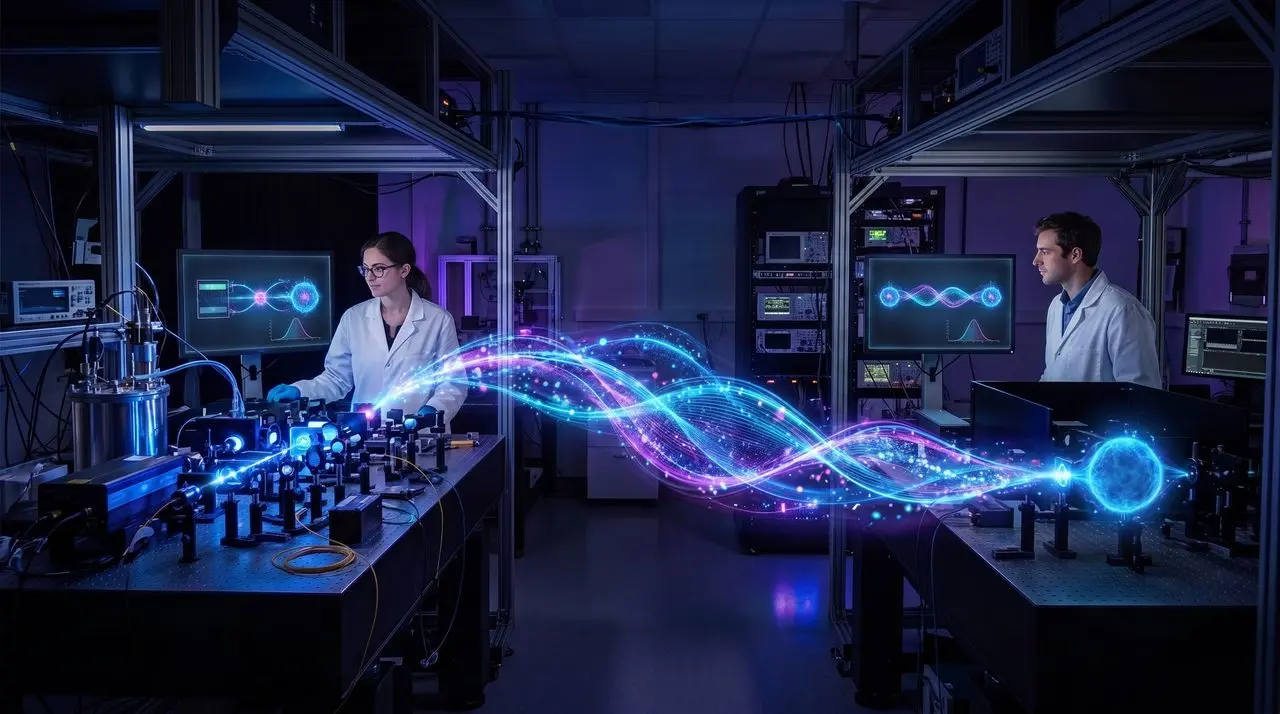
Researchers from Zhejiang University and The Hong Kong University of Science and Technology (Guangzhou) have demonstrated the robust teleportation of a topological rotated surface code on a superconducting quantum processor containing 125 qubits. The team achieved this quantum teleportation with code distances up to 7, a new benchmark in scaling up this approach to quantum error correction. This work uses the surface code, a leading candidate for protecting quantum information, and supports distributed fault-tolerant quantum computation. The results help to understand simulating and using topological quantum matter on quantum devices.
Surface Code Teleportation Achieved on Superconducting Processor
This advance used a 125-qubit superconducting processor to reliably teleport logical states encoded within a topological rotated surface code, a method designed to protect against the inherent errors of quantum systems. The experiment’s success hinges on the fidelity of the underlying quantum gates, with single-qubit operations achieving 99.94% accuracy and two-qubit gates reaching 99.64% fidelity, critical performance levels for both state preparation and teleportation. Researchers mapped the teleportation process onto a superconducting processor arranged as two square lattices, designated Alice and Bob, each with dimensions corresponding to the code distance.
For a code distance of 7, the arrangement required slight adjustments to the qubits on Bob’s lattice boundary, as detailed in the supplemental information accompanying the study. This configuration allowed for the creation and manipulation of entangled states essential for teleportation, using tunable nearest-neighbor couplings to facilitate rapid and high-fidelity two-qubit gates.
The resulting teleportation phase diagram was determined by systematically adjusting the strength of these local entangling gates across a defined threshold, revealing the conditions under which robust teleportation is possible. Beyond simply demonstrating teleportation at this scale, the team investigated methods to improve the system’s performance by injecting “magic resources” through coherent qubit rotations. These rotations move the system beyond the limitations of Clifford circuits, restoring a duality symmetry within the topological phase and minimizing the entanglement resources needed for successful teleportation.
This approach is rooted in the principles of lattice gauge theory and topological order, offering a pathway to enhance the entangling threshold, the minimum level of entanglement required for reliable operation. “Restoring the electric–magnetic duality” is how the researchers describe this enhancement, experimentally demonstrating its effect on the teleportation process.
The ability to finely tune the interactions between qubits is paramount, allowing researchers to create and maintain the long-range entanglement that underpins the surface code’s error-correcting properties. The success of this experiment suggests that superconducting processors are a viable platform for realizing fault-tolerant quantum computation. The study’s findings illuminate the relationship between topological quantum matter and its simulation on quantum devices, offering insights into the fundamental properties of these exotic states of matter.
By manipulating and observing the behavior of the surface code on a physical quantum processor, researchers can gain a deeper understanding of the underlying physics and explore new ways to harness its potential. This knowledge is important for developing more robust and scalable quantum technologies. While challenges remain in scaling up these systems to even larger qubit counts and maintaining coherence for extended periods, this experiment provides a clear path forward.
The combination of high-fidelity gates, a carefully designed processor architecture, and innovative techniques for enhancing entanglement resources offers a promising blueprint for future research. The results suggest that the theoretical advantages of surface codes can be realized in practice, bringing the dream of fault-tolerant quantum computation closer to reality.
The success of this experiment demonstrates the dedication and ingenuity of the researchers involved, and it sets the stage for further advancements in the field. The ultimate goal, as the team suggests, is to create a network of interconnected quantum computers capable of solving problems that are currently intractable, and this work represents a step in that direction.
Experimental Setup: Superconducting Quantum Processor Details
The superconducting quantum processor used in this experiment incorporated a median single-qubit gate fidelity of 99.94%, a critical specification for both preparing the surface code’s logical states and executing the subsequent teleportation process. Achieving this level of control required careful calibration and optimization of the qubit control parameters, ensuring minimal errors in the fundamental operations. The processor’s architecture was specifically designed to facilitate rapid execution of these gates, minimizing decoherence and preserving the delicate quantum states.
Beyond gate fidelity, the readout process itself was refined to maximize accuracy. Researchers employed a technique of pumping each qubit from the |1⟩ state to the |2⟩ state before applying the readout pulse, resulting in a median readout fidelity of 99.08%.
This pre-readout manipulation effectively amplified the signal, improving the ability to distinguish between the qubit’s quantum states and reducing the probability of misinterpreting the measurement outcome. The enhanced readout fidelity is essential for verifying the success of the teleportation protocol and characterizing the performance of the surface code. The processor’s design allowed for tunable nearest-neighbor couplings, a feature that proved vital for implementing the high-fidelity two-qubit gates required for entanglement generation and manipulation.
The team’s approach to qubit design and fabrication represents an advancement in superconducting quantum computing. The ability to precisely tune the couplings between qubits allowed for dynamic control over the interactions, enabling the implementation of complex entanglement protocols. The experimental setup also included sophisticated control electronics and software, responsible for generating and sequencing the microwave pulses that manipulate the qubits.
These systems were carefully calibrated to ensure accurate timing and amplitude control, minimizing errors in the gate operations. The researchers demonstrated an ability to tune local entangling gates uniformly across a finite threshold, an important step in characterizing the teleportation phase diagram. This tuning process allowed them to identify the optimal operating conditions for achieving robust teleportation, maximizing the fidelity of the transferred quantum state.
They discovered that coherent qubit rotations, injecting magic resources beyond the Clifford regime, could boost the entangling threshold. The experimental validation of these theoretical concepts involved a series of carefully designed measurements, comparing the performance of the surface code with and without the application of magic resources.
Teleportation Fidelity Demonstrated Up To Distance Seven
This scale, realized on a superconducting quantum processor, required a total of 98 data qubits and demonstrates a significant advance in the physical resources now available for implementing these complex protocols. This finding highlights the importance of circuit design in optimizing teleportation fidelity and minimizing error propagation. Tuning the effective entangling parameter, t, allowed researchers to map out a phase diagram illustrating the relationship between entanglement strength and error rates.
The experiment also investigated the impact of coherent errors, introduced by the parameter t, on the teleportation process. By systematically varying t from 0 to π/4, the researchers observed how the entangling between Alice and Bob’s qubits influenced the fidelity of the teleported state. This control over entanglement allows for fine-tuning of the protocol and optimization of performance in the presence of noise.
Hefei National Laboratory’s Role in the Teleportation Experiment
The surface code employed in the experiment is designed to protect quantum information from errors, a major challenge in building practical quantum computers. The laboratory’s advanced measurement capabilities were important for accurately assessing the impact of these errors and refining the control strategies. The Hefei National Laboratory’s expertise in quantum control was instrumental in implementing these complex qubit rotations with the required precision.
This would involve performing teleportation over longer distances, requiring even more robust error correction and entanglement distribution techniques. The laboratory is actively investing in the development of new quantum technologies and materials to support these future experiments.



See today’s quantum computing news on Quantum Zeitgeist for the latest breakthroughs in qubits, hardware, algorithms, and industry deals.