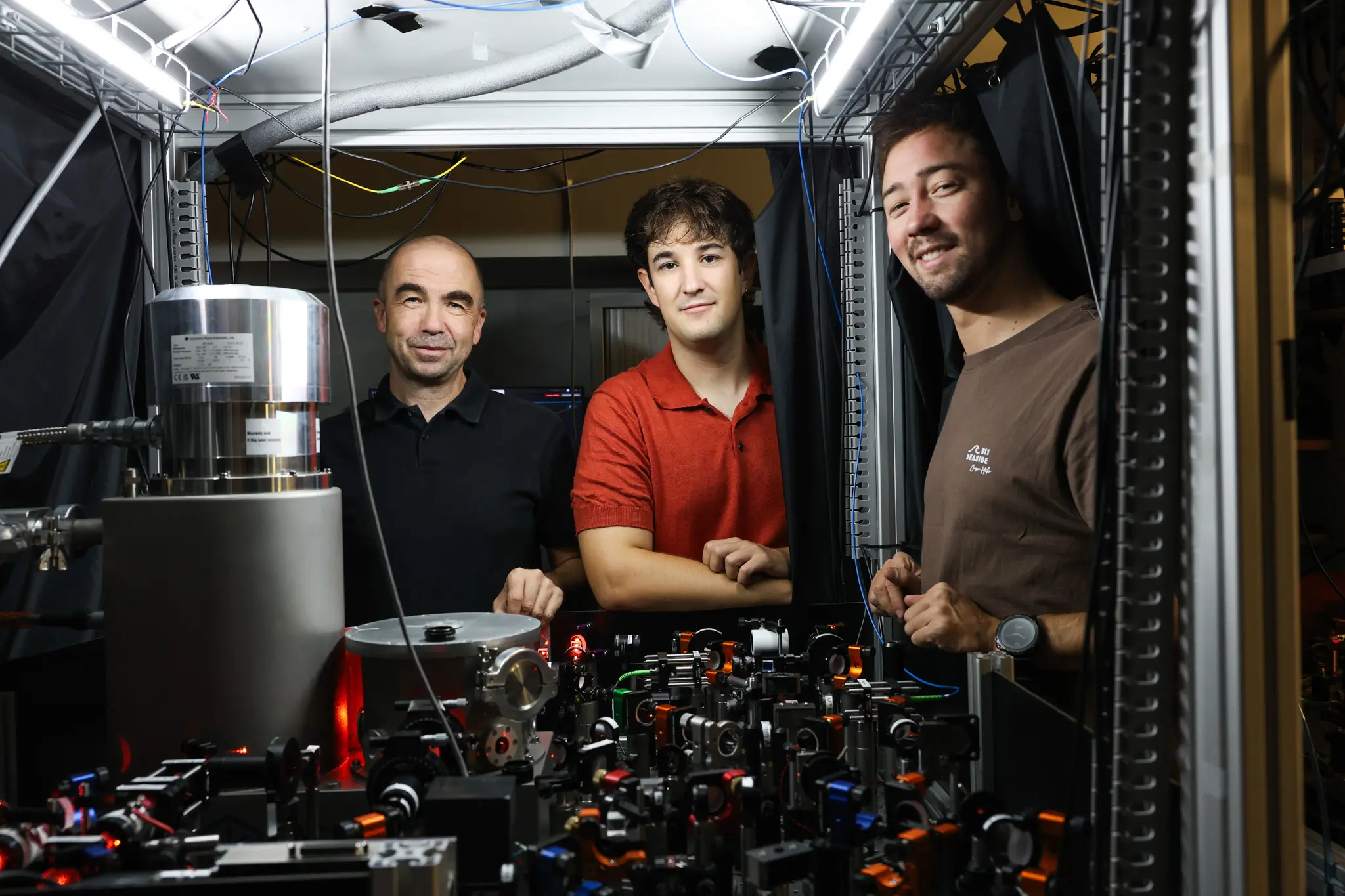
Researchers led by Hugues de Riedmatten, ICREA Professor at the Institute of Photonic Sciences (ICFO) in Barcelona, have demonstrated a quantum memory capable of storing single photons for the longest duration yet achieved in a solid-state system, the company says. This advance, detailed in Physical Review Letters, addresses a critical challenge in building the quantum internet: maintaining the fragile quantum state of information long enough to synchronize distant network segments.
The ICFO team’s work uses a novel protocol to counteract decoherence, bringing practical quantum networks closer to reality. “We are continuously sending information to each other,” explains the team, “scientists are now trying to extend this familiar concept of the internet to the quantum realm.”
Spin Rephasing Counteracts Decoherence in Praseodymium-Doped Crystals
The ICFO team achieved the longest storage time to date for single photons within a solid-state quantum memory, using a crystal doped with praseodymium to hold quantum information. This advancement relies on a technique called spin rephasing, which actively combats decoherence, the loss of quantum properties, within the memory itself. Alberto Rodríguez Moldes, the first author of the published work, anticipates even longer storage durations will become possible through the application of small magnetic fields to the quantum memory system.
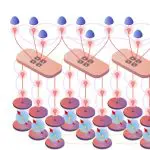
The core of this achievement lies in the manipulation of atomic spin states within the praseodymium-doped crystal, a process that effectively pauses the emission of a photon and stores the quantum information it carries. Initially, an optical control pulse transfers the collective excitation of the crystal into a spin state, preventing immediate re-emission.
However, variations in the crystal environment around each ion naturally cause the collective excitation to lose coherence over time, degrading the stored quantum information. To counteract this, the researchers implemented a series of radiofrequency pulses designed to flip the phase each ion accumulates, effectively resetting the system and extending the storage duration.
This precise timing ensures that newly accumulated phase offsets the previously flipped phase, restoring the collective spin excitation. “Spin rephasing had been demonstrated in the past with classical input states, but our results show that it can be extended to quantum light,” explains ICREA Professor Hugues de Riedmatten, senior researcher on the study.
This demonstration is important because quantum repeaters, essential for long-distance quantum communication, depend on quantum memories capable of maintaining quantum states for extended periods to synchronize measurements and establish entanglement across network segments, according to the company. ICFO’s work addresses a key challenge in building these practical quantum networks, using the high efficiency and capacity for entanglement storage already inherent in solid-state memories. ICFO’s commitment to quantum technologies is reflected in its broad research portfolio, encompassing both the theoretical underpinnings of quantum networks and experimental work on quantum electromechanics.
Founded in 2002 and headquartered in Barcelona, the institute operates 80 research laboratories dedicated to quantum science, advanced imaging and nanomaterials. Recent work from ICFO, including a deterministic entanglement swapping scheme published in Quantum Science and Technology in August, demonstrates the breadth of its quantum research.
The institute also collaborates extensively with international partners, including the Université de Bordeaux, the University of Chicago and Argonne National Laboratory, on projects such as controlling carbon nanotube motion at the zero-point scale, the company says. The Secretaria d’Universitats i Recerca del Departament de Recerca i Universitats de la Generalitat de Catalunya also provides support for ICFO’s research initiatives. ICFO researchers have demonstrated that solid-state quantum memories can store single photons for longer times than previously possible.
Spin rephasing had been demonstrated in the past with classical input states, but our results show that it can be extended to quantum light.
ICREA Prof. Hugues de Riedmatten, senior researcher of the study
180 Microsecond Storage Extends Quantum Memory Fiber Distance to 30km
The ICFO team achieved single-photon storage for 180 microseconds, extending the effective distance of quantum communication via fiber optic cables to over 30 kilometers, a new record for this type of quantum memory. This advancement relies on a mechanism applied to a praseodymium-doped crystal cooled to 3 kelvin, a technique that counteracts the natural tendency of quantum information to degrade. The experiment involved generating entangled photon pairs, one tuned for long-distance transmission through optical fiber and the other compatible with the quantum memory itself.
Precise control over the crystal’s collective excitation was achieved through a series of radiofrequency pulses, manipulating the spin of the praseodymium ions to effectively “flip” and then “wait” before rephasing the stored quantum state. This carefully timed sequence allowed the researchers to preserve the quantum information for an extended period, culminating in the readout of the stored photon.
The team also verified the preservation of quantum correlations between the rephased memory and the telecom photon, a critical requirement for secure quantum communication, ICREA reports. ICFO’s expertise in quantum technologies extends beyond this specific memory development, encompassing both theoretical work on network architectures and experimental investigations into quantum electromechanics.
The institute’s broad research portfolio, supported by funding from sources including the Gordon and Betty Moore Foundation and the European Union’s Horizon Europe program, positions it as a leading center for quantum innovation. “Our scheme thus establishes praseodymium-doped quantum memories as a major candidate for the scalable implementation of quantum networks,” the researchers state in their publication.
Our scheme thus establishes praseodymium-doped quantum memories as a major candidate for the scalable implementation of quantum networks.


See today’s quantum computing news on Quantum Zeitgeist for the latest breakthroughs in qubits, hardware, algorithms, and industry deals.