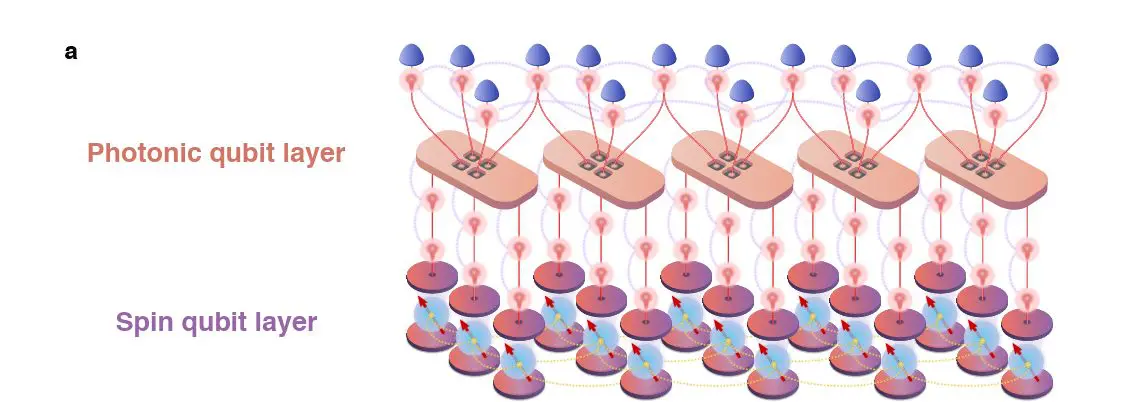
Moving beyond the limitations of individual devices, Quandela has collaborated with C2N and other institutions to fabricate thousands of spin-photon interfaces, a critical step toward scalable photonic quantum computing. These semiconductor structures, built on a foundry-compatible III-V platform, connect stationary matter qubits with photons, enabling hybrid architectures where spin preserves quantum information and photons carry it across networks. Researchers evaluated optical performance, spin properties and inter-device compatibility within the same study, reporting industry-ready devices. This advance addresses a key challenge: producing reproducible, high-quality qubit devices essential for building larger quantum systems.
Spin-Photon Interfaces Bridge Matter and Photonic Qubits
The fabrication of over a thousand spin-photon interfaces marks a step beyond the limited number traditionally used in early quantum hardware development, demonstrating a move towards scalable production techniques. Researchers from Quandela, the Center for Nanosciences and Nanotechnologies (C2N), and collaborating institutions achieved this milestone using a semiconductor pilot production line, a process designed for large-scale deployment and reproducible device characteristics, the company says. This pilot line is compatible with existing III-V semiconductor manufacturing, a factor important for integrating quantum components into established fabrication facilities.
The ability to manufacture these interfaces in a foundry-compatible environment addresses a key bottleneck in scaling hybrid photonic quantum computers, where photons carry quantum information and matter qubits provide local memory and control. Representative devices produced through this process achieve quantum performance, with the team reporting seven-partite spin-multi-photon entanglement involving a single spin and six photons.
This level of entanglement, coupled with a per-cycle spin-photon entangling fidelity of 93. 5(3)%, surpasses previous deterministic quantum-dot demonstrations, tripling the number of photons involved. The interfaces are based on quantum dots, nanostructures acting as artificial atoms within a semiconductor, positioned inside microscopic optical cavities that enhance and direct emitted light, a design that efficiently connects spin states to a sequence of photons. The architecture explored by the researchers combines the strengths of both photons and matter qubits, providing long-distance transmission capabilities and local memory and control.
Photons, ideal for carrying quantum information due to their minimal environmental interaction, can be generated on demand by the spin qubits, becoming entangled with successive photons. This creates optical links between different elements of the quantum system, transforming the spin-photon interface into more than just a photon source.
It functions as a connector between the matter-based and photonic layers of the quantum computer, simultaneously supporting photon generation, local memory and entanglement within a single semiconductor device. “The challenge is shifting from proving the viability of the spin–photon interface to optimising and integrating it at system scale for fault-tolerant computation,” the researchers conclude in their preprint. The process developed by Quandela and C2N prioritizes reproducible manufacturing, aiming for consistent device characteristics across the entire production run.
Highly efficient and indistinguishable photons are central to this goal, alongside sufficiently long spin coherence, the duration for which the spin state maintains quantum information. The team’s results demonstrate minute-scale quantum-purity stability, a critical factor for maintaining the integrity of quantum information over time, according to Quandela. The extended spin coherence, reaching into the microsecond regime, brings the technology closer to the speed requirements for fast repeat-until-success quantum gates.
This focus on both performance and reproducibility distinguishes the work from earlier demonstrations, which often prioritized achieving high performance in a limited number of devices without addressing the challenges of scaling. The significance of this work lies in its integrated approach, bringing together multiple demanding requirements within a single, production-oriented semiconductor platform. The pilot line fabrication of thousands of spin-photon interfaces is coupled with single-photon generation efficiency and record photon-state reconstruction.
The researchers also demonstrate remote-source interference at the limit set by individual-source coherence, indicating a high degree of compatibility between independently fabricated devices. Their analysis extends to fault-tolerance, revealing that the optimized single-source performance approaches key thresholds for error correction, the company says. The team’s results demonstrate that the pilot-line process, with improved doping, nears the 6. 4% optical-loss threshold.
Quandela’s involvement in this research builds upon its core technology: a single-photon emitter created from semiconductor nanostructures that emit one photon at a time, used for gate-based quantum computing. Founded in 2017 and headquartered in Massy, France, the company has rapidly expanded, now employing approximately 130 people and raising over €107 million in funding, Quandela reports.
In October 2025 Quandela delivered Lucy, a 12-qubit photonic system, to the CEA, the French Alternative Energies and Atomic Energy Commission, where it sits at the TGCC under the EuroHPC JU and is designed to scale to 24 qubits by 2026. Lucy is coupled to the Joliot-Curie supercomputer and is open to European researchers, providing access to a quantum computing platform. Quandela also offers open-source software, Perceval and online courses, further democratizing access to quantum computing tools and knowledge. Recent partnerships demonstrate Quandela’s commitment to expanding the reach of photonic quantum computing.
A collaboration with Mekdam Holding Group aims to bring the technology to Gulf markets, while a partnership with CMC Microsystems expands its Canadian presence through the Quantum Computing Sandbox. DARPA selected Quandela for Stage An of the Quantum Benchmarking Initiative, tasking the company with detailing a concept for a utility-scale, fault-tolerant quantum computer. The company also introduced MerLin, an open-source framework for photonic and hybrid quantum machine learning, further solidifying its position as a key player in the rapidly evolving quantum landscape.
The researchers emphasize that their work doesn’t claim to have crossed every performance target immediately, but rather to have combined record and quantum results with a clear path towards achieving fault-tolerant hybrid photonic quantum computing. The platform’s ability to deliver the core light-matter capabilities required for scalable quantum computing represents an advancement, shifting the focus from proving viability to optimizing and integrating the technology at a system level. The study’s findings emphasise the importance of addressing both manufacturing and quantum performance simultaneously, an important step towards realizing the full potential of scalable quantum computers.
Record 80% Photon Extraction Efficiency Achieved in Devices
This improvement, detailed in a recent arXiv preprint, stems from a pilot production line process designed for repeatability and large-scale deployment, using a foundry-compatible III-V platform. The ability to manufacture devices within existing semiconductor fabrication facilities is important for scaling quantum computing, as it bypasses the need for entirely new infrastructure. The process developed by the team allows for reproducible control of parameters governing photon extraction, indistinguishability and compatibility between devices, while simultaneously maintaining high quantum performance, the company’s account states.
Mean photon indistinguishability reached 95%, with the best devices achieving 98% without spectral filtering, values that already approach or exceed error-correction benchmarks for successive photon emission from a single source. This isn’t simply about creating more devices, but systematically improving fabrication quality and optical performance within a scalable process. Beyond efficiency, the research demonstrates a record single-photon Wigner-function negativity, a measure of quantum purity.
To the authors’ knowledge, it is also the first reconstruction of the Wigner function of optical quantum light generated by a solid-state emitter, with a negativity larger than the record value reported for on-demand atom-based single-photon sources. This indicates that the emitted photons combine high efficiency with near-unity quantum purity, remaining stable for tens of minutes, a critical requirement for sustained quantum operations. 5(3)%. This approach addresses the need for not only high-performing qubits but also the ability to manufacture them consistently and integrate them into a larger architecture.
The company, which builds photonic quantum computers based on single photons emitted from semiconductor light sources, has established itself as a key player in the field, with over €107 million in funding. The team’s work highlights the importance of treating manufacturing and quantum performance as interconnected challenges, rather than separate problems.
A scalable architecture requires numerous devices with predictable characteristics, compatible outputs, and performance sustained through a repeatable fabrication process. This shift reflects a maturing field, moving from demonstrating proof-of-concept to building the foundations for practical, scalable quantum computers. The collaborative effort involved researchers from Quandela, Université Paris-Saclay and the Centre for Nanosciences and Nanotechnologies (C2N), alongside collaborators from institutions in Singapore, Denmark, Germany, Italy and France, the company claims.
Quandela researchers contributed to device development, characterisation, advanced measurements, theoretical and numerical modelling, project supervision and manuscript preparation. This broad collaboration emphasises the complexity of scaling quantum technologies and the need for expertise across multiple disciplines.
Seven-Partite Entanglement and Extended Spin Coherence Demonstrated
The fabrication of devices capable of sustaining entanglement between a single spin and six photons marks an advance in hybrid quantum computing, according to findings published in a recent preprint. This level of control is important for distributing quantum information across a larger system, a key requirement for scaling photonic quantum processors. Beyond simply achieving multi-partite entanglement, the team extended spin coherence to 1.94(17) microseconds using dynamical decoupling, a two-orders-of-magnitude increase from approximately 20 nanoseconds, Quandela says.
This extended coherence time brings the technology closer to the regime needed for fault-tolerant gate schemes, where maintaining quantum information for longer periods is essential for reliable computation. The ability to preserve spin state for this duration directly addresses a major hurdle in building practical quantum computers.
The results stem from a pilot production line established to fabricate thousands of monolithic III-V semiconductor quantum-dot-cavity devices, a departure from the typical “hero device” approach common in early quantum hardware development. This pilot line is compatible with large-scale deployment, indicating a move towards more robust and reproducible manufacturing processes. A large-scale processor will require numerous spins connected through entangled photons, demanding that photons from independently fabricated devices interfere reliably. Improving single-source coherence directly improves interference between independently fabricated devices, suggesting a clear pathway for further optimization.
This is an integrated system approaching the requirements for practical quantum computation. The researchers emphasize that their analysis focuses on concrete metrics, rather than simply claiming that every threshold has already been crossed. Quandela, the company behind the technology, has been actively expanding its ecosystem. This commitment to open-source tools and interoperability reflects a broader industry trend towards collaborative development and accessibility. These strategic partnerships demonstrate Quandela’s ambition to establish a global footprint and broaden access to its technology.
Source: https://www.quandela.com/resources/blog/spin-photon-interfaces-hybrid-photonic-quantum-computing/