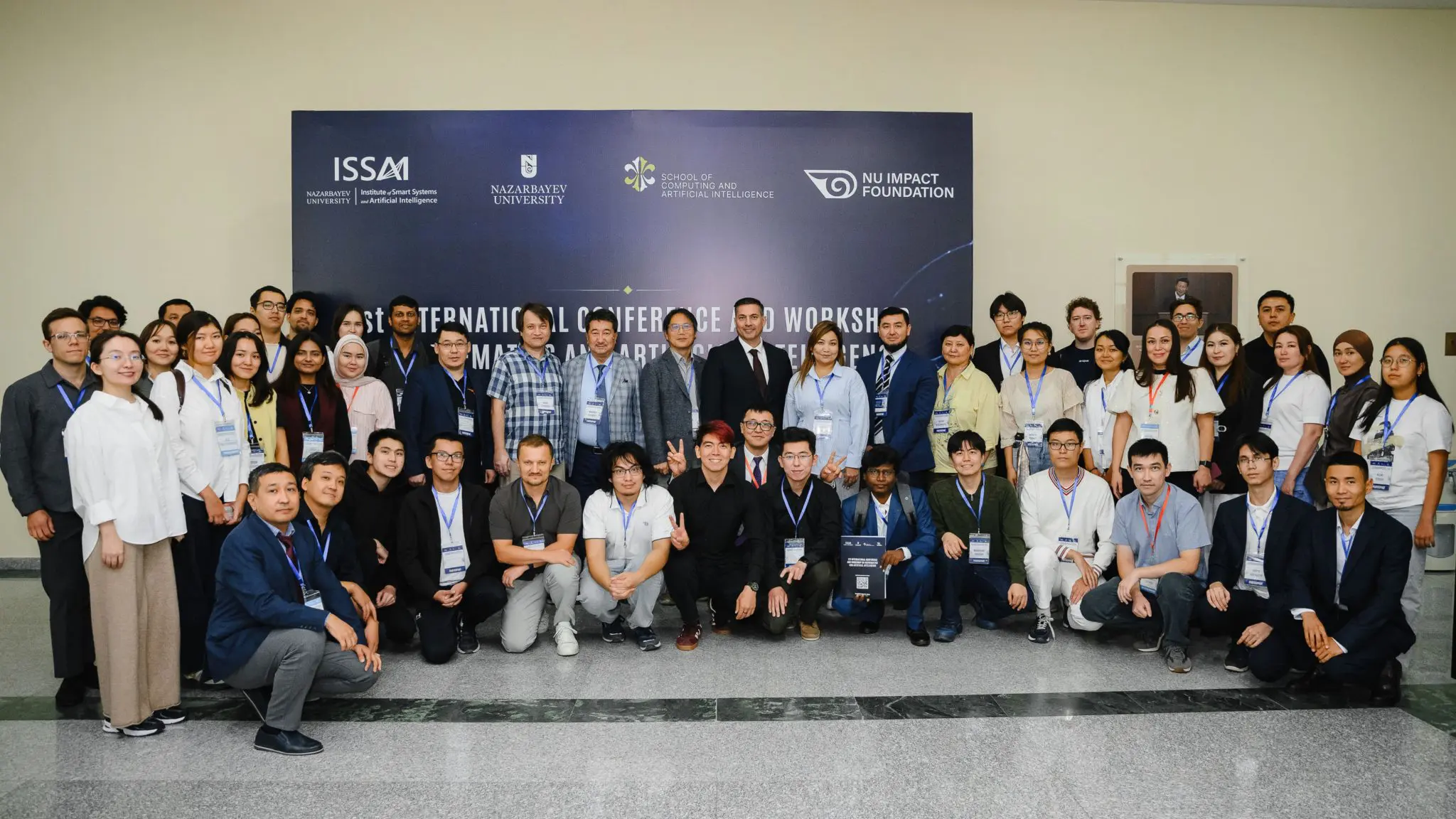
Ninety researchers from seven nations convened for the first International Conference on Mathematics and Artificial Intelligence (ICMAI 2026), indicating a broad initial reach for the new academic event. The conference, hosted by Sciences and Artificial Intelligence and the Institute of Smart Systems and Artificial Intelligence at NU, featured a program of seven plenary lectures, 32 sectional talks, and four hands-on workshops.
“It was a very exciting and productive three days,” said Professor Durvudkhan Suragan of SCAI, co-chair of ICMAI 2026, emphasizing the event’s success in fostering dialogue between mathematics and artificial intelligence and creating opportunities for international research collaboration.
ICMAI 2026: International Collaboration at Kazakhstan’s Mathematics and AI Conference
The conference attracted participants from seven countries, Kazakhstan, Russia, Saudi Arabia, the United Arab Emirates, Hungary, Azerbaijan, and China, demonstrating a broad initial international reach for the inaugural ICMAI 2026 event. This geographic diversity signals early interest in collaborative research at the intersection of mathematics and artificial intelligence beyond regional boundaries. The pairing reflects a deliberate effort to integrate computational and theoretical approaches within the conference framework.
Beyond presentations, the ICMAI 2026 program included four hands-on workshops designed to provide practical experience with modern computational methods and tools. These sessions allowed attendees to explore applications of AI in research, extending the conference’s impact beyond theoretical discussions. Students from computer science and mathematics programs at Sciences and Artificial Intelligence actively participated, gaining direct exposure to international scholars and current research trends. This integration of student involvement suggests a commitment to fostering the next generation of researchers in both fields.
Participants explored the application of graph theory, linear algebra, and high-dimensional data analysis in AI system development, while also considering how AI can advance mathematical research through pattern identification and hypothesis testing. The growing intersection of these fields was further exemplified by recent work from OpenAI, which reported using AI in relation to the Navier-Stokes equations, including the formalization of mathematical proofs using Lean.
This research, and its discussion at ICMAI 2026, underscores the need for rigorous verification of AI-generated results within the scientific community. Professor Suragan expressed hope that ICMAI will continue to be a platform for scientific exchange, practical learning, and joint research both within Kazakhstan and internationally.
It was a very exciting and productive three days. With seven plenary lectures, 32 sectional talks and four workshops, ICMAI 2026 brought together researchers and students from different countries and created a valuable space for dialogue between mathematics and artificial intelligence.
Professor Durvudkhan Suragan, SCAI

See today’s quantum computing news on Quantum Zeitgeist for the latest breakthroughs in qubits, hardware, algorithms, and industry deals.