
A femtosecond laser pulse is altering the magnetic behavior of electrons within an electron-doped cuprate superconductor, according to new research. Scientists from the European XFEL in Schenefeld, Germany, collaborated with researchers at Emory University and the Stanford Institute for Materials and Energy Sciences to track collective magnetic excitations, known as paramagnons, after they were driven out-of-equilibrium.
The work demonstrates an anti-Stokes signal linked to paramagnon generation, modifying their dispersion near the material’s zone center while leaving the bandwidth unchanged. This light-driven boost to the paramagnon population and resulting spectral-weight transfer could provide new methods for manipulating cuprate properties.
trRIXS Tracks Paramagnon Dynamics in Photo-excited Cuprates
Time-resolved resonant inelastic X-ray scattering (trRIXS) measurements revealed a modification of paramagnon dispersion near the zone center in an electron-doped cuprate following excitation with a femtosecond laser pulse, though the overall bandwidth of these magnetic excitations remained stable. This observation, achieved at the Cu L₃-edge, provides a new spectroscopic view into the behavior of collective spin excitations, paramagnons, within these complex materials when driven away from equilibrium.
Researchers utilized this technique to track these paramagnons in Nd₂-ₓCeₓCuO₄ (NCCO) at an optimal doping level of approximately x = 0.15, an important step in understanding the material’s response to rapid energy input. The study addressed a gap in understanding how collective magnetic excitations behave in photo-excited cuprates, a challenge stemming from the lack of a suitable experimental probe capable of tracking these excitations in both time, energy, and momentum.
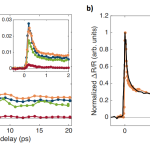
While techniques like time-resolved optical spectroscopy and angle-resolved photoemission spectroscopy have illuminated the behavior of electronic bands, superconducting pairs, and the lattice under photoexcitation, the dynamics of spin correlations remained comparatively unexplored. The advent of high-repetition-rate soft X-ray free-electron lasers (FELs) and high-resolution trRIXS instruments, however, has recently enabled these comprehensive measurements. Examining raw RIXS spectra at a specific reciprocal lattice unit (r.l.u.), researchers observed a suppression of the paramagnon peak intensity upon pumping, without a corresponding shift in its position.
Simultaneously, an increase in spectral weight was detected in the energy gain regime, extending up to -0.3 eV, indicative of scattering from modes whose population significantly increased due to the laser pulse. Given their energy scales, considerably larger than the maximum phonon energy in cuprates, these modes are most likely paramagnons, the dominant excitation at that momentum and energy.
Calculations using trRIXS further corroborated these findings, ruling out potential artifacts arising from the finite core-hole lifetime and matrix element effects. The observed changes in paramagnon behavior correlate with the dynamics of quasiparticles in the photoexcited state, beginning with the generation of hot electrons forming a pseudo-Fermi distribution with an effective electronic temperature. In this initial phase, the paramagnon population increases, their dispersion is modulated, and spectral weight is redistributed throughout the Brillouin zone.
This initial paramagnon recovery aligns with the timescale of hot electron relaxation, which occurs through energy transfer to strongly coupled phonons over a few hundred femtoseconds. The redistribution of spectral weight across the Brillouin zone is particularly noteworthy, as it suggests a transient alteration in the coupling between antiferromagnetic (AFM) correlations and Fermi-surface quasiparticles.
Specifically, a reduction in spectral weight at larger momenta implies a weaker coupling between electrons and magnetic fluctuations at higher momentum, including those near the (π,π) point. This diminished electron-AFM coupling may be a key factor in the filling-in of the pseudogap at the Fermi-surface “hot spots” in photo-excited NCCO. The study’s findings suggest that manipulating the paramagnon population and spectral weight distribution could offer new avenues for controlling the properties of cuprates, potentially influencing their superconducting behavior.
To model the observed dynamics, researchers employed a Gaussian function to fit the time dependence of both the paramagnon and plasmon excitations, acknowledging the heavily damped nature of these modes in optimally-doped electron-doped cuprates. Exact diagonalization calculations further supported these findings, providing snapshots of the trRIXS spectra at various time delays and confirming the observed trends.
These calculations, performed at a momentum of (0.33, 2π/a), demonstrated the evolution of the RIXS scattering cross section before, during, and after the pump pulse, providing a detailed picture of the underlying microscopic processes. The team’s work provides a strong link between ultrafast photoexcitation, the dynamics of collective magnetic excitations, and the evolution of electronic structure in these complex materials.
Electron-Doped NCCO’s Antiferromagnetic Correlations & Phase Diagram
The momentum-dependent variation in spectral weight across the Brillouin zone provides a detailed picture of how light alters magnetic interactions within the electron-doped cuprate Nd₂₋ₓCeₓCuO₄ (NCCO). Researchers found this redistribution isn’t uniform; instead, it shifts depending on the electron’s momentum, suggesting a nuanced impact on the material’s magnetic properties. This observation builds on prior work demonstrating that photoexcitation can fill the pseudogap, a region of suppressed electronic density, in these materials, though the underlying dynamics remained unclear until now.
The study focused on NCCO at optimal doping (x~0. 15), a material characterized by a strong antiferromagnetic (AFM) phase, to directly observe the evolution of magnetic excitations following a femtosecond laser pulse. Calculations simulating the time-dependent dynamical spin structure factor revealed a rapid decrease in the peak height corresponding to paramagnon excitation, collective magnetic fluctuations, immediately after the laser pulse arrives.
This decrease is a change in the way electrons interact with these magnetic excitations, as evidenced by the observed spectral weight variation. The researchers employed the Krylov subspace technique to model the time evolution of the wavefunction under laser illumination, simulating the nonequilibrium dynamical spin structure factor. Their model incorporated a Gaussian probe shape function, allowing them to track the changes in paramagnon excitations over time.
The beam spot on the sample was set to 10 μm (V) x 150 μm (H), providing a focused area for excitation and analysis. By analyzing the differential RIXS spectra at various time delays (Δt), the researchers were able to map the evolution of the paramagnon peak and its associated spectral weight. Waterfall plots of these spectra visually demonstrate the changes occurring in the material’s magnetic structure following photoexcitation.
Femtosecond Laser Pulse Modifies Paramagnon Dispersion
While previous studies focused on how photoexcitation affects individual electrons within these materials, this work specifically tracked the behavior of collective magnetic excitations known as paramagnons. The experimental design employed 400 nanometer laser pulses. This choice, the paper states, was motivated by higher optical absorption at the shorter wavelength, ensuring a robust excitation of the material.
Despite this difference in excitation source, the induced changes in the cuprate’s electronic structure closely mirrored those produced by 800 nanometer pulses, suggesting a broadly similar excitation mechanism. Specifically, the researchers observed a softening of the paramagnon peak near the zone center, meaning a reduction in the energy required to excite the magnetic excitation in that region.
This softening diminishes as one moves toward the zone boundary, resulting in a modulation of the paramagnon dispersion without altering its overall bandwidth. “The paramagnon softening is most prominent near the zone center and diminishes when moving toward the zone boundary,” the paper reports, detailing the spatial extent of this laser-induced effect. This localized change suggests that the laser pulse is selectively influencing the magnetic interactions within specific regions of the material’s momentum space.
The pump laser spot size, set to 10 μm (V) x 150 μm (H), was intentionally larger than the x-ray spot used for analysis, ensuring homogeneous photon excitation within the probed region. This careful control of the excitation area minimized the possibility of spatial variations influencing the results. Notably, the researchers found no alteration in the spin-exchange coupling strength along the probed direction, as evidenced by the unchanged paramagnon dispersion bandwidth near the zone boundary.
This suggests that the laser pulse primarily affects the paramagnon energy itself, rather than fundamentally altering the underlying magnetic interactions. The paper states, clarifying the scope of the observed changes.
Time-Resolved RIXS Enables Cuprate Spin Excitation Study
Calculations of the dynamical spin structure factor, S(q,ω,t), revealed fluence dependence at a momentum of (0. 33,0), providing insight into how light alters magnetic properties within the electron-doped cuprate. Researchers performed these calculations using a single-band Hubbard model on a 12-site cluster. Analysis of differential resonant inelastic X-ray scattering (RIXS) spectra, obtained by subtracting spectra at a -2. 0 ps time delay from those at 0. 25 ps, highlighted changes linked to paramagnon generation.
These spectra, as depicted in figures 2(a,b) within the original research showed variations near the peaks of both paramagnons and plasmons. The team estimated the pump excitation density within the XFEL probe beam footprint to be approximately 0. 6 photons per unit cell per pulse, based on reflectivity data. This level of excitation is sufficient to induce measurable changes in the material’s magnetic behavior, as evidenced by the observed spectral shifts.
The observed increase in elastic peak intensity, coupled with a finite spectral weight at zero energy, further supports the idea of light-driven modifications to the magnetic landscape. To quantitatively assess these effects, researchers employed exact diagonalization simulations, incorporating a time-dependent Hamiltonian. This approach allowed them to model the evolution of the dynamical spin structure factor, S(q,ω,Δt), and compare it directly with experimental RIXS data.
Spectral cuts of the trRIXS data, taken before and pump pulse, further illustrate the changes in the excitation spectrum. These cuts demonstrate the dynamic response of the material to the ultrafast photoexcitation, confirming the reshaping of collective magnetic behavior.
The team’s work builds on previous tr-ARPES studies, which linked photoexcitation to a decrease in spin correlation length, and provides a more direct spectroscopic interrogation of the collective spin excitations in the photoexcited state. Looking ahead, especially when paired with tailored pump pulses, ultrafast excitation offers powerful new leverage for actively controlling the magnetic properties of materials.
👉 More information
🗞 Collective Magnetic Excitations in a Photoexcited Electron-Doped Cuprate Superconductor
✍️ Daniel Jost et al.
🧠 DOI: http://link.aps.org/doi/10.1103/2h9x-8tjk



See today’s quantum computing news on Quantum Zeitgeist for the latest breakthroughs in qubits, hardware, algorithms, and industry deals.