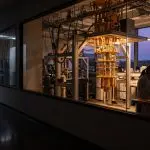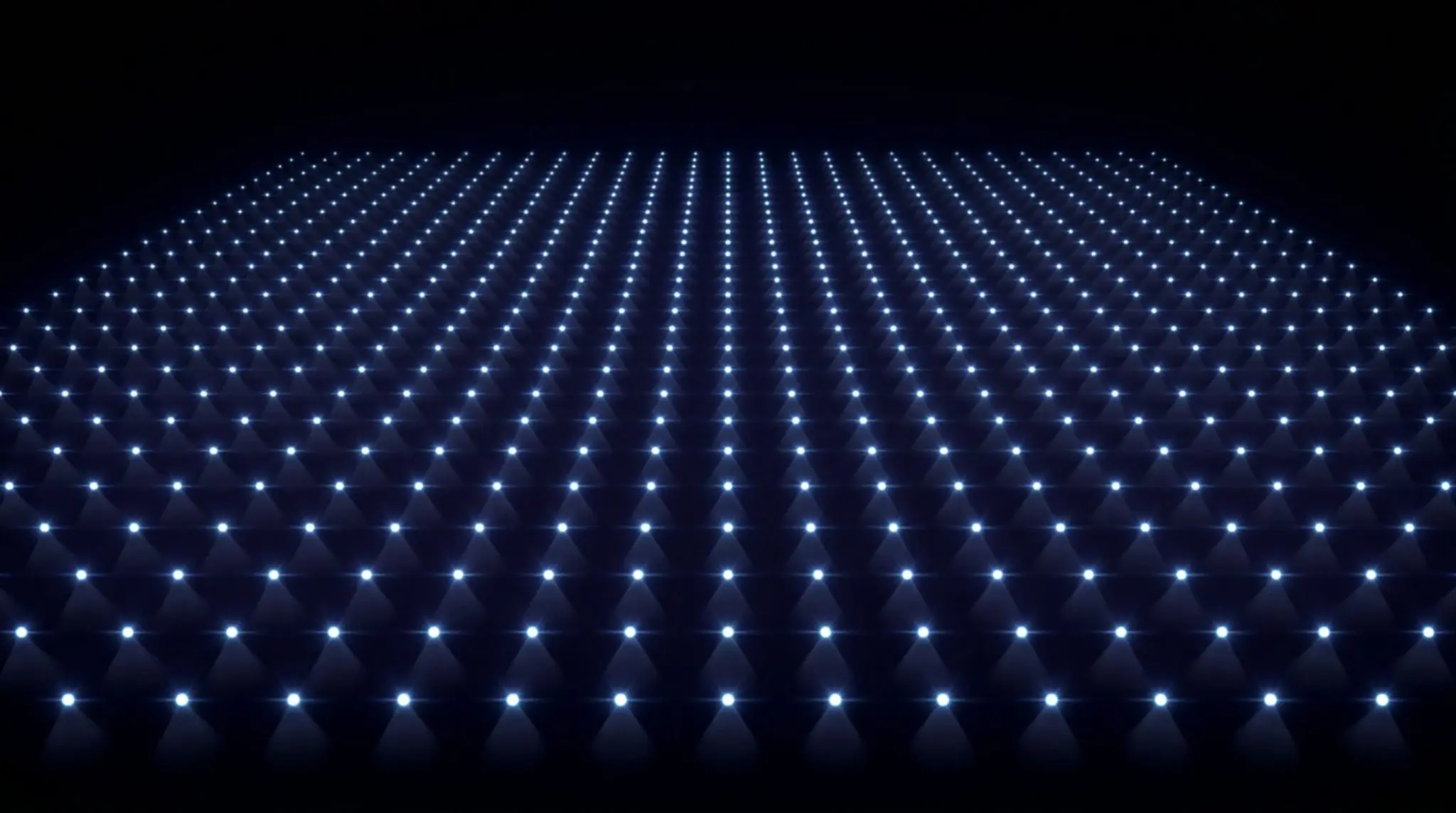
Pasqal and Université Paris-Saclay have created a cryogenic system that can manipulate 1024 individual atoms within a single quantum array. The platform operates at 4 Kelvin, achieving trapping lifetimes of around 5000 seconds and extending the time available to prepare large-scale arrays.
By combining two trapping lasers at different wavelengths and minimising atom losses during rearrangement and imaging, the researchers demonstrate the preparation of defect-free arrays with up to 1024 atoms, opening prospects for both analogue and digital quantum computing. This cryogenic design enables the creation of large registers essential for scaling quantum processors.
Cryogenic Platform Enables 1024-Atom Tweezers Arrays
Pasqal SAS, a company with facilities in Palaiseau, France, has created defect-free arrays containing up to 1024 neutral atoms, a significant step toward scalable quantum technologies. This accomplishment relies on a newly developed cryogenic platform operating at 4 Kelvin, a temperature that extends the time available for preparing these large-scale arrays. The system’s design incorporates high numerical aperture optics, enabling the precise manipulation of individual atoms within the array, and is compatible with Rydberg-state manipulation, a key technique for enhancing quantum interactions.
The engineering behind this platform addresses a critical challenge in scaling neutral atom quantum systems: maintaining atomic coherence over extended periods. Desiree Lim of Pasqal SAS and colleagues detail how the cryogenic environment functions as an efficient cryopump, improving vacuum quality and extending these lifetimes.
This improvement allows for the preparation of larger, more complex quantum registers than previously possible. The resulting arrays exhibit a high probability, exceeding 10 per cent, of being entirely free of defects, with an average defect rate of only 0.3 per cent. The authors write that “with proper shielding, it is possible to combine high optical access with significantly improved atomic lifetimes,” highlighting the importance of their design choices.
The platform’s architecture features a series of windows attached to thermal shields, carefully positioned to reduce the influx of gas particles from warmer regions into the ultra-cold environment. This design balances the need for optical access with maintaining an extreme-high vacuum.
The science chamber underwent a vacuum-firing process prior to installation, further minimising outgassing and enhancing the overall vacuum performance. The incorporation of high numerical aperture objectives, positioned outside the cryogenic shields, provides the necessary resolution for individual atom control. This cryogenic design is not simply about achieving low temperatures; it’s about creating a stable and controlled environment for quantum manipulation. The reduction of blackbody radiation at 4 Kelvin is particularly beneficial for Rydberg-state operations, increasing the lifetime of these excited states and improving quantum-gate fidelity.
Gwennolé Cournez and colleagues explain that for circular Rydberg states, the lifetime gain can reach several orders of magnitude. This extended coherence time is essential for performing complex quantum computations and simulations. The demonstrated ability to create defect-free arrays of 1024 atoms represents an advance in neutral atom quantum computing.
The extended lifetimes and high-fidelity control offered by this cryogenic platform enable exploration of more complex quantum algorithms and tackle increasingly challenging computational problems. The work opens exciting prospects for analog and digital quantum computing, positioning Pasqal SAS in this rapidly evolving field.
4-Kelvin Environment Extends Atomic Trapping Lifetimes to 5000 Seconds
The platform’s architecture addresses a key limitation in neutral atom quantum computing: maintaining atomic coherence long enough to perform complex operations on increasingly large registers. The system’s success hinges on a carefully engineered balance between optical access and vacuum integrity. Desiree Lim and colleagues at Pasqal SAS detail how the science chamber underwent a vacuum-firing process before installation, minimizing outgassing and maximizing the effectiveness of the cryogenic environment as a cryopump.
This extreme-high vacuum environment is crucial, as atom loss due to vacuum-limited losses becomes the dominant factor when scaling systems to thousands or tens of thousands of atoms. This level of control is significant in large-scale neutral atom arrays.
The team’s approach builds on previous work, improving upon earlier designs by incorporating enhanced shielding and optimized window attachment to the shields to reduce gas permeation from warmer regions of the apparatus. The system’s performance, detailed in the recent publication, suggests a viable path toward building larger, more robust, and more powerful quantum processors.
High Numerical Aperture Optics Facilitate Large-Scale Array Generation
The platform’s design directly addresses a longstanding challenge: maintaining both robust optical access and the ultra-high vacuum necessary for extended atomic trapping times. This extreme-high vacuum environment, coupled with the cryogenic temperatures, significantly enhances the cryopumping efficiency, allowing for prolonged experimental durations. Beyond extended lifetimes, the system’s architecture incorporates high numerical aperture objectives positioned outside of the primary cryogenic shields. This arrangement maintains a clear optical path for precise manipulation and imaging of the atoms, while simultaneously minimizing thermal radiation from warmer components that could disrupt quantum states.
The design represents a significant refinement over previous iterations, which suffered from limited shielding and shorter atomic lifetimes. By meticulously minimizing atom losses during rearrangement and imaging processes, the team has achieved a substantial increase in the number of atoms that can be reliably trapped and manipulated. Grégoire Pichard, Hadriel Mamann, and Lilian Bourachot, all affiliated with Pasqal SAS, contributed to the development of the optical and cryogenic systems that underpin this performance.
The implications of this work extend beyond fundamental research. The extended coherence times and high-fidelity array preparation allow for more complex quantum simulations and the development of larger, more powerful quantum processors.
The system’s compatibility with Rydberg-state manipulation, a technique used to enhance interactions between atoms, suggests a versatile platform for exploring a wide range of quantum phenomena. The combination of cryogenic cooling, high numerical aperture optics, and careful attention to vacuum integrity represents a step forward in the field of neutral atom quantum computing, positioning Pasqal SAS as a key player in the ongoing development of this promising technology.
Dual-Wavelength Laser Combination Forms Independent Trap Arrays
This significant jump in scale, detailed in recent work, promises to accelerate advancements in controlled quantum experiments and hints at increased computational potential for both analog and digital approaches. Achieving such high fidelity in large arrays is crucial, as even small defect rates of 0.3 percent accumulate and limit the complexity of quantum simulations or computations that can be performed. The extended trapping lifetimes, reaching approximately 5000 seconds, are equally critical, providing ample time for complex manipulations and measurements.
Earlier systems suffered from insufficient shielding, hindering the attainment of extended atomic lifetimes. The team at Pasqal SAS addressed a key challenge in cryogenic systems: balancing optical access with effective shielding. Their solution involves incorporating windows attached to the thermal shields, interrupting direct line-of-sight paths between the warmer, 300-Kelvin environment and the ultra-cold, XHV region where the atoms are trapped. This design minimizes gas flux from the warmer environment, which can contaminate the cryogenic surfaces and reduce their cryopumping efficiency.
The researchers write that “several requirements need to be met to achieve good vacuum performance in a cryogenic environment within a vacuum chamber,” emphasizing the complex interplay of factors involved. They further explain that minimizing outgassing from vacuum components, increasing pumping speed, and reducing conductance between temperature zones are all vital considerations. The benefits of operating at such low temperatures extend beyond simply extending atom lifetimes.
The reduction of blackbody radiation, which can disrupt Rydberg state lifetimes, is a significant advantage, particularly for circular Rydberg states currently attracting growing interest in quantum computing and simulation. The researchers note that removing the contribution of blackbody radiation at low temperatures can increase Rydberg state lifetimes by a factor of two to three, and even several orders of magnitude for circular states.
This improvement directly translates to higher fidelity in Rydberg-mediated operations, enabling more complex and reliable quantum algorithms. The ability to consistently create and maintain arrays of this size and quality represents a step toward building practical quantum processors, with a defect rate of 0.3 percent.
Defect-Free Array Assembly Achieves 10% Probability, 0.3% Defect Rate
Maintaining this extreme cold is crucial not only for extending the duration of experiments but also for minimizing disruptive influences on the quantum states of the atoms. The researchers explain that operating at such low temperatures significantly reduces blackbody radiation, a phenomenon that can shorten the lifespan of Rydberg states, excited atomic states essential for many quantum operations. The design of the cryogenic system itself addresses a key challenge in scaling neutral atom platforms: vacuum performance.
Maintaining an ultra-high vacuum within the cryogenic environment is essential to prevent vacuum-limited losses, which can lead to atom loss. The team at Pasqal SAS implemented several strategies to optimize vacuum quality, including vacuum-firing the science chamber and utilizing a series of windows attached to the thermal shields.
Leveraging these extended atomic lifetimes and optimized imaging capabilities, the researchers demonstrated the assembly of large atom arrays with a probability of achieving defect-free registers exceeding 10 percent. This achievement builds upon previous work by the same team, who previously demonstrated arrays containing more than 800 atoms. However, limitations in shielding hampered atomic lifetimes and prevented the creation of truly defect-free arrays.
The current design, incorporating improved shielding and a refined optical layout, overcomes these challenges. The researchers also note that the system’s design allows for swift recovery of atomic lifetimes after any degradation, ensuring long-term stability and reliability.
👉 More information
🗞 Defect-Free Arrays at the Thousand-Atom Scale in a 4-K Cryogenic Environment
✍️ Desiree Lim et al.
🧠 DOI: http://link.aps.org/doi/10.1103/45t1-vl5y


See today’s quantum computing news on Quantum Zeitgeist for the latest breakthroughs in qubits, hardware, algorithms, and industry deals.