The EuroHPC Joint Undertaking is allocating EUR 20 million for a call to develop a trapped-ion quantum computer capable of addressing over 1,000 individual qubits; this investment targets a specific scale of quantum processing and integration with existing high-performance computing systems. Alongside this, a second call focuses on superconducting quantum computing, specifically requiring chiplet technology to achieve extended coherence times and fast read-outs.
Both initiatives mandate cloud accessibility for researchers and industry users, with projects expected to run for 3.5 years and applications due by November 17. A total of EUR 44 million is allocated across these two calls, EUR 20 million for trapped-ion technologies and EUR 20 million for superconducting technologies, and a further EUR 24 million for QKD and EUR 20 million for testing infrastructure.
Trapped-Ion & Superconducting Qubit Development for Full-Stack Systems
The EuroHPC Joint Undertaking launched calls for proposals on August 13, 2026, seeking to build full-stack systems integrated with existing high-performance computing infrastructure and accessible through cloud platforms. Each call aims for over 1,000 individually addressable physical qubits. Projects selected through these calls will run for 3.5 years, with applications due by November 17, 2026, at 17:00 CET.
The EuroHPC Joint Undertaking envisions these systems supporting a wide range of applications and integrating with the existing EuroHPC supercomputing infrastructure, the company says. The calls also aim to strengthen European supply chains for essential quantum technology components, fostering greater self-reliance in this emerging field.
Neutral-Atom Processors Aim for 10,000 Qubit Scalability & Quantum Advantage
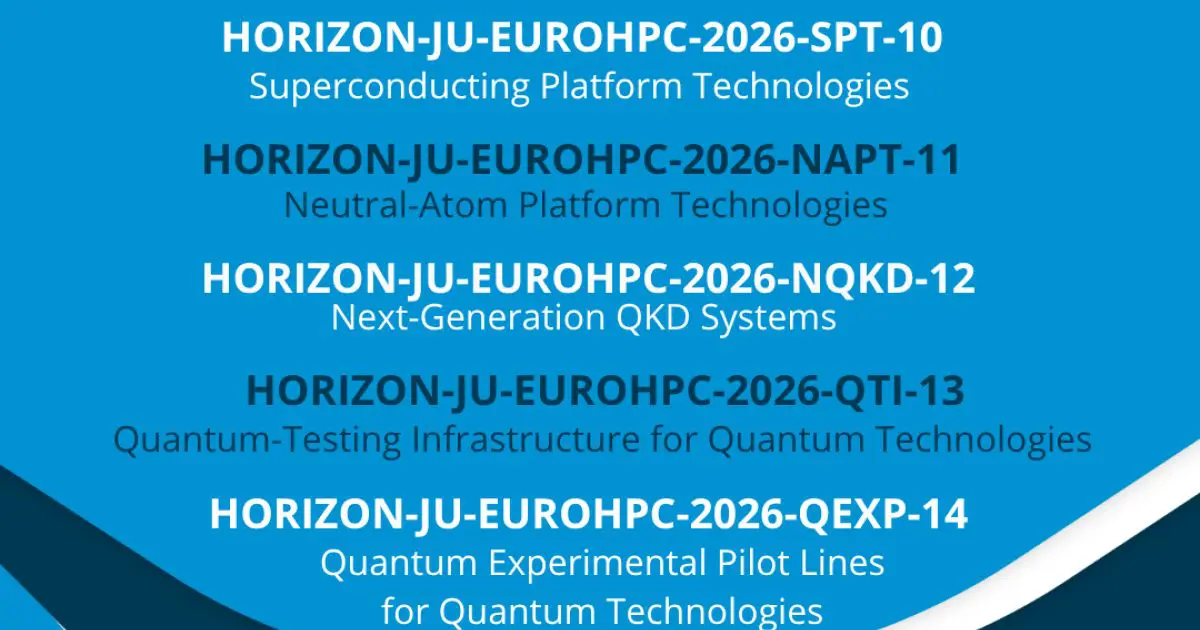
The EuroHPC Joint Undertaking is prioritizing scalability in neutral-atom quantum computing with a new call for proposals targeting processors capable of supporting 10,000 neutral atoms for simulation and 1,000 physical qubits for computation. This initiative, designated HORIZON-JU-EUROHPC-2026-NAPT-11, seeks to move beyond theoretical designs toward industry-ready systems capable of tackling complex problems. Projects responding to the call will be expected to achieve coherence times substantially longer than currently available, alongside operation fidelities exceeding 99 percent.
Demonstrating quantum advantage through real-world applications in sectors such as energy and health is also a stated objective, pushing the technology beyond fundamental research and into practical utility. The call specifically requests the development of scalable quantum processors utilizing individually addressable neutral atoms, with an emphasis on gate-based quantum computing architectures. Robust quantum error mitigation and correction techniques are also required, alongside efforts to strengthen the European supply chain for essential components of neutral-atom based computational processors.
A total indicative budget of EUR 20 million will fund projects lasting 3.5 years, capable of both simulation and computation. This dual focus suggests a strategy to maximize the versatility of the resulting technology, enabling exploration of a wider range of quantum algorithms and applications. Relevant details and information concerning this call are available on the dedicated call page.
Next-Generation QKD & Quantum-Testing Infrastructure for Secure Networks
The HORIZON-JU-EUROHPC-2026-NQKD-12 call specifically targets next-generation QKD systems capable of achieving key rates exceeding 1 Mbps over metropolitan distances and extending operational coverage to regional networks surpassing 300 km. This push aims to move beyond current limitations in secure data transmission, addressing a critical need for enhanced cybersecurity infrastructure. Beyond simply improving QKD, the call also emphasizes the integration of advanced cryptographic protocols, including hybrid frameworks that combine QKD with post-quantum cryptography.
Projects responding to this call will need to demonstrate these technologies in practical applications, extending beyond the existing EuroQCI infrastructure to protect vital sectors like energy grids, cloud storage, and industrial control systems. Engagement with industry and national network providers is considered crucial to ensure compatibility with existing telecom standards.
Complementing these security efforts, the EuroHPC JU is also establishing a pan-European, open-access testing infrastructure for quantum technologies through the HORIZON-JU-EUROHPC-2026-QTI-13 call. This initiative will deploy distributed testing facilities across multiple EU member states, developing certification services aligned with emerging standards. According to call documentation, this will strengthen Europe’s competitiveness by ensuring robust quality assurance mechanisms with standardized protocols.
The budget foreseen for QKD is EUR 24 million, while the budget for testing infrastructure is EUR 20 million, totaling EUR 44 million, with projects expected to run for 3.5 years. This combined investment signals a concerted effort to establish a comprehensive, secure, and verifiable quantum ecosystem across Europe.
See today’s quantum computing news on Quantum Zeitgeist for the latest breakthroughs in qubits, hardware, algorithms, and industry deals.