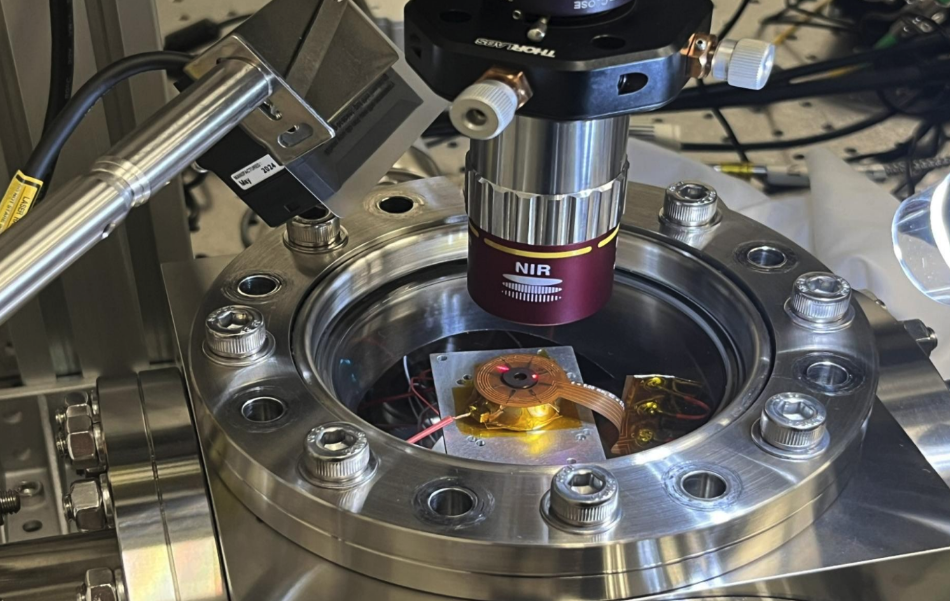
Researchers at the A*STAR Quantum Innovation Centre have engineered a millimetre-scale rotor that spun freely for over 10 hours after power was removed, achieving the lowest energy loss reported for a mechanical rotor of this size. The team demonstrated commercial-grade gyroscope sensitivity using the levitated device, opening possibilities for precision navigation in environments where GPS signals are blocked, such as underwater or underground.
“Achieving extremely low energy loss in larger rotors has long been a challenge,” said Dr Xianfeng Chen, Scientist at A*STAR Q.InC. “Our work overcomes this trade-off, establishing a platform for advancing precision sensing.” The breakthrough, detailed in Nature Communications, relies on exploiting rotational symmetry to suppress energy-dissipating eddy currents.
Diamagnetic Levitation Achieves Record-Low Rotor Energy Loss
Historically, these currents limited the performance of levitated devices, but the team’s approach minimized their impact, allowing for a dissipation rate of 3.85 microhertz. This breakthrough enabled the demonstration of commercial-grade gyroscope sensitivity, as the rotor, accelerated to 930 revolutions per minute, maintained stability sufficient to detect rotations as slow as 0.0065 degrees per second, placing its performance within the range required for practical navigation applications.
The team’s success stems from a holistic approach, combining millimetre-scale passive levitation with room-temperature operation, high spinning speeds, and the record-low energy loss; this integration of capabilities is rare and positions Singapore as a potential leader in the development of advanced sensing technologies.
Professor Lam Ping Koy, A*STAR Chief Quantum Scientist who leads A*STAR Q.InC, emphasized the strategic importance of this work, stating, “This work demonstrates how advances in fundamental science can establish strategically important capabilities for Singapore.” Further development aims to increase rotor speed, enhance stability, and reduce the size of supporting systems, with the ultimate goal of creating an affordable and commercially viable sensor platform for real-world navigation applications.
By drawing on expertise in advanced control, levitation physics, precision engineering and sensing from across A*STAR and Singapore’s wider quantum research ecosystem, we are laying the foundations for future technologies that could address real-world needs in navigation and beyond.
Millimetre-Scale Rotor Demonstrates Commercial-Grade Gyroscope Sensitivity
The ability to navigate without reliance on satellite signals is becoming increasingly vital, and a new device developed at the A*STAR Quantum Innovation Centre offers a potential solution. A key innovation lies in how the team addressed a longstanding problem with diamagnetic levitation: eddy-current damping. Historically, these currents dissipated energy and limited performance, but the A*STAR Q.InC researchers exploited rotational symmetry to minimize their impact, as the rotor spins around its central axis and experiences a consistent magnetic field, suppressing the eddy currents that would otherwise slow it down.
This resulted in a dissipation rate of 3.85 microhertz, a significant improvement over previous millimetre-scale rotors and allowing for the extended spin time. “By drawing on expertise in advanced control, levitation physics, precision engineering and sensing from across A*STAR and Singapore’s wider quantum research ecosystem, we are laying the foundations for future technologies that could address real-world needs in navigation and beyond.” The team is now focused on increasing the rotor’s speed, enhancing its stability, and miniaturizing the supporting systems to create a commercially viable sensor platform.
This work demonstrates how advances in fundamental science can establish strategically important capabilities for Singapore.
Professor Lam Ping Koy, A*STAR Chief Quantum Scientist, who leads A*STAR Q.InC
Source: https://www.a-star.edu.sg/



See today’s quantum computing news on Quantum Zeitgeist for the latest breakthroughs in qubits, hardware, algorithms, and industry deals.