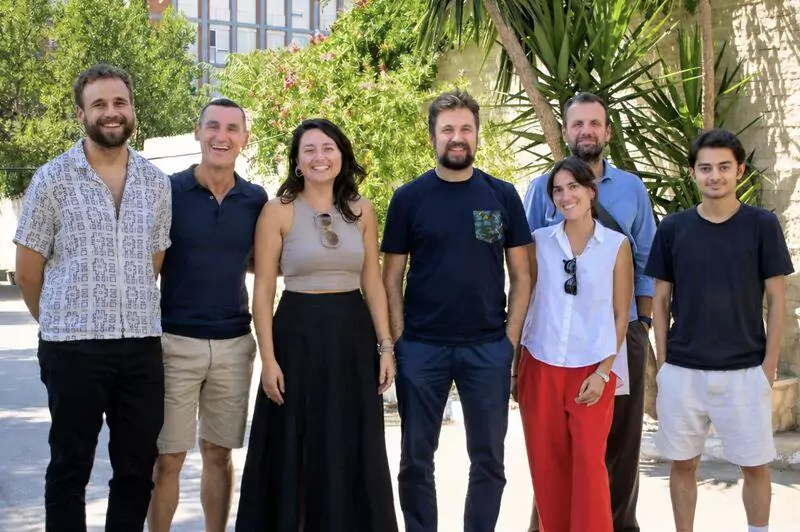
Italian quantum sensing firm QSENSATO will establish an in-house fabrication facility after securing a €1 million SAFE investment led by Quantonation. The funding will allow the University of Bari spin-off to scale production of its integrated atomic vapor cells, a critical component for quantum sensors used in fields from navigation to medical diagnostics.
“Quantum sensing has produced extraordinary science, but scaling that science into products that can be manufactured reliably remains a major challenge,” says Raphael Bodin, an investor at Quantonation. QSENSATO aims to bridge that gap, bringing industrial-scale manufacturing to a technology still largely confined to laboratory settings.
Quantonation’s €1M Investment Scales QSENSATO’s Sensor Fabrication
This funding directly addresses a critical bottleneck in quantum sensing: the transition from demonstrations to repeatable, industrial-scale manufacturing of core sensor components. QSENSATO, originating as a spin-off from the University of Bari Aldo Moro, specializes in laser-written integrated atomic vapor cells, the foundational element of compact quantum sensors built onto all-glass chips. The new facility, planned for the TecnoPolis Science and Technology Park in Valenzano, Bari is expected to be operational by year-end and will grant the company greater control over production processes.
This investment isn’t simply about increasing output; it’s about refining a complex fabrication process. QSENSATO holds a patent for its method of creating these integrated atomic vapor cells, essential for magnetometers, atomic frequency references and radio-frequency sensors. The company’s approach allows for multiple optical pathways into the sensing chamber and supports the creation of complex internal structures, expanding the range of sensor types it can produce.
A recently signed research agreement with Italy’s National Institute of Metrological Research (INRiM) in Turin will further validate this fabrication process and its suitability for advanced quantum sensing and metrology applications, QSENSATO says. This collaboration ensures the company’s manufacturing standards align with national metrological benchmarks. Quantonation’s decision to invest reflects a broader understanding of the challenges facing the quantum sensing field.
“Gianvito and the QSENSATO team understand that the next breakthrough is not simply better sensor performance, but making that performance repeatable, manufacturable and commercially viable. That combination of scientific depth and industrial focus is what makes QSENSATO particularly compelling.” The company’s technology is also licensed from ICFO in Barcelona, marking QSENSATO as the twelfth venture built on intellectual property developed by the Atomic Quantum Optics group led by Morgan Mitchell.
The €1 million SAFE investment builds on existing support from LIFTT and Quantum Italia, alongside funding from TecnoNidi, D3-4 Health, the European Space Agency’s Open Space Innovation Platform and ESA BIC, according to the company. Prof. QSENSATO’s position as the only native quantum sensing startup in Italy, as recognized by the NQSTI Quantum for Italy report, highlights its unique role in advancing this technology within the country.
This €1 million SAFE investment is a strong vote of confidence from Quantonation and Deep Ocean Capital as we enter the next phase of QSENSATO’s development.
Prof. Vito Giovanni Lucivero, CEO of QSENSATO



See today’s quantum computing news on Quantum Zeitgeist for the latest breakthroughs in qubits, hardware, algorithms, and industry deals.