Students at the University of Washington have built a hands-on laboratory for combating quantum noise, directly mapping strategies to services within Amazon Web Services. As part of a 10-week industry mentorship with AWS, the team progressed through noise suppression, mitigation and correction, techniques important for realizing practical quantum computing. The students used Amazon Braket and AWS infrastructure to run experiments on both simulated and real quantum hardware, including the Rigetti Cepheus-1-108Q processor. This work demonstrates how each stage “maps naturally onto AWS services,” according to the team.
UW Students Characterize Qubit Coherence with Amazon Braket
The University of Washington team’s error correction layer proved most computationally intensive, requiring parallel execution managed by AWS Batch, a service designed for efficiently distributing and running large numbers of computing tasks. This scaling capability is important because logical qubits, encoded across multiple physical qubits to detect and correct errors, demand significant resources; the more physical qubits involved, the greater the computational burden. This hands-on laboratory progressed through three complementary strategies for tackling quantum noise: suppressing it at the source, mitigating its effects through post-processing techniques, and correcting errors with encoded logical qubits.
The team’s work builds on a previous project where students modeled a nitrogen-vacancy center with NVIDIA CUDA-Q last year. This progression demonstrates a focused effort to apply student research to specific quantum hardware and software combinations, encouraging practical experience alongside theoretical understanding.
The team’s notebooks, available through a project repository, detail the full noise suppression, mitigation, and correction workflow, AWS says. The ability to rapidly set up infrastructure was facilitated by CloudFormation templates, allowing the students to deploy resources quickly and consistently. According to the team, each stage of their noise mitigation process “scales naturally across Amazon Braket, AWS Batch, and AWS PCS,” streamlining the experimental design and analysis pipeline.
This scalability is particularly relevant given Amazon’s plans to expand collaboration with QuEra, aiming to bring Libra, a fault-tolerant quantum computer, to AWS customers by 2028. The AQET traineeship program at the University of Washington receives partial funding from NSF award DGE-2021540, supporting this type of industry-linked research. James Whitfield, an Amazon Visiting Academic working on quantum education, oversaw the project.
Dynamical Decoupling and Zero-Noise Extrapolation via AWS Batch
Dynamical decoupling and zero-noise extrapolation benefited from parallel processing capabilities; the University of Washington team used AWS Batch to distribute circuit executions for zero-noise extrapolation, a technique demanding numerous repetitions at varied noise levels to achieve stable results. This approach allowed the team to efficiently analyze circuits amplified with differing levels of noise, then extrapolate back to a theoretical zero-noise limit, improving the accuracy of their measurements, according to AWS.
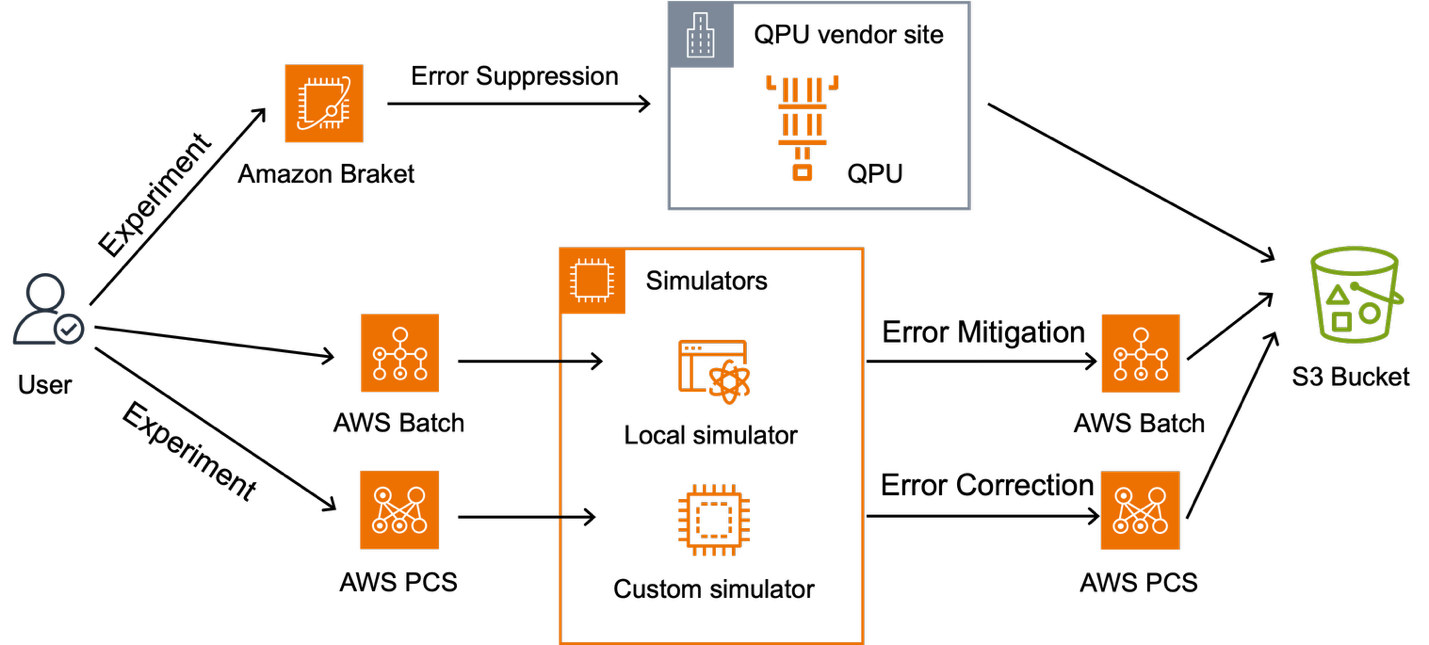
The team’s work extended beyond simulation, deploying experiments on the Rigetti Cepheus-1-108Q superconducting quantum processing unit accessed through Amazon Braket demonstrating a hybrid approach to noise analysis. Mitigation strategies were then layered onto suppression techniques, with the team’s workflow designed to use distinct AWS services for each task. Circuits with error-suppression protocols ran on a third-party QPU via Amazon Braket, while the computationally intensive post-processing for mitigation was handled by AWS PCS, using containerized environments deployed through CloudFormation templates.
This division, according to the team, allowed for efficient scaling of experiments and facilitated the exploration of novel noise reduction methods. Final results were consistently stored in shared S3 storage, enabling easy access and analysis of the collected data. The most demanding stage, quantum error correction, saw the team use AWS PCS alongside the Stim and PyMatching tools for syndrome decoding and correction.
Encoding a logical qubit across multiple physical qubits requires significant computational resources, and the team’s workflow demonstrates how these resources can be effectively managed within the AWS ecosystem, the firm reports. “The same services and workflow can be reused to design and scale novel noise experiments of your own,” the team noted, highlighting the reproducibility and scalability of their approach.
Quantum Error Correction Scaled on AWS Parallel Computing Service
Simulating quantum error correction (QEC) codes demands substantial computational resources, prompting a University of Washington team to use Amazon Web Services Parallel Computing Service (PCS) for scaled computation. The rotated surface code was studied on PCS using the Stim and PyMatching libraries for circuit simulation and error syndrome decoding, a workflow designed to understand the trade-offs between code performance and physical qubit requirements.
This analysis is critical as fault-tolerant quantum devices approach commercial availability, with Amazon Braket planning to offer access to QuEra’s Libra computer by 2028, the first of its kind capable of tackling scientifically relevant problems. AWS Batch facilitated parallel execution of simulations using a containerized environment, while the team dispatched circuits with error-suppression protocols to a third-party quantum processing unit (QPU) via Amazon Braket.
Circuits designed for zero-noise extrapolation were also distributed on noisy simulators using AWS Batch, which handled post-processing mitigation steps. “Understanding what different codes can achieve, and at what physical-qubit cost is a prerequisite for using the fault-tolerant devices now on the horizon,” the team noted, highlighting the importance of simulation in guiding hardware development. The team’s workflow demonstrates a clear progression from noise suppression to error correction, with each stage using a distinct AWS service, the company states.
The project, partially sponsored by NSF award DGE-2021540, also provides resources for other institutions, with the AWS Cloud Credit for Research program offering support for those seeking to replicate the experiments. Detailed documentation and code are available in the project repository, enabling wider adoption and further exploration of QEC strategies on AWS infrastructure.
End-to-End Workflow Maps Noise Stages to AWS Infrastructure
The University of Washington team’s workflow divided quantum noise mitigation into three distinct stages, suppression, mitigation and correction, each using specific Amazon Web Services offerings for optimal scaling and efficiency. Initial efforts focused on extending qubit coherence times through dynamical decoupling, employing precisely timed pulse sequences to average out environmental interference, a technique important for preserving quantum information.
Characterizing qubit decay rates via T1 and T2 measurements formed the foundation for this noise suppression stage, establishing a baseline for subsequent improvements. Following suppression, the team turned to mitigating noise effects through post-processing techniques and zero-noise extrapolation, distributing circuits across noisy simulators using AWS Batch.
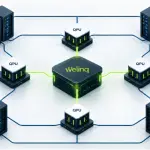
The team’s design, as schematically represented in project documentation, enabled efficient scaling of these experiments, a key factor in evaluating the effectiveness of different approaches, by the company’s account. This allowed the team to model complex error correction schemes and assess their ability to protect quantum information from noise, AWS claims.
The AWS Center for Quantum Computing, founded on December 2, 2019 and headquartered in Pasadena, provided the infrastructure underpinning these simulations, building on its development of superconducting cat-qubit hardware like the Ocelot logical qubit memory chip announced on February 27, 2025. Peter DeSantis, who now leads Amazon’s AI models, chips and quantum organisation, stated on June 19, 2026 that he expects commercially useful small quantum computers within five to seven years, a timeline supported by ongoing advancements in error mitigation and correction techniques.


See today’s quantum computing news on Quantum Zeitgeist for the latest breakthroughs in qubits, hardware, algorithms, and industry deals.