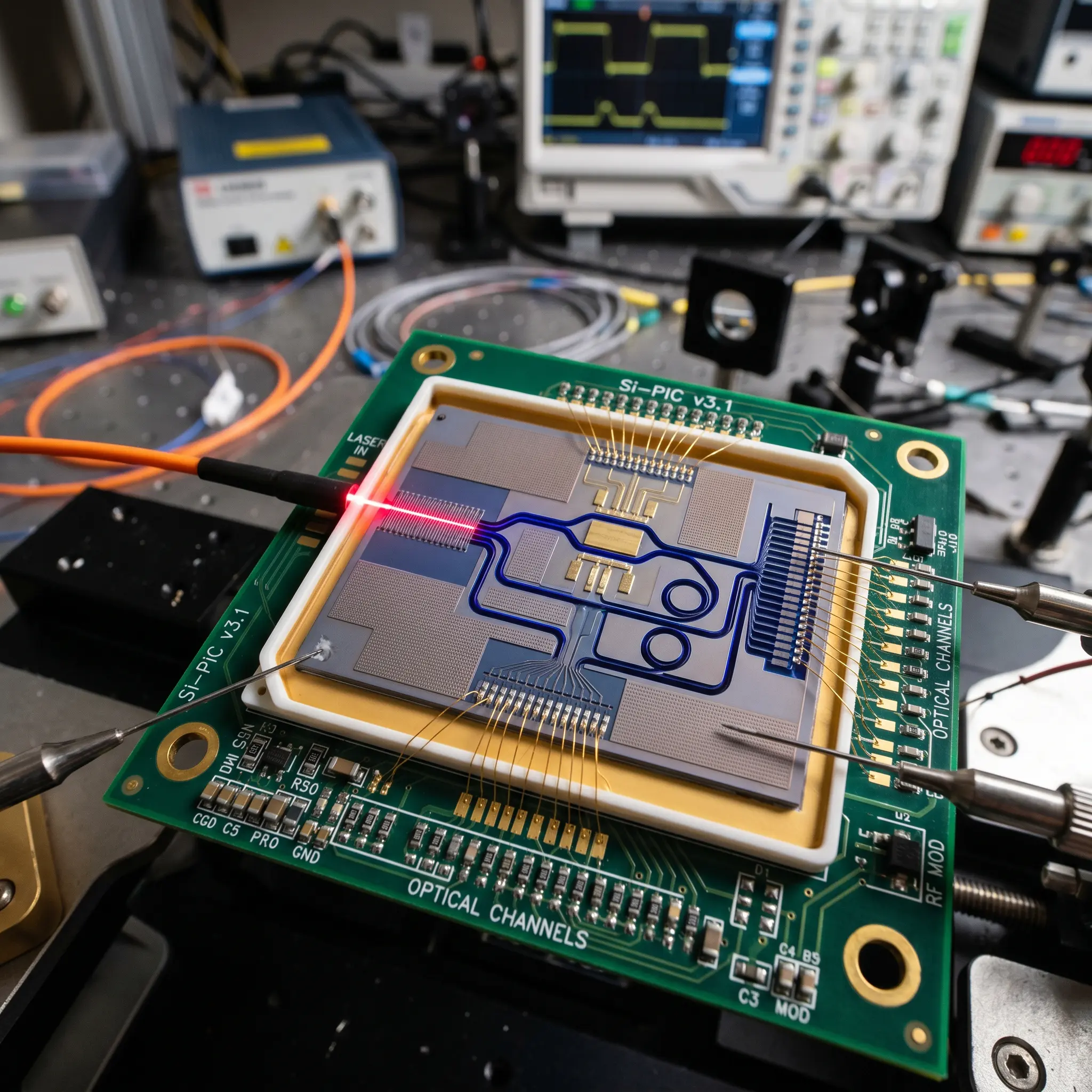
Lingzhi Luo and Yizhi Wang authored a publication detailing a Temporally Plastic Photonic Processor (TPPP) that achieves up to 100 times lower intrinsic single-pass compute delay compared to advanced electronic processors. The new architecture integrates a “recursive optical delay memory” allowing time-varying weights to be embedded directly within the photonic domain, bypassing the limitations of traditional electronic memory access. This innovation addresses a critical bottleneck for real-time adaptive computing, where systems must continuously adjust to evolving inputs and prevent error accumulation. Scaling analysis projects up to 16 times higher per-operation energy efficiency under an INT8 comparison, establishing the TPPP as a promising framework for intelligent systems operating in dynamic environments.
Temporally Plastic Photonic Processor Architecture for Adaptive Computing
Achieving a 100 times reduction in single-pass compute delay, the Temporally Plastic Photonic Processor (TPPP) represents a significant departure from conventional electronic architectures struggling with the demands of real-time adaptive computing. The research published by Lingzhi Luo and Yizhi Wang details their work, addressing limitations inherent in systems requiring continuous adjustment to changing inputs and the accumulation of errors in dynamic environments. Existing processors, reliant on static-weight inference, prove vulnerable to these shifts; the TPPP offers a solution through in-situ adaptation. The core of this innovation lies in a dual-kernel design, integrating a slow, reconfigurable kernel for stable long-term processing alongside a fast, dynamic kernel for transient adaptation. The published paper states that the architecture’s fundamental difference is its operation via this dual-kernel design.
The system’s ability to sustain recurrent low-loss signal circulation, achieved through the heterogeneous integration of III-V gain modules on silicon photonics, avoids repeated electronic memory access and its associated latency. Experimental validation on both linear and nonlinear sequential tasks demonstrated the TPPP’s superior robustness and accuracy compared to static photonic baselines, solidifying its potential as a hardware framework for real-time adaptive photonic computing. The published research indicates that a validated 8×8 INT8-encoded operating point was achieved, demonstrating a functional and efficient system.
The pursuit of adaptable computing hardware has largely focused on overcoming limitations inherent in traditional electronic processors, particularly the “memory wall” and energy inefficiencies associated with frequent data transfer. While photonic computing offers advantages in speed and energy use, most implementations remain reliant on static operations. The published research addresses this with architectures capable of on-chip learning, and the Temporally Plastic Photonic Processor (TPPP) presents a dual-kernel design as a key innovation. This approach, detailed in recent work, moves beyond simple acceleration by embedding adaptive weights directly within the photonic circuitry. This capability relies on the integration of thermo-optic and electro-optic control mechanisms alongside a “recursive optical delay memory”.
Photonic computing can move beyond simply accelerating existing algorithms by embedding adaptability directly into the hardware itself. This addresses a longstanding bottleneck in computing, often referred to as the “memory wall”.
The demand for real-time intelligent systems capable of adapting to changing conditions is driving innovation beyond conventional static processors. The published research demonstrates a Temporally Plastic Photonic Processor (TPPP) capable of learning and adjusting on the fly. In linear mode, the processor accelerates regression by reducing the computational cost of iterative matrix inversion, demonstrated through real-time spectral analysis.
Artificial intelligence capable of real-time adaptation often clashes with the limitations of conventional computing hardware; systems designed for static tasks struggle with the continuous shifts inherent in dynamic environments. This approach moves beyond simply accelerating inference, tackling the fundamental issue of maintaining robust computation amidst changing conditions. The TPPP’s architecture facilitates nonlinear recurrent decision-making through a carefully orchestrated interplay of optical components. The published research validates the processor’s performance by implementing an adaptive autoregressive model, showcasing its ability to navigate autonomously. The system’s ability to handle evolving inputs, noise, and device imperfections further solidifies its potential for deployment in complex, real-world applications.
A hundredfold reduction in compute delay represents a dramatic leap in processing speed, and the Temporally Plastic Photonic Processor (TPPP) achieves precisely that compared to state-of-the-art electronic processors. This substantial decrease in latency stems from the TPPP’s architecture, which moves beyond simply accelerating calculations to address fundamental limitations of conventional systems. The published research demonstrates that the TPPP’s ability to perform adaptive computation in situ, within the processor itself, avoids the bottlenecks created by constant data transfer to and from external memory. This approach, inspired by multi-timescale biological plasticity, allows the system to embed time-varying weights directly within the photonic domain, eliminating the need for repeated electronic memory access.
Current photonic integrated circuits often rely on passive components, limiting their ability to perform complex, recurrent computations without frequent electronic control. This new architecture overcomes those limitations through heterogeneous integration, sustaining recurrent low-loss signal circulation and minimizing reliance on electronic memory access. The published work details the utilization of III-V gain modules to amplify optical signals within the silicon photonic framework, a crucial step for maintaining signal integrity during prolonged, recurrent processing. This integration avoids the latency penalties inherent in repeatedly converting optical signals to electronic data for control and memory operations, a significant bottleneck in traditional systems. The design supports two primary computational modes: linear adaptive inference and nonlinear recurrent decision-making, demonstrating versatility across different applications. The TPPP’s architecture incorporates a “recursive optical delay memory” allowing temporal state evolution and adaptive processing to remain entirely within the optical domain. The core challenge lies in balancing stability and plasticity; a system must retain learned information while simultaneously responding to new data, a feat difficult to achieve with conventional electronic hardware.
See today’s quantum computing news on Quantum Zeitgeist for the latest breakthroughs in qubits, hardware, algorithms, and industry deals.