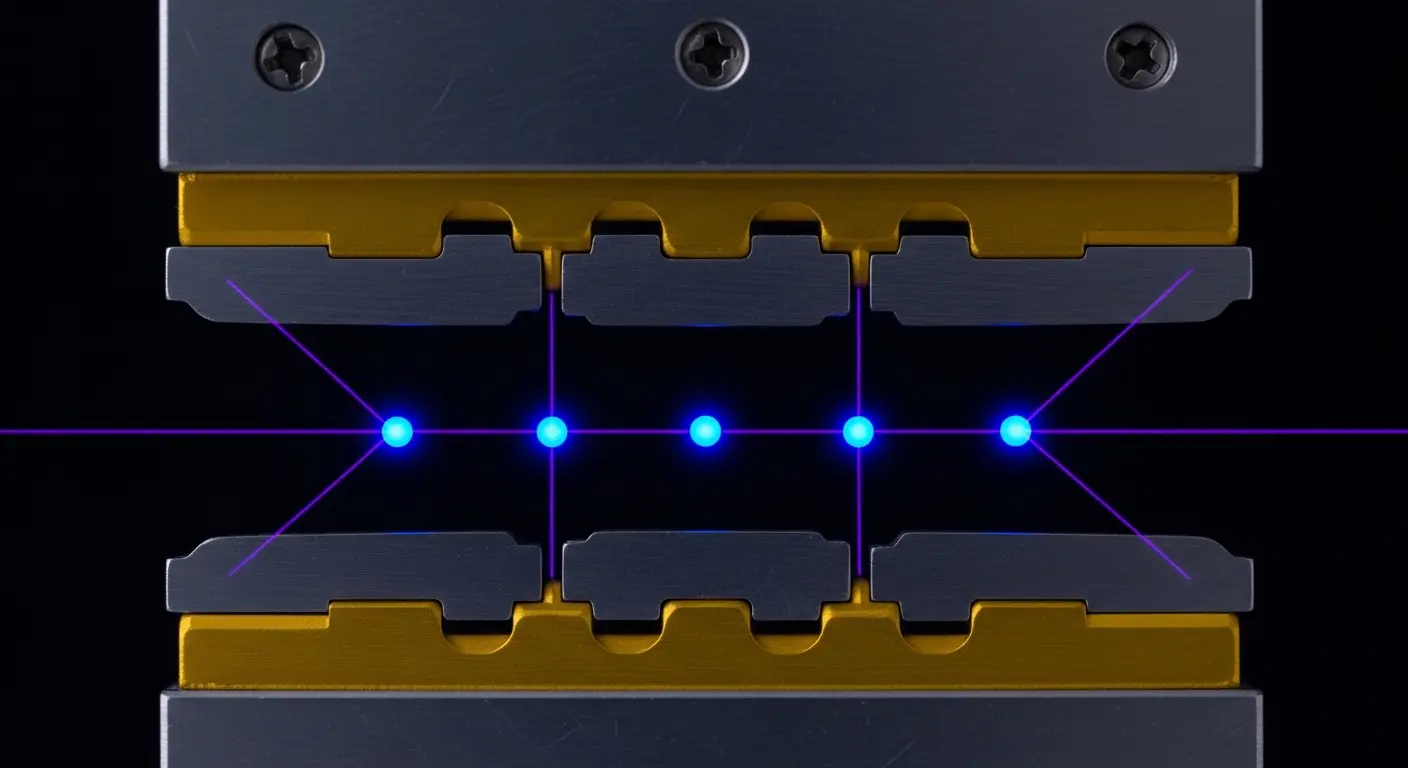
Researchers at the School of Physics, Xi’an Jiaotong University report a novel mechanism for strong coupling in hybrid quantum systems, predicting a nonlinear interaction where two phonons simultaneously interact with a single spin and magnon excitation. This tripartite coupling leverages an electron’s charge, spin, and motional degrees of freedom, moving beyond the typical two-way interactions seen in these systems. The team demonstrates that this setup, combining a trapped electron and a micromagnet, allows for a tunable and strong spin-magnon-motion coupling at the single quantum level. This capability, they say, enables magnons to mediate coupling between the degrees of freedom of two electrons, potentially offering a route to the rapid preparation of few-body entangled states and opening new avenues for quantum simulations and hybrid quantum information processing.
This approach centers on coupling a trapped electron with a micromagnet composed of yttrium iron garnet (YIG), a material chosen for its high spin density. The researchers’ work, submitted May 1, 2026, suggests a pathway to manipulate quantum states with increased control. The researchers at the School of Physics, Xi’an Jiaotong University propose that the YIG micromagnet’s quantized magnetic field mediates the coupling, not only between the magnon and electron spin, but also introduces the electron’s motional states, enabling higher-order interactions. “Building on these mechanisms, we demonstrate a tunable and strongly nonlinear tripartite coupling,” the team reports, a phenomenon previously unobserved in comparable systems. The amplification factor is e to the power of 2r, where ‘r’ represents the strength of the parametric drive. The researchers envision a method for rapidly preparing few-body entangled states, and the proposed scheme requires only minor modifications to existing experimental setups, suggesting a relatively straightforward path toward practical realization and a versatile platform for exploring multipartite interactions.
The pursuit of robust interactions between disparate quantum systems has intensified, with current efforts largely focused on two-way couplings. However, researchers at the School of Physics, Xi’an Jiaotong University are detailing a mechanism that moves beyond this limitation, predicting a nonlinear tripartite coupling within a hybrid quantum system. This simultaneous interaction is particularly noteworthy given the typically minute zero-point fluctuations of motional states, which previously rendered such higher-order couplings negligible. The researchers overcame this challenge by utilizing the substantial zero-point fluctuations inherent in the electron’s motion within a solid neon platform, effectively amplifying the interaction. This amplification is further enhanced through parametric driving, a technique employing a time-dependent electric field to modulate the electron’s confinement potential, resulting in an increase in coupling strength of e to the power of 2r, where r represents the strength of the parametric drive. The implications extend to the creation of entangled states, and the team believes this protocol can be readily implemented with existing technologies in electron traps and quantum magnonics, potentially accelerating progress in the field.
Researchers at the School of Physics, Xi’an Jiaotong University are investigating a method to intricately link the charge, spin, and motion of single electrons, pushing the boundaries of hybrid quantum systems. Their work, submitted May 1, 2026, centers on a setup leveraging an electron trapped above a solid neon surface and coupled to a micromagnetic sphere, a configuration designed to explore previously unrealized quantum interactions. Unlike earlier approaches focused on two-way couplings, this team predicts a nonlinear tripartite coupling mechanism, where an electron’s motional states simultaneously interact with both its spin and the magnons, collective spin excitations, within the micromagnet. This simultaneous interaction, previously unobserved in similar systems, is crucial for enhancing higher-order couplings that have historically been too weak to investigate experimentally.
Their work focuses on harnessing magnons, quantized spin waves, to forge connections between seemingly disparate characteristics of individual electrons. This isn’t simply about observing interaction, but establishing a controlled, multi-faceted coupling that could unlock new avenues for quantum control. This simultaneous interaction is a key differentiator, moving beyond typical two-way interactions in quantum systems. “Magnons mediate effective coupling among four distinct degrees of freedom across two electrons, providing a reliable platform for the preparation and investigation of few-body entanglement,” they state. The potential for creating and manipulating entangled states is central to many quantum technologies.
The pursuit of robust quantum interactions often assumes a two-particle framework, yet nature frequently presents systems where multiple degrees of freedom intertwine. Central to this advancement is the exploitation of the trapped electron’s zero-point motion; the inherent uncertainty in its position, even at absolute zero temperature, dramatically enhances the potential for higher-order interactions. This technique, they predict, exponentially enhances the spin-magnon-motion coupling, with the amplification factor expressed as e to the power of 2r, where r represents the strength of the parametric drive.
The pursuit of robust quantum interactions has led researchers to explore unconventional qubit platforms, and recent work from the School of Physics, Xi’an Jiaotong University details a novel approach leveraging electrons trapped on solid neon or helium surfaces. These eNe and eHe qubits overcome the limited coherence times caused by material defects and background noise in charge qubits, as well as the short coherence times and size reduction challenges in superconducting qubits, and are now at the heart of a proposed hybrid quantum system designed to manipulate interactions at the single quantum level. Researchers are particularly focused on overcoming limitations in realizing direct tripartite coupling, simultaneous interaction between multiple quantum degrees of freedom, a key requirement for advanced quantum simulations. This is enabled by the large spatial extent of the electron’s zero-point motion, allowing for what the researchers describe as a “tunable and strong spin-magnon-motion coupling.” Crucially, the substantial zero-point fluctuations inherent in eNe platforms amplify these higher-order interactions, making experimental investigation more feasible, with magnons acting as the intermediary.
Current approaches frequently involve coupling spins to photons or phonons, but achieving strong, multi-particle interactions remains a significant hurdle. This configuration isn’t simply about whether coupling occurs, but how it happens, with a surprising level of complexity. This is a departure from typical two-way interactions, introducing a more intricate interplay of quantum properties. The spatial gradients and curvature of the magnetic field generated by the magnons are key to this effect, naturally incorporating the electron’s motional states. Parametric driving, achieved by modulating the electron’s confinement potential, further amplifies this coupling, with an exponential enhancement factor of e to the power of 2r, where ‘r’ represents the drive strength.
The microsphere, held in place by a clamping structure, allows for direct coupling via a magnetic stray field, creating a platform for manipulating quantum states. This setup effectively transforms the micromagnet into a nanomagnonic cavity, confining magnonic excitations within extremely small spatial domains.



See today’s quantum computing news on Quantum Zeitgeist for the latest breakthroughs in qubits, hardware, algorithms, and industry deals.