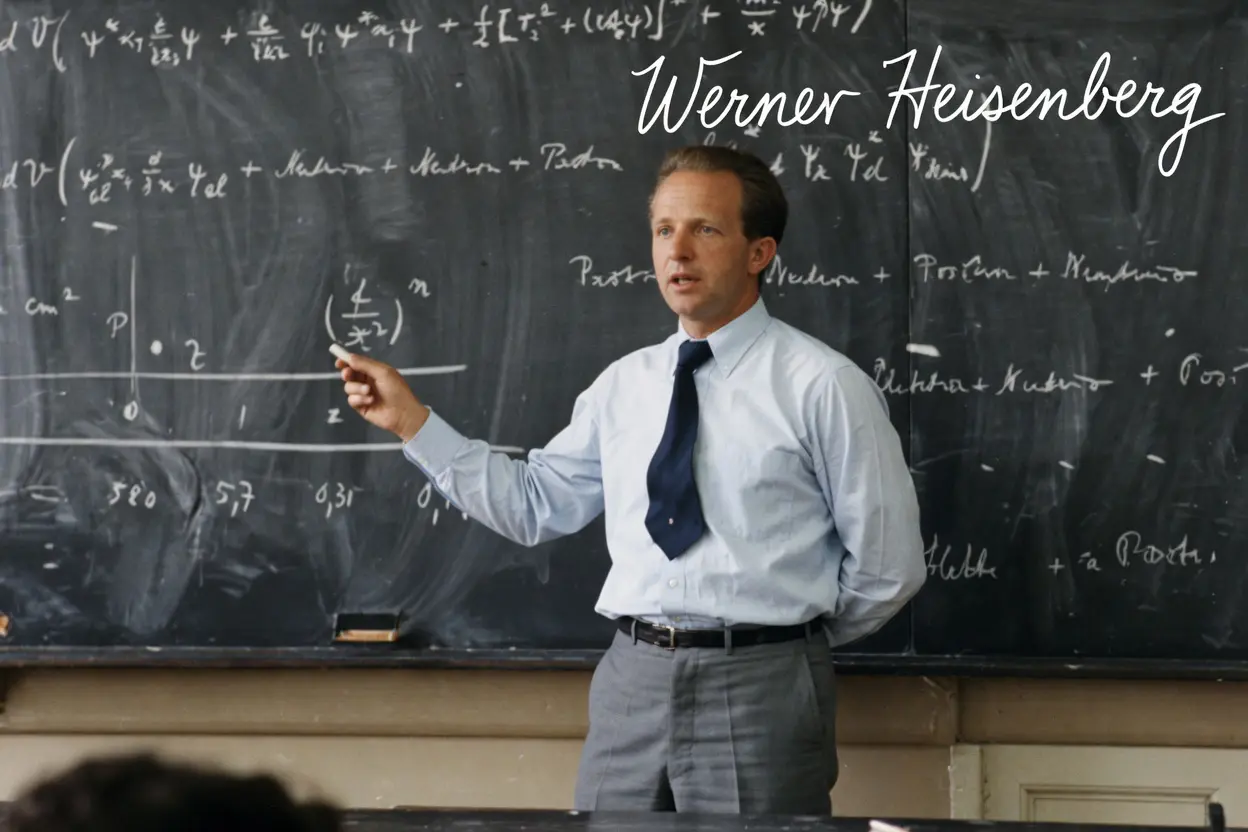
The physicist who built the first quantum mechanics in his twenties and discovered the uncertainty principle, placing a permanent limit on what nature will let us know.
Werner Heisenberg is the physicist who taught the world that there are limits to what can be known. Still in his twenties, he built the first complete version of quantum mechanics and then uncovered the principle that bears his name, the rule that a particle cannot have both a definite position and a definite momentum at the same time. In doing so Heisenberg overturned centuries of confidence that nature was, in principle, perfectly predictable.
This is the story of a dazzling young talent who reshaped physics in a single decade, and of a complicated figure whose later life ran through the darkest chapter of the twentieth century. It covers the breakthrough of matrix mechanics, the uncertainty principle that made Heisenberg famous, his central role in the Copenhagen interpretation, and the lasting questions about his work during the Second World War.
The boy wonder of quantum physics
Werner Heisenberg was born in 1901 in Wurzburg, Germany, into an academic family, and he showed an early brilliance in mathematics and physics. He studied at Munich under Arnold Sommerfeld and then moved into the orbit of Niels Bohr in Copenhagen and Max Born in Gottingen, the two centres where quantum theory was being forged. By his early twenties he was already working at the frontier of the subject alongside the leading minds of the age.
His rise was astonishingly fast. Heisenberg made his decisive breakthrough at twenty three and received the Nobel Prize in Physics for 1932 while still in his early thirties, one of the youngest laureates in the field. Like a handful of others in that extraordinary generation, he did his most revolutionary work before most scientists have finished finding their feet.
Matrix mechanics, the first quantum theory
In the summer of 1925, suffering from hay fever, Heisenberg retreated to the rocky North Sea island of Helgoland to recover, and there he had the idea that changed physics. He decided to stop picturing electrons as little planets orbiting the nucleus and to focus only on quantities that could actually be measured, such as the light atoms emit. The result was a strange new algebra that became known as matrix mechanics.
Working with Max Born and Pascual Jordan, Heisenberg turned this insight into the first complete and consistent formulation of quantum mechanics. It was abstract and unfamiliar, dispensing with any visual picture of what an electron was doing, and some physicists found it hard to accept. Within a year it would be matched by Erwin Schrodinger’s wave mechanics, and the two approaches were soon shown to be mathematically equivalent.
The uncertainty principle
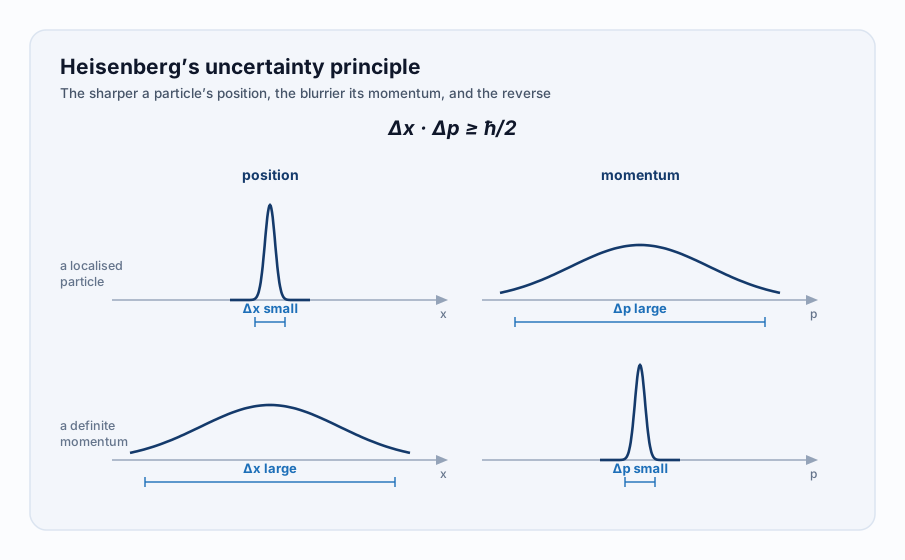
In 1927 Heisenberg published the idea for which he is best remembered, the uncertainty principle. It states that the position and momentum of a particle cannot both be measured precisely at the same time, and that the sharper one quantity becomes, the more uncertain the other must be. The relationship is captured in a simple inequality linking the two spreads to a fundamental constant of nature.
The diagram below shows the trade-off at the heart of the principle. A particle pinned down to a tiny region of space has a wildly uncertain momentum, while a particle with a sharply defined momentum is smeared across a wide region of space. There is no way to escape the bargain, because it follows directly from the wave nature of matter.
What the uncertainty principle really means
It is tempting to read the uncertainty principle as a mere practical limit, the idea that measuring something inevitably disturbs it. Heisenberg himself sometimes described it that way, but the deeper meaning is more radical. The uncertainty is built into nature, not into our instruments, so a particle simply does not possess a precise position and a precise momentum simultaneously.
This was a profound break with classical physics. Isaac Newton’s universe was a clockwork in which, given complete information, the future could be calculated exactly, and the uncertainty principle showed that such complete information can never exist. Heisenberg had placed a permanent fog at the foundations of reality, and physics has been learning to live with it ever since.
Heisenberg, Bohr and the Copenhagen interpretation
Heisenberg worked closely with Niels Bohr in Copenhagen, and together they shaped the dominant way of understanding quantum mechanics, now called the Copenhagen interpretation. In this view there is no point in asking what a particle is doing when nobody is looking, because only the results of measurements are real and meaningful. The theory predicts probabilities, and the act of observation is what turns possibility into fact.
The partnership was intense and sometimes stormy, with Bohr pressing Heisenberg to think harder about the physical meaning of his mathematics. Out of their arguments came the framework that most physicists adopted for the rest of the century. It was a view that Albert Einstein and Erwin Schrodinger never accepted, but that Heisenberg defended for the rest of his life.
The war years and the German bomb
When the Second World War came, Heisenberg remained in Germany and became the leading scientist in its nuclear weapons research, a decision that has been debated ever since. Whether he genuinely tried to build a bomb for the Nazi regime, quietly held the project back, or simply failed to solve the problem, remains a matter of historical argument. His own later accounts were not always consistent.
After the war he and other German physicists were held at Farm Hall in England, where their secretly recorded conversations revealed their surprise at the success of the American effort. The ambiguity of Heisenberg’s wartime role inspired plays and books, most famously Michael Frayn’s Copenhagen, which dramatises a mysterious 1941 meeting with Bohr. The full truth may never be settled.
After the war and the search for unity
In the post-war years Heisenberg helped rebuild German science and led the Max Planck Institute for Physics, training new generations of researchers. He continued to work on fundamental problems, including an ambitious attempt at a unified theory of elementary particles that ultimately did not succeed. His earlier work on the scattering matrix, however, became an important tool in particle physics.
He also wrote widely for general readers, reflecting on the philosophical meaning of quantum mechanics and the relationship between science and the wider culture. Heisenberg had become an elder statesman of physics, his early revolution long since absorbed into the foundations of the subject. He died in Munich in 1976.
The legacy of Heisenberg
The uncertainty principle has long since escaped the physics seminar to become one of the defining ideas of modern thought, a byword for the limits of knowledge. Within science it remains absolutely central, shaping everything from the stability of atoms to the noise limits of the most sensitive measuring devices. Heisenberg’s insistence on dealing only with observable quantities also pointed toward how modern physics is done.
His ideas echo through today’s quantum technologies as well. The same uncertainty that limits measurement is exploited in quantum cryptography, and the matrix mechanics he pioneered is part of the mathematical language of every quantum computer. More than a hundred years after his birth, the world Heisenberg revealed remains as strange and as productive as ever.
Frequently asked questions
Who was Werner Heisenberg?
What is Heisenberg’s uncertainty principle?
What is matrix mechanics?
Did Heisenberg build an atomic bomb for Germany?
Why does Heisenberg matter to quantum computing?



See today’s quantum computing news on Quantum Zeitgeist for the latest breakthroughs in qubits, hardware, algorithms, and industry deals.