

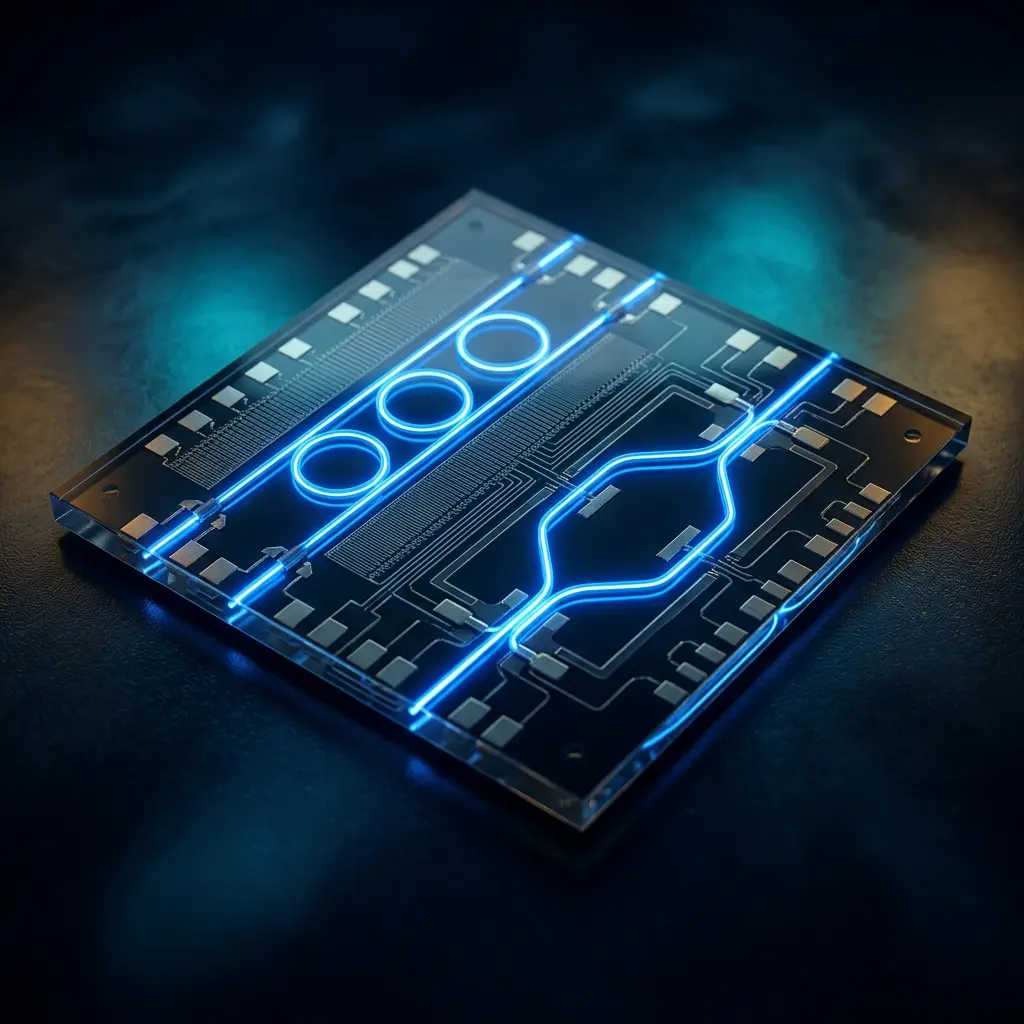
A new method for controlling anomalous Floquet corner responses in a non-Hermitian physical-synthetic photonic lattice has been developed by W. C. Ning and X. Z. Zhang at College of Physics and Materials Science, in collaboration with Tianjin Normal University. The method uses a two-step modulation protocol utilising both real synthetic flux and imaginary gauge fields to manipulate loop interference and non-reciprocal envelopes. It predicts three distinct physical layers within anomalous corner pairs and reveals how complex gauge fields can tune exceptional points, separating topological existence from skin-selected localisation, optical visibility, and two-period dynamics in a non-Hermitian synthetic dimension. Ning and colleagues show that manipulating these parameters enables control over whether a doubled-period optical response is visible, resulting in corner states that can be bright, skin-dark, or flux-dark during local optical measurement.
Decoupling topology from visibility enables independent control of photonic states
A doubled-period optical response, previously requiring strong signal visibility for detection, now exhibits three distinct states: bright, skin-dark, and flux-dark, representing a key advance in photonic control. Separating topological existence from optical visibility was previously impossible, as topological states could be predicted but lacked the means to independently control their manifestation. Manipulating complex gauge fields within a non-Hermitian photonic lattice effectively decouples a system’s inherent topology from how light propagates and is observed.
This new technique utilises a combination of physical space and a ‘synthetic’ frequency, opening new avenues for advanced optical component design and allowing precise control over light’s behaviour. A non-Hermitian Floquet photonic lattice achieves this, combining physical resonator coordinates with a ‘synthetic’ frequency; this artificially created dimension enables light manipulation. The team demonstrated that anomalous corner pairs, appearing at quasienergies zero and π/T, exhibit varying behaviours dictated by the interaction of imaginary gauge fields controlling light accumulation, and a real synthetic flux controlling interference. Furthermore, the complex gauge structure can tune an ‘exceptional point’ in the corner dynamics, altering the response envelope without eliminating the doubled-period signal.
Synthetic Frequency Drift and Resonator Mode Modulation
This work was underpinned by a two-step modulation protocol, carefully organising light’s behaviour within a non-Hermitian photonic lattice; this specially designed structure guides light, allowing for energy loss and gain, creating unusual behaviours. The process began by applying a ‘synthetic-frequency drift’, manipulating light as if it were travelling along an artificially created dimension added to the physical space. Real phases were then used to control how light waves interfere with each other, influencing their overall path.
A one-dimensional array of optical resonators, each supporting multiple frequency modes, was constructed, treating these modes as a synthetic coordinate to create an artificial dimension alongside the physical space. These resonators contained two internal optical modes, acting as carriers for the modulation processes. The two-step modulation protocol then applied a synthetic-frequency drift, followed by flux-threaded internal mixing; these steps utilise both real and imaginary gauge fields to control light behaviour. The system’s architecture includes four corner windows for local optical measurements, enabling analysis of doubled-period responses and the accumulation of right eigenmodes.
Decoupling topology and visibility in photonic lattices for advanced optical control
Controlling how light behaves within complex materials is important for developing new technologies in sensing and signal processing. This research offers a new method for manipulating light’s properties, decoupling topological characteristics from its actual visibility; however, achieving this precise control relies on a carefully constructed non-Hermitian photonic lattice, a system where light can both gain and lose energy. A key limitation lies in scaling up this intricate structure for practical applications, as the current demonstration focuses on a specific, relatively simple arrangement.
Despite the current limitations in scaling up the structure, this work establishes a vital foundation for future advancements in integrated photonics. The ability to independently control topological properties and optical visibility opens doors to designing more sophisticated optical devices, potentially benefitting areas like telecommunications and medical diagnostics. Scientists at [Institution Name] anticipate that first functional prototypes could begin appearing within the decade.
For the first time, scientists at [Institution Name] have demonstrated independent control over a light wave’s fundamental properties within a specially engineered photonic lattice, allowing manipulation of light’s behaviour. This decoupling of topological characteristics, intrinsic properties of a material, from optical visibility represents a key advance, enabling the creation of corner states that appear bright, skin-dark, or flux-dark during observation. Precisely tuning complex gauge fields allowed scientists to manipulate how light accumulates and interferes within the lattice, effectively controlling its observable characteristics.
Scientists demonstrated independent control of a light wave’s properties within a non-Hermitian photonic lattice. This decoupling of topological characteristics from optical visibility allows for the creation of unique corner states exhibiting varied behaviours during observation. By tuning complex gauge fields, researchers manipulated light accumulation and interference, controlling its observable characteristics within the lattice. The work provides a photonic route to separate topological existence, skin-selected localisation, and defective two-period dynamics in a synthetic dimension.
👉 More information
🗞 Complex-gauge control of anomalous Floquet corner responses in a non-Hermitian physical-synthetic photonic lattice
🧠 ArXiv: https://arxiv.org/abs/2606.07038


See today’s quantum computing news on Quantum Zeitgeist for the latest breakthroughs in qubits, hardware, algorithms, and industry deals.



