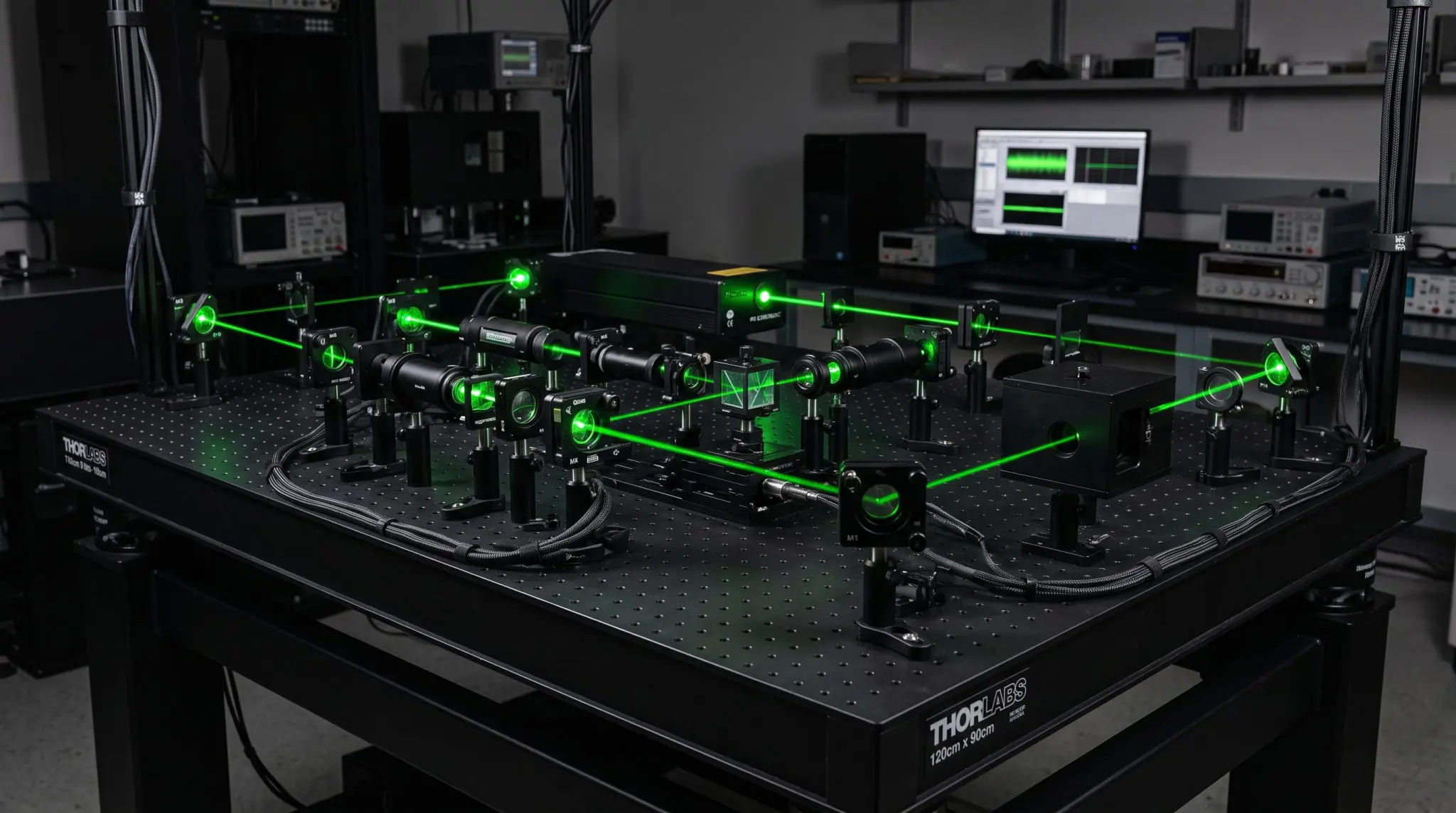
Researchers at the University of Ottawa and their collaborators have created a quantum simulator that runs over 300 distinct quantum processes using only light, bypassing the need for complex electronic hardware. The team leverages three programmable optical screens to sculpt light, replicating the movement of particles within materials and allowing for rapid reconfiguration via software updates. “We program the structure of light the way a musician tunes an instrument,” says Ebrahim Karimi, Full Professor in uOttawa’s Department of Physics. The platform successfully reproduced the signatures of topological materials, an exotic phase of matter crucial for electronics, offering a clearer view of quantum dynamics previously hidden within solid-state devices.
Light-Based Simulation Replicates Complex Material Dynamics
Researchers have devised a quantum simulator utilizing light to model the behavior of particles within complex materials, circumventing the limitations of traditional electronic hardware. The University of Ottawa team, collaborating with Federico II University in Italy, employs three programmable optical screens, spatial light modulators, to sculpt light beams, effectively replicating electron movement inside crystalline structures. This innovative approach allows for rapid reconfiguration of experiments via software updates, enabling the simulation of diverse materials without physical alterations to the optical setup. The simulator’s versatility is demonstrated by its successful execution of over 300 distinct quantum processes, distributing a single input beam across thousands of output channels. The platform accurately reproduced the characteristics of topological materials, an area of condensed-matter physics where internal geometry shields electrons from external disturbances, crucial for advancements in electronics.
Dr. Alessio D’Errico, senior research associate, explains, “Topology is a current focus in condensed-matter physics, but measuring its effects directly is notoriously hard,” adding that the optical platform allows for real-time observation of these effects. Beyond two-dimensional grids, the system simulates particle motion on complex geometries like toruses and cylinders, replicating features of advanced quantum materials rarely achieved in photonic experiments. This capability, coupled with the direct visualization of quantum evolution through photography, provides an improved level of clarity in studying quantum dynamics.
Topology is a hot topic in condensed-matter physics, but measuring its effects directly is notoriously hard.
Dr Alessio D’Errico, senior research associate at Prof.
Central to this innovation are three programmable optical screens, known as spatial light modulators, which manipulate the properties of photons to mimic the behavior of particles within materials. This allows for rapid experimentation, as the entire simulation can be altered with a simple software update, a level of adaptability previously unavailable in condensed matter physics research, according to Alessio D’Errico, senior research associate.
We program the structure of light the way a musician tunes an instrument.
This capability is enabled by three programmable optical screens, or spatial light modulators, which allow for rapid alteration of experimental parameters via software updates, offering an advantage over conventional material science setups. The simulator’s ability to model topological materials is particularly noteworthy, as these phases of matter hold promise for electronics but are notoriously difficult to study directly, as Alessio D’Errico, senior research associate, highlights. This advancement allows researchers to directly observe quantum effects unfolding in real time, captured via standard cameras, providing a clarity previously unavailable in solid-state device analysis.
We’ve essentially turned light into a controllable laboratory for quantum matter studies.
Professor Karimi