

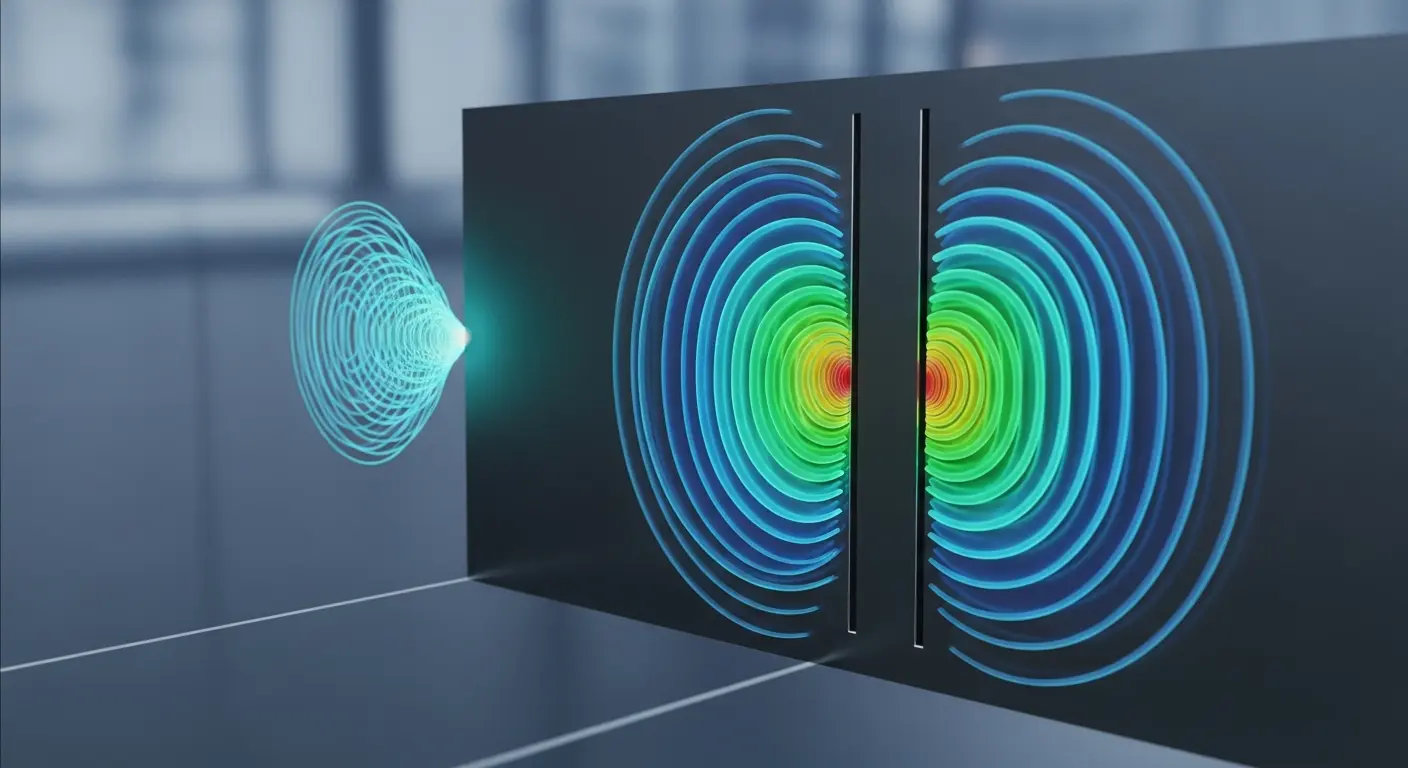
Tulane University researchers have simplified the creation of superoscillations, achieving a twofold enhancement in local frequency using only two harmonic frequencies, a feat previously achieved with four harmonics. The team reanalyzed existing data and conducted new experiments in the terahertz range, demonstrating that frequencies of approximately 0.5 THz and 0.6 THz, and 0.55 and 0.6 THz, when combined, produce superoscillations of comparable quality to more complex setups. This simplification relies on near-complete destructive interference between the frequency components, balancing enhancement with signal strength and identifying an optimal frequency separation of approximately 0.1 THz. This work lowers the experimental barrier to implementing superoscillation-based technology.
Two-Harmonic Synthesis of Terahertz Superoscillations
Superoscillations, band-limited signals exhibiting faster-than-expected local oscillations, are rapidly becoming a tool for advanced sensing and spectroscopy. Recent work demonstrates a simplification in their creation, requiring only two harmonic frequencies instead of the previously established four. Researchers at Tulane University have demonstrated that this reduction in complexity does not compromise the quality of the superoscillation, achieving a comparable twofold enhancement in local frequency, a key metric for performance. This advancement promises to broaden the accessibility of superoscillation-based technology, potentially impacting fields from materials science to medical imaging.
Through meticulous minimization of a cost function designed to optimize signal intensity within a defined time window, they observed a consistent doubling of local frequency within the superoscillating region. Figures presented in the research visually confirm this enhancement, showing a clear deviation in the combined waveform’s frequency compared to its individual components. The paper details the parameters explored during the analysis. This careful control over frequency separation is crucial, as the researchers discovered an optimal balance between maximizing frequency enhancement and maintaining sufficient signal amplitude for reliable detection. The underlying principle behind this simplified approach lies in near-complete destructive interference between the two frequency components. The researchers developed a simple analytical explanation, demonstrating that as the frequency difference between the two harmonics diminishes, the local frequency of the combined signal increases, approaching a twofold enhancement.
However, this comes at a cost; reducing the frequency separation also weakens the overall signal strength. The study highlights this trade-off. They found that an optimal frequency separation of approximately 0.1 THz provides the best balance, allowing for a strong superoscillatory signal with a significantly enhanced local frequency.
Local Frequency Enhancement in Superoscillatory Signals
Researchers at Tulane University are refining the creation of superoscillatory signals, a development that could broaden the application of this technology beyond fundamental research. A simplified approach utilizing just two harmonics delivers comparable results, streamlining the experimental setup and potentially accelerating the deployment of superoscillation-based technologies. This finding is significant because it challenges the assumption that complexity is essential for generating robust superoscillations. However, this enhancement is not without trade-offs; the amplitude of the superoscillation weakens as the frequencies converge. The researchers explain in their published work that “the closer the frequencies, the closer the function comes to exhibiting two oscillations within the superoscillating region.” This reduction in harmonic requirements has practical implications. Previous demonstrations of superoscillation-based technologies, such as superspectroscopy, did not explicitly demonstrate enhanced sensitivity in material analysis and relied on intricate experimental setups.
By reducing the number of necessary THz generation channels and optical components, this new approach promises to make superoscillation-based spectroscopy and sensing considerably more accessible. The team anticipates that the super-sensing advantages previously demonstrated can be retained with a significantly simpler and more cost-effective system. All codes and data used in this study can be found in Ref. [14].
Experimental Implementation with PPLN and THz Detection
The pursuit of increasingly sensitive detection methods has led researchers to explore superoscillations, and a recent simplification promises to broaden access to this technology. While previous demonstrations of temporal superoscillations relied on combining four distinct frequencies, a team at Tulane University has shown that comparable results can now be achieved with just two, significantly streamlining experimental setups. This advancement, detailed in their recent work, centers on the generation and detection of terahertz (THz) radiation using periodically poled lithium niobate (PPLN) crystals. These frequencies were generated via optical rectification, a process where focused laser pulses interact with the PPLN, and detected using free-space electro-optic sampling with zinc telluride crystals.
By carefully adjusting the time delays between the two THz waveforms, the researchers minimized a specific cost function, ultimately synthesizing superoscillations. Their analysis reveals that as the frequency separation approaches approximately 0.1 THz, the superoscillating region exhibits increasingly rapid oscillations. This balance is crucial for practical applications. As the team points out, four-color superoscillations have already demonstrated the potential for a 100-fold contrast enhancement in linear THz time-domain spectroscopy.
👉 More information
🗞 Synthesizing superoscillations with just two frequencies
✍️ Denys I. Bondar and Diyar Talbayev
🧠 ArXiv: https://arxiv.org/abs/2607.19542




See today’s quantum computing news on Quantum Zeitgeist for the latest breakthroughs in qubits, hardware, algorithms, and industry deals.



