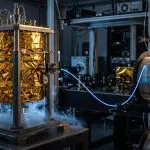
Researchers at TU Wien have, for the first time, detected a high degree of quantum entanglement within a centimetre-sized crystal of a strange metal. The team evidenced this effect using the quantum Fisher information, establishing a new method to quantify quantum entanglement directly within a macroscopic material.
“Our approach is different,” says Prof. Silke Bühler-Paschen from the Institute of Solid State Physics at TU Wien, “We do not try to bring the crystal as a whole into a superposition of two states. Instead, we ask whether its constituents are, collectively, in such a state of entanglement.” This work, referencing Erwin Schrödinger’s famous thought experiment, demonstrates quantum effects can occur in objects far larger than individual atoms or photons.
Quantum Fisher Information Quantifies Entanglement in Strange Metals
Researchers used theoretical work originally developed by physicist Peter Zoller and his team at Innsbruck demonstrating the applicability of quantum Fisher information to large many-body systems. “The quantum Fisher information quantifies how sensitively a quantum system responds to a change,” explains Silke Bühler-Paschen of TU Wien, highlighting the method’s ability to detect subtle quantum effects. This discovery builds on investigations into strange metals, materials exhibiting unusual electronic properties also found in high-temperature superconductors.
The team’s analysis revealed a direct link between strong entanglement and the atypical behaviour observed in these materials; “What we see here is not a detail of one particular material, but a general physical principle,” states Fakher Assaad, lead theorist on the project. Unlike a system of independent particles, the collective response amplified by entanglement allows for a heightened sensitivity to external changes, a characteristic the researchers successfully measured using the quantum Fisher information.
In a normal material, Assaad notes, “one would expect a neutron to transfer its energy to an individual particle,” but this crystal demonstrates a fundamentally different interaction. The success of this approach, employing tools from quantum information science to study solid-state physics, confirms the potential for cross-disciplinary insights.
The researchers are now exploring potential applications of strange metals in quantum technologies, specifically in high-precision measurements for quantum metrology; “We want the transfer of knowledge between the two fields to also work in the other direction,” Bühler-Paschen adds. This work not only demonstrates entanglement in a macroscopic object but also opens avenues for harnessing its properties in future quantum devices.
The quantum Fisher information quantifies how sensitively a quantum system responds to a change.
Bühler-Paschen, Institute of Solid State Physics at TU Wien
Neutron Scattering Reveals Collective Response in Cerium-Palladium-Silicon Crystal
The cerium-palladium-silicon crystal exhibited a collective response to neutron bombardment, defying expectations for typical metallic behavior. PhD student Federico Mazza at the Institut Laue-Langevin in Grenoble directed neutrons at the crystal, expecting energy transfer to single particles, but the resulting data indicated a far more coordinated reaction within the material. This coordinated response is directly linked to strong entanglement within the strange metal, according to the team at TU Wien.
Unlike conventional materials where a neutron interacts with a single particle, the crystal’s entangled state amplifies the response, allowing for a sensitivity far exceeding that of a system of independent particles. The quantum Fisher information served as the key analytical tool, quantifying this sensitivity and providing evidence for the entanglement itself.
“The results are a great success for us,” Bühler-Paschen added, emphasizing the significance of observing this quantum phenomenon in a macroscopic object. This approach, focusing on collective behavior rather than individual particle superposition, offers a new pathway for investigating quantum effects in materials and potentially harnessing them for technological applications, moving beyond the limitations of studying isolated quantum systems.
In a normal material, one would expect a neutron to transfer its energy to an individual particle.
Federico Mazza, PhD student at ILL




See today’s quantum computing news on Quantum Zeitgeist for the latest breakthroughs in qubits, hardware, algorithms, and industry deals.