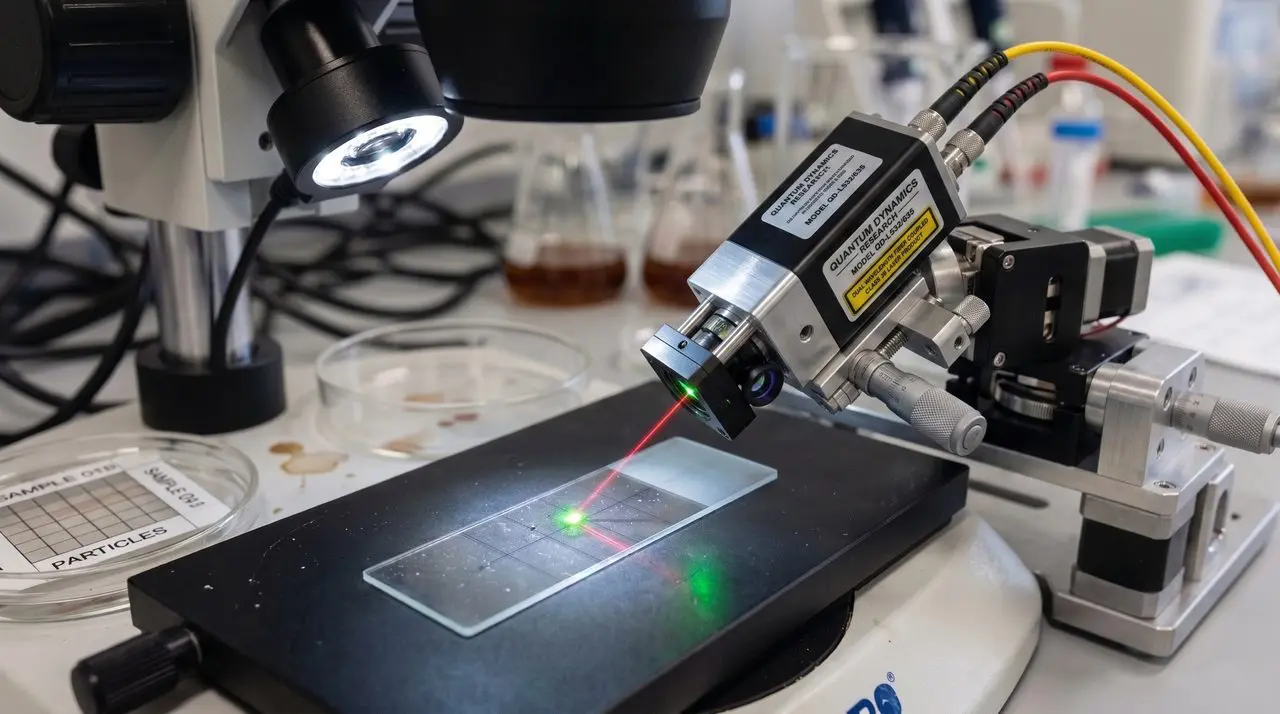
TU Wien, collaborating with the University of Vienna, JKU Linz, and the University of Innsbruck, is building an electron microscope integrated with a quantum computer, a combination not previously achieved, the company says. Researchers are aiming to extract and utilize the quantum information carried by electrons, potentially reducing the number needed for imaging sensitive samples like individual proteins.
“Today, we can image tiny details on the atomic scale,” says Philipp Haslinger from the Institute of Atomic and Subatomic Physics at TU Wien, “However, this requires a large number of electrons. And not every sample can be exposed to so many electrons without being damaged.” The new technology promises to achieve atomic-scale resolution without the damage caused by conventional electron microscopes’ high electron counts.
Electron-Ion Interaction Enables Quantum Information Extraction
The ability to create quantum entanglement between electrons and ions represents a core innovation driving a new generation of electron microscopes currently under construction at TU Wien. “Our idea is to combine the electrons with a quantum computer,” explains Iva Březinová from Theoretical Physics at TU Wien, “This interaction establishes a shared quantum state, allowing for significantly more data extraction from fewer particles. What would previously have been indistinguishable from random noise can thus become a clear signal.” The resulting system promises to overcome statistical limits inherent in classical electron microscopy.
Thomas Juffmann from the University of Vienna adds, “It is exciting that, within the quantA Cluster of Excellence, we can combine the expertise in quantum information, quantum computing and electron microscopy available at the different universities in Austria. This allows us to launch a unique project.”
It is really exciting that, within the quantA Cluster of Excellence, we can combine the expertise in quantum information, quantum computing and electron microscopy available at the different universities in Austria. This allows us to launch a unique project.
Thomas Juffmann, University of Vienna
Quantum Algorithms Optimize Signal Strength in Microscopy
The integration of a quantum computer directly into an electron microscope is redefining signal processing in materials science and biology. Each electron, traditionally used solely for counting, now carries untapped quantum information. This advancement is particularly crucial for imaging sensitive samples susceptible to damage from high-energy electron beams. By entangling electrons with ions held within the microscope, researchers can create a shared quantum state, amplifying signal strength.
Algorithms developed with Johannes Kofler’s team at JKU Linz are central to this process, enabling the extraction of data previously lost as noise. The theoretical advantages of this method are now transitioning to experimental validation, with an ion-based quantum computer from the University of Innsbruck being integrated into the transmission electron microscope at TU Wien’s University Service Centre.
The electrons themselves are used to image small objects, just as in any other electron microscope. But by processing the quantum information carried by these electrons in a quantum computer, we can extract significantly more information from the process.
Iva Březinová, Institute for Theoretical Physics at TU Wien
See today’s quantum computing news on Quantum Zeitgeist for the latest breakthroughs in qubits, hardware, algorithms, and industry deals.