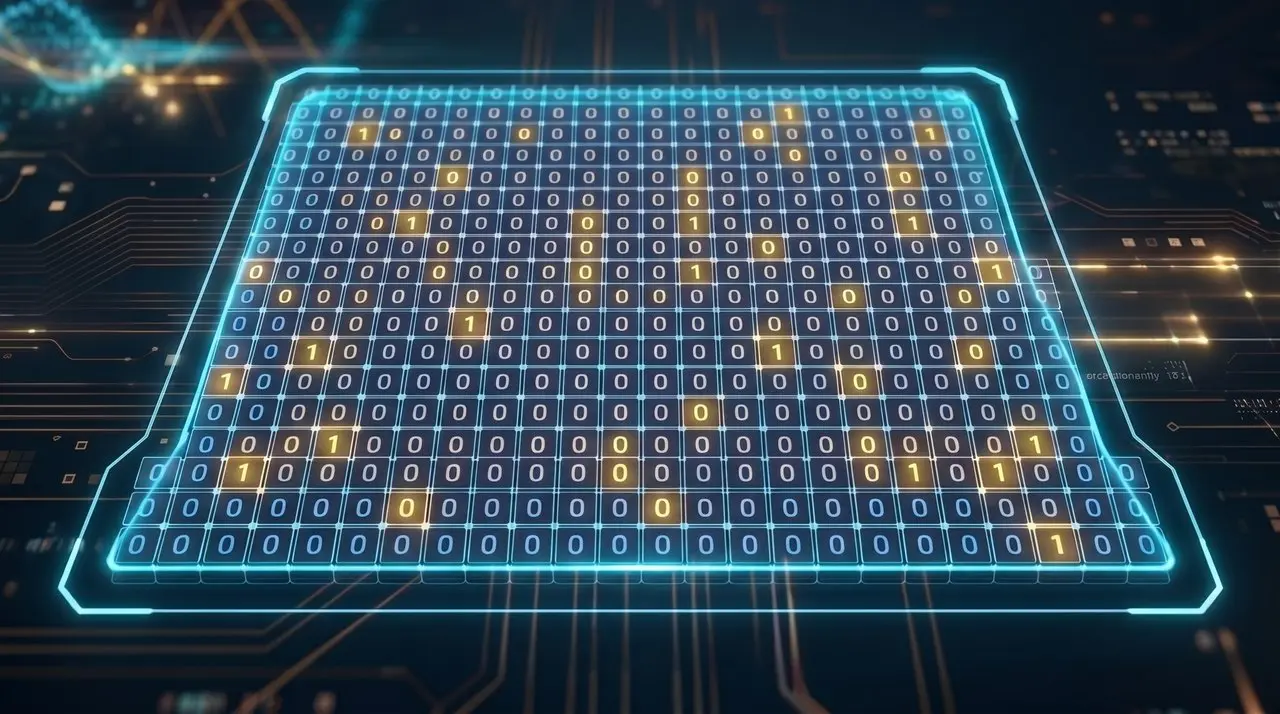
A new quantum communication protocol combines established methods for transmitting information with key error protection. The approach integrates classical error-control coding, techniques used to correct transmission mistakes, alongside entanglement distribution and superdense coding; superdense coding encodes multiple bits onto single quantum particles called qubits. Kristian Skafte Jensen, René Bødker Christensen, Čedomir Stefanović, and Petar Popovski developed the system to improve reliability in practical channels prone to signal loss and noise.
A new method transmits information using both conventional techniques and principles of quantum mechanics by combining established methods for correcting transmission errors with concepts like entanglement and superdense coding. Entanglement is a phenomenon where two particles become linked and share the same fate regardless of distance; superdense coding efficiently encodes multiple bits onto single quantum particles called qubits. The new method enables reliable quantum communication that blends traditional error-correction with cutting-edge techniques such as entanglement distribution and superdense coding.
This approach is particularly suited for shorter distances within Quantum Local Area Networks (QLANs). Entanglement can be likened to two particles linked together so they share the same fate, measuring one instantly reveals information about the other, regardless of how far apart they are. The team’s protocol uses classical error-correcting codes to combat issues like spurious signals, akin to static on an old radio, and signal loss during transmission by strategically encoding data not only through qubits but also in their very presence or absence.
Enhanced Quantum Data Transmission via Integrated Error Correction and Superdense Coding
A quantum communication system has now exceeded established upper bounds for conventional superdense coding; optimised code configurations within this novel protocol achieve higher data rates and improved energy efficiency under identical error frequency constraints. This breakthrough resolves limitations previously hindering performance in practical quantum channels where existing methods simultaneously compromised these metrics. The approach integrates classical error-correcting codes with entanglement distribution and superdense coding, a technique encoding multiple bits onto single quantum particles called qubits, to combat errors stemming from dark counts and photon losses during transmission.
Optimised configurations within the integrated quantum communication system achieved improvements in both data rate and energy efficiency given equivalent levels of transmission errors. Conditions ensuring successful error correction under realistic scenarios, those with bounded error frequencies, have been derived; this demonstrates that the new protocol exceeds established upper bounds on data throughput and power consumption when subjected to identical constraints. Encoding data not only within individual qubit properties but also through their precise timing during transmission created redundancy against errors caused by spurious signals and photon loss.
Entanglement integration boosts secure short-range quantum communications
The continuing demand for secure communication drives innovation in quantum technologies, and this new protocol offers a pathway towards stronger short-distance links vital for emerging applications such as on-site quantum data centres and networked processors within larger systems. Its current suitability is restricted to relatively brief distances mirroring those found in Quantum Local Area Networks (QLANs). Directly integrating entanglement distribution, the process where two particles become linked regardless of distance, into communication improves both speed and efficiency within contained systems like data centres or between processors. By combining classical error correction with techniques including entanglement distribution and superdense coding, signal degradation can be combatted. A novel method now exists for strengthening reliability in these short-distance quantum communication links, offering gains in both data throughput and energy efficiency compared to methods relying solely on quantum channels; acknowledging its range limitations to QLANs does not diminish its importance for specific applications.
The research demonstrated a new quantum communication protocol that enhances data rate and energy efficiency under conditions mirroring those found in Quantum Local Area Networks. This approach exceeds previously established upper bounds for performance when subjected to similar levels of transmission error, providing more reliable short-distance links. The authors evaluated different code configurations using a physical error model based on factors like fibre attenuation and detector efficiency.
👉 More information
🗞 Classical Communication Protocol based on Joint Classical-Quantum Coding
✍️ Kristian Skafte Jensen, René Bødker Christensen, Čedomir Stefanović and Petar Popovski
🧠 ArXiv: https://arxiv.org/abs/2609.16938
See today’s quantum computing news on Quantum Zeitgeist for the latest breakthroughs in qubits, hardware, algorithms, and industry deals.