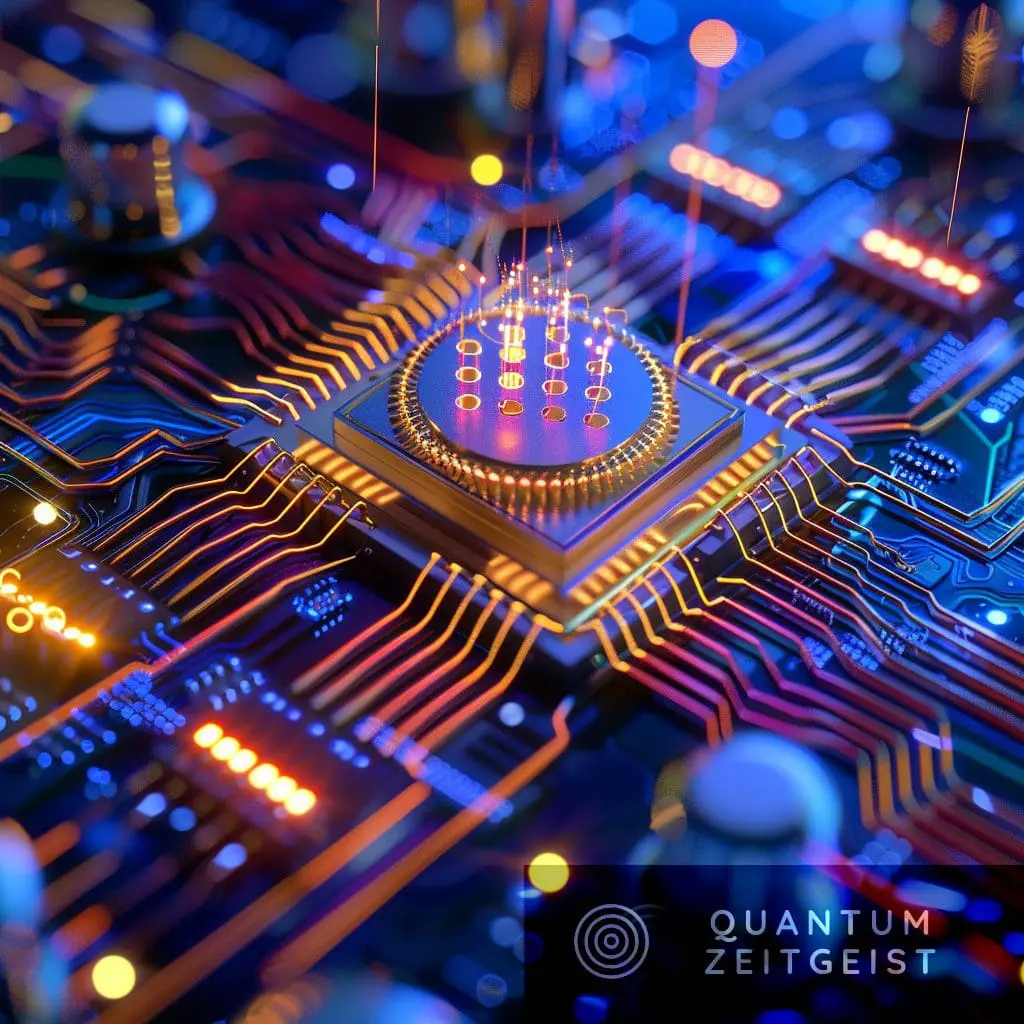
Superconducting qubits are crucial for quantum computing, allowing for faster information processing. However, their development comes with stringent technical requirements, including a high coherence-time-to-gate-time (CT2GT) ratio. Over the past two decades, superconducting qubits have seen significant improvements, but challenges remain, including losses from various sources and the need for very weak coupling to the qubit. Recent developments have shown promise in addressing these issues, particularly the introduction of on-chip filters for subharmonic driving in two-dimensional qubit schemes. These filters isolate the qubit from the drive line at its resonance frequency, improving the CT2GT ratio and reducing thermal noise.
What is the Significance of Superconducting Qubits in Quantum Computing?
Superconducting qubits are a critical component in the development of quantum computers. These qubits, or quantum bits, are the fundamental units of information in quantum computing. They are capable of existing in multiple states simultaneously, which allows quantum computers to process information at a much faster rate than traditional computers. However, the physical realization of a universal, useful quantum computer comes with very stringent technical requirements, including those summarized in the DiVincenzo criteria. One such requirement is a high coherence-time-to-gate-time (CT2GT) ratio, which ensures that the physical system representing a qubit stores the encoded information with high fidelity until the execution of the assigned task.
How are Superconducting Qubits Improved?
Superconducting qubits have exhibited remarkable progress over the past two decades, with relaxation times extending from a few nanoseconds to nearly a few milliseconds. The quest for further improvement of the coherence time is still ongoing. Alternatively, gates can be sped up to further improve the CT2GT ratio. However, this requires strong external coupling of the qubit to the drive line, which inadvertently decreases the coherence of the qubit, thereby posing a significant trade-off. The coherence times of a qubit are influenced not only by the external coupling but also by intrinsic losses, which in properly designed qubits represent the primary loss mechanism, thus limiting the qubit performance.
What are the challenges in improving superconducting quotas?
These losses arise from various sources such as the presence of two-level-system defects near the qubit, associated with dielectric losses and quasiparticle tunneling. Remarkable progress has been made in understanding and mitigating these internal losses through the implementation of high-coherence materials, fabrication recipes, and improved qubit geometry. However, engineering very weak coupling to the qubit can increase the CT2GT ratio, but it will impose a significant heat load on the dilution refrigerators that house the qubit and especially on the attenuators that provide an electromagnetic environment for the qubit. To minimize the corresponding thermal noise reaching the qubit, attenuators are placed at multiple stages of the dilution refrigerators.
What are the recent developments in superconducting quotas?
Recent progress has shown promise in addressing the challenge of simultaneously achieving fast control and long coherence time. However, the approach raises concerns of quasiparticle generation due to the saturation of the Josephson junction employed in the qubit drive line at high power levels. Another important work utilizes a novel way to drive a three-dimensional transmon qubit by subharmonics of the qubit resonance. The nonlinearity of the qubit upconverts the drive at one-third of the qubit frequency to the qubit frequency in the spirit of three-wave mixing.
How does the introduction of on-chip filters improve superconducting quotas?
This work introduces designs and implementations of on-chip filters for subharmonic driving in two-dimensional qubit schemes. The on-chip filters are devised to fully isolate the qubit from the drive line at its resonance frequency while establishing two orders of magnitude stronger coupling at the subharmonic frequency compared to standard drive lines. This result enables fast single-qubit gates via subharmonic drive while demonstrating the T1-limit owing to the external coupling of milliseconds, thereby substantially improving the corresponding CT2GT ratio. The introduced on-chip filters facilitate the use of over 60 dB of attenuation in the control lines to ensure a thermal noise photon below 2 5*10^-3.
integrated on-chip filters”
Publication Date: 2024-02-13
Authors: Aashish Sah, Suman Kundu, Heikki Suominen, Qiming Chen et al.
Source: arXiv (Cornell University)
DOI: https://doi.org/10.48550/arxiv.2402.08906



See today’s quantum computing news on Quantum Zeitgeist for the latest breakthroughs in qubits, hardware, algorithms, and industry deals.