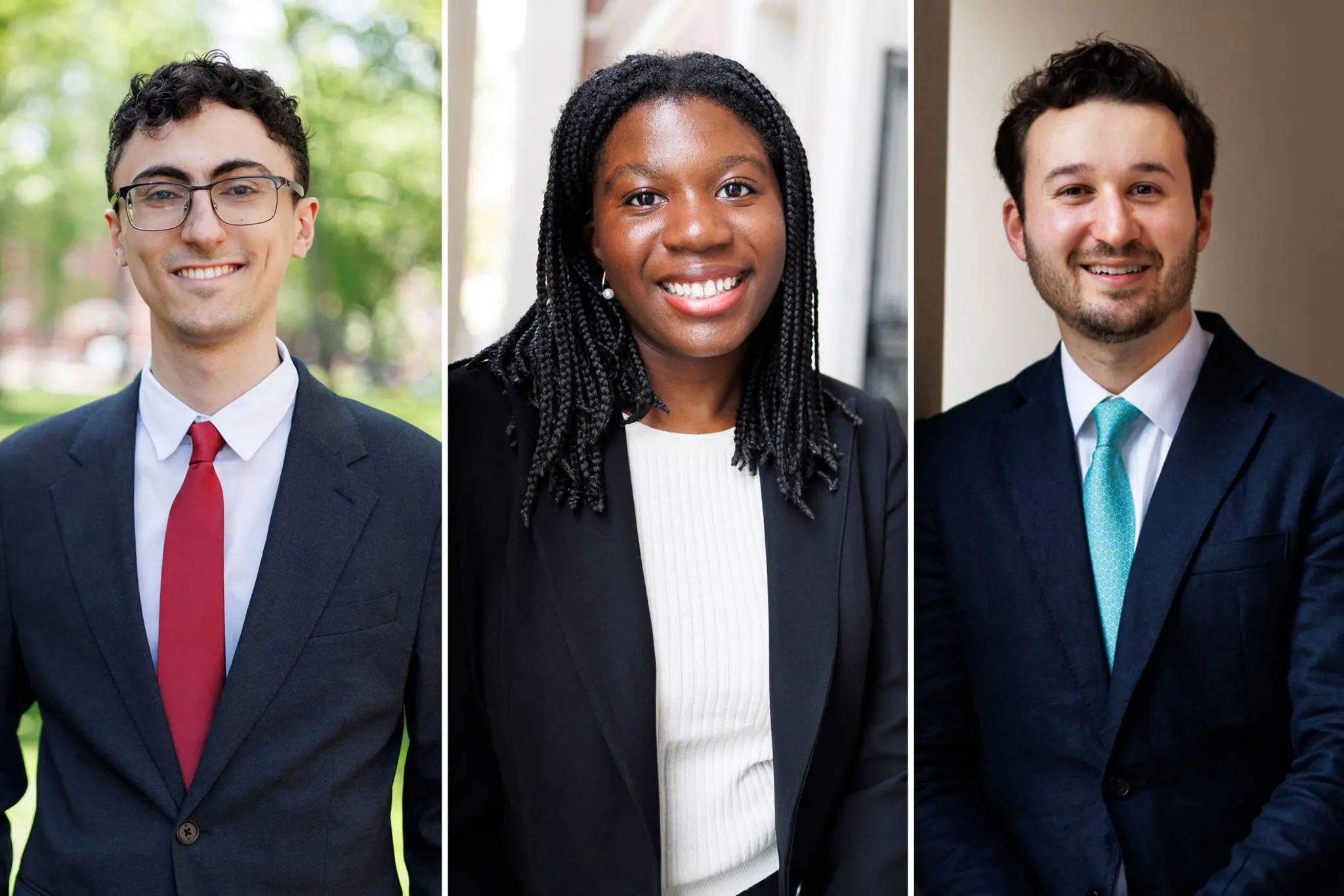
Harvard’s 375th Commencement will feature Kiesse Nanor delivering the Latin Salutatory, a distinction earned through University-wide competition and rooted in a fascination with ancient narratives that began in her youth. Nanor’s interest was first sparked at age 12 with Gregory Nagy’s “The Ancient Greek Hero in 24 Hours,” leading her to analyze stories and heroism in a new way. Rather than continue with French, a language spoken at home, Nanor chose to study Latin at Phillips Exeter Academy, captivated by its structure and layered meanings. Having studied Nagy’s work for six years, she recalls being starstruck encountering him as a student at Harvard, and ultimately focused her studies on the connections between ancient texts, culminating in a thesis written in Ancient Greek. “Taking stories and looking at them as something that can be analyzed really productively,” she said, has shaped her academic path and will now inform her address to the graduating class.
Nanor’s Classical Studies Connect Ancient Texts to Modern Relevance
Kiesse Nanor, selected to deliver the Latin Salutatory at Harvard’s 375th Commencement, embodies a rare convergence of classical scholarship and contemporary insight, demonstrating how the study of ancient texts can illuminate modern challenges. This early exposure fostered a commitment to understanding narratives not merely as entertainment, but as complex reflections of human values and societal structures. “I’d never encountered a language that was so grammatically precise,” she explained, highlighting the appeal of Latin’s layered implications and the analytical rigor it demanded. This preference wasn’t simply about linguistic mechanics; it signaled a deeper attraction to a system where meaning was meticulously constructed and subtly conveyed. Her engagement extended beyond translation, as she actively participated in the Classics Club, fostering discussions that enriched her understanding of the texts.
These Friday evening meetings impacted her social life, but provided a crucial forum for collaborative interpretation and intellectual exchange. At Harvard, Nanor’s academic journey continued with the course that initially inspired her, taught by Nagy himself. “I sat in the first row of the Gen Ed course, like, ‘Oh my gosh, this is the professor whose book I’ve read for the past six years!’” she recounted, emphasizing the profound connection she felt to both the scholar and the subject matter. The small size of the Classics department facilitated close mentorship and collaborative research, allowing Nanor to explore the deep connections between ancient texts and their enduring relevance. She broadened her academic scope by adding an economics concentration, especially enjoying learning about the incentives and reasoning that drive human decision-making, a pursuit that complements her classical studies by offering a different lens through which to examine human behavior.
Nanor’s commitment to classical languages extends to her senior thesis, a bold undertaking written in Ancient Greek. Focusing on the poets Sappho and Alcaeus, she challenged conventional interpretations that rigidly categorize their work, arguing that a binary division of their themes, war and politics for Alcaeus and women loving women for Sappho, oversimplifies their poetic relationship and obscures their shared complexity. In her Commencement oration, Nanor intends to convey the enduring value of these ideas. “These are things that have real relevance and still resonate with people today,” she said, hoping to demonstrate that the insights gleaned from ancient texts remain powerfully applicable to contemporary life, a sentiment she believes would delight her 12-year-old self.
O’Donohue’s Research Examines Courts’ Impact on Global Democracy
Andrew O’Donohue’s research offers a critical reassessment of the role courts play in sustaining, or undermining, democratic principles globally, moving beyond the conventional view of judicial bodies as automatic defenders of liberty. His work, stemming from doctoral studies at Harvard, challenges the long-held assumption that the United States possesses a universally applicable model for democratic governance, instead advocating for a reciprocal learning process between nations. O’Donohue’s investigations began with a formative experience interning in Turkey in 2016, witnessing firsthand the fragility of democratic institutions during a failed coup attempt and the subsequent political purges. This event sparked a desire to understand why democracies appear increasingly vulnerable worldwide and what measures can be taken to safeguard them. Rather than focusing solely on legal frameworks, O’Donohue’s approach centers on the complex interplay between courts, political actors, and civil society.
He argues that courts are not neutral arbiters, but rather institutions deeply embedded within political landscapes, susceptible to manipulation and influence. “The traditional model of thinking about democracy was that we, the United States, have lessons to share with the rest of the world,” O’Donohue explained, highlighting his shift toward a comparative perspective. His dissertation, based on extensive interviews with judges from Turkey’s Constitutional Court and Israel’s Supreme Court, alongside analysis of thousands of court decisions, reveals how politicians can subtly bend judicial processes to their will. This research demonstrates that the effectiveness of courts in upholding democracy depends heavily on external support from allies, protestors, and engaged political actors. O’Donohue’s findings suggest that a robust democracy requires more than simply a functioning judicial system; it demands active participation from a broad range of stakeholders.
He discovered that courts rely on these external forces to enforce rulings and maintain legitimacy, a dynamic often overlooked in traditional analyses. The forthcoming publication of his dissertation as a book, supported by fellowships at Princeton University and the Carnegie Endowment for International Peace, promises to offer a nuanced understanding of the conditions necessary for judicial independence and democratic resilience. O’Donohue’s perspective extends to the importance of civic engagement within academic institutions, particularly in times of political polarization. He observed a recent trend among students toward disengagement from civic life, manifested in declining participation in leadership roles and reluctance to express opinions publicly. “Our universities and our democracy depend on one another,” he asserts in his Commencement oration, emphasizing the crucial link between academic freedom and democratic principles. He argues that even seemingly minor acts of participation, such as signing petitions or holding leadership positions, are vital for maintaining a healthy democracy, and that a withdrawal from these activities can erode the foundations of a free society.
You have to think about ways of coming up with solutions that work for everyone.
Eckstein Integrates Musical Pursuits with Physics Studies
Noah Eckstein’s path to a Harvard degree demonstrates a deliberate integration of seemingly disparate fields, a strategy increasingly common among students seeking interdisciplinary approaches to complex problems. Eckstein’s commitment to both music and physics wasn’t a matter of casual interest; it fundamentally shaped his academic choices, culminating in a concurrent master’s program alongside his bachelor’s degree. Initially drawn to classical guitar at age five, Eckstein continued lessons even as he discovered a passion for physics during his freshman year of high school, a subject he embraced despite a challenging start. Eckstein recalled highlighting the initial hurdles overcome in his pursuit of scientific understanding. This dedication led him to Harvard College specifically because of the Harvard-Berklee Joint Studies Program, a unique opportunity to formally combine musical study with rigorous physics coursework.
Before beginning his undergraduate studies, Eckstein took physics courses at his local community college in Bedford, Texas, demonstrating a proactive approach to his education. The pivotal moment arrived during his first semester with Physics 19, a course that solidified his commitment to the field and introduced him to Jacob Barandes, a senior preceptor who became a crucial mentor. “Jacob has this funny trick that he plays,” Eckstein said, “which is he teaches you a lot of things without you realizing it.” This mentorship proved vital as Eckstein rapidly advanced, enrolling in Quantum Mechanics I, typically a sophomore-level course, and subsequently pursuing research opportunities. Eckstein’s academic trajectory wasn’t simply about accumulating credits; it was about forging connections between disciplines. He found a collaborative partner through Susanne Yelin, professor of physics in residence, who connected him with a fellow student sharing similar academic interests.
Describing the resulting program as “Utopia,” Eckstein clearly valued the synergistic environment fostered by combining his passions. The ability to maintain both pursuits, despite the demands of a challenging curriculum, speaks to a deliberate prioritization of holistic development. Eckstein’s story suggests a growing recognition that creativity and analytical thinking are not mutually exclusive, but rather complementary skills essential for innovation in both the arts and sciences, and that a well-rounded education can yield unexpected benefits. “Every physicist has to take quantum mechanics when they’re ready, only when they’re ready, not before, not after, but when they’re ready,” Barandes told him, a sentiment that encapsulates the importance of individual pacing and readiness in advanced scientific study.
I sat in the first row of the Gen Ed course, like, ‘Oh my gosh, this is the professor whose book I’ve read for the past six years!’” she said.
Commencement Speakers Reflect on Shared Values & Civic Engagement
Harvard’s 375th Commencement exercises reveal a deliberate emphasis on the intersection of humanistic inquiry and active citizenship, as evidenced by the selection of this year’s orators and the themes underpinning their anticipated addresses. Beyond the traditional celebratory function, the University appears to be leveraging the platform to highlight the enduring relevance of both classical learning and engaged political participation in a rapidly changing world. This focus is particularly notable given the current climate of social and political polarization, suggesting a conscious effort to foster values of critical thinking and civic responsibility among graduating students. Kiesse Nanor’s journey exemplifies this commitment to bridging the ancient and modern. This early exposure wasn’t merely about mythology; it fostered a rigorous approach to understanding stories as vehicles for cultural meaning. This preference extended beyond linguistic mechanics, signaling a deeper appreciation for the power of precise articulation and nuanced interpretation.
Her academic path at Harvard, culminating in a thesis exploring the poetic relationship between Sappho and Alcaeus, demonstrates a dedication to uncovering complexity and challenging conventional interpretations of their work. Nanor intends to demonstrate “These aren’t just dead languages,” she said. O’Donohue’s work focuses on the role of courts, challenging the assumption that they are always defenders of democracy and revealing how they can, at times, undermine it. His research, based on interviews with judges in Turkey and Israel, demonstrates a nuanced understanding of the complex interplay between legal systems and political power. He argues that universities and democracies are interdependent, requiring active defense, stating, “We must speak in defense of both.” Noah Eckstein’s story illustrates the value of pursuing seemingly disparate passions, physics and music, and finding synergy between them.
His decision to attend Harvard hinged on the availability of the Harvard-Berklee Joint Studies Program, allowing him to integrate his musical pursuits with a rigorous scientific education. Eckstein took courses at his local community college in Bedford, Texas, while pursuing his interests. His embrace of quantum mechanics, despite an initial struggle, reflects a willingness to confront intellectual challenges and persevere. He credits Jacob Barandes with a unique teaching style, explaining, Eckstein’s commitment to both disciplines underscores the importance of holistic education and the potential for cross-disciplinary innovation.
I think my 12-year-old self would be very excited to see that I’m the one doing that for people.


See today’s quantum computing news on Quantum Zeitgeist for the latest breakthroughs in qubits, hardware, algorithms, and industry deals.