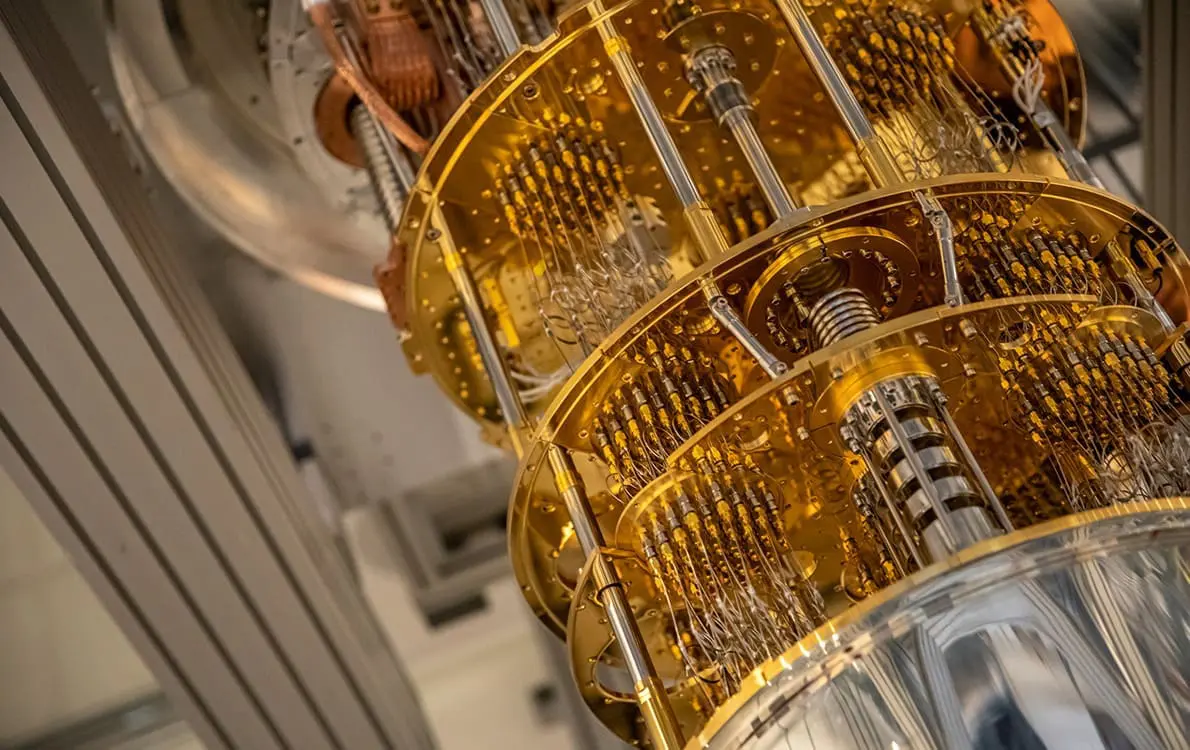
Researchers at Lawrence Berkeley National Laboratory are pushing the boundaries of quantum computing by cooling qubits to about 0.02 degrees above absolute zero, a temperature even colder than outer space, to maintain the delicate superconducting state necessary for preserving quantum information. This extreme cooling is achieved using a dilution refrigerator, described as a golden chandelier with cables running up and down that deliver and receive signals at millikelvin temperatures. The effort is part of a broader initiative to build a complete quantum computing “stack,” encompassing hardware, software, and controls for error-corrected calculations. “Making a functional quantum computer requires much more than qubits alone,” explains Chris Spitzer, operations lead at the Advanced Quantum Testbed (AQT). “It takes an entire technology stack that can harness quantum science for real-world applications.”
Superconducting QPU & Cryogenic System for Quantum Control
Maintaining the delicate quantum state of qubits demands an environment colder than outer space; at Lawrence Berkeley National Laboratory, the superconducting quantum processing units (QPUs) are consistently chilled to approximately 0.02 degrees above absolute zero. This extreme temperature is fundamental to preserving the superconducting state necessary for qubits to store and manipulate quantum information without succumbing to disruptive environmental interactions. The architecture supporting this feat is complex, with the dilution refrigerator serving as a central component. Described as a “golden chandelier with cables running up and down,” this device is not simply a cooler, but a sophisticated interface between room temperature controls and the millikelvin-range quantum chip. These cables are critical conduits, transmitting microwave signals that dictate qubit behavior and relaying information back from the processor.
The precision of these signals is paramount; the rack of control electronics must deliver highly precise, synchronized microwave pulses to perform “gating,” the process of enabling qubits to interact as required for computation. Berkeley Lab leverages an open-source system called QubiC, developed within its Accelerator Technology & Applied Physics Division (ATAP), alongside custom software to optimize quantum programs and ensure signal fidelity. Researchers are actively investigating new types of low-noise wiring technology that can optimize coherence, or the lifetime of quantum information. Beyond wiring, the dilution refrigerator itself must prevent injecting noise or heat, delivering only the intended signals to the processor. AQT’s focus extends to operating processors with the highest possible coherence, acknowledging that even the most stable qubits are useless without pristine signal delivery. The lab is currently working on building processors with performance increases of roughly 1,000 times compared to existing systems, aiming to apply these advancements to real-world scientific challenges and collaborate with industry partners on future quantum computer development.
QubiC System & Precise Microwave Pulse Delivery
This level of cooling, exceeding the frigidity of outer space, is not merely about low temperature, but about isolating the quantum system from external noise that would degrade the information stored within the qubits. These cables are not simply conduits, but critical components in a sophisticated system for manipulating quantum information. They transmit highly precise, synchronized microwave pulses that dictate qubit behavior, a process known as “gating,” enabling the necessary interactions for quantum computation. Figuring out new types of low-noise wiring technology that can optimize coherence or the lifetime of quantum information is an active area of research, recognizing that current wiring configurations, one or more wires per qubit, will become impractical as processor sizes increase beyond a few thousand qubits. The team is developing QubiCML, an AI-assisted readout for quantum computers, to enhance capabilities like quantum-error correction and advanced hybrid algorithms. Spitzer emphasizes that any element within this integrated stack has the potential to limit overall performance, highlighting the importance of a holistic approach to quantum computer design and the ongoing need for innovation across all layers of the system.
Making a functional quantum computer requires much more than qubits alone. It takes an entire technology stack that can harness quantum science for real-world applications.
Chris Spitzer, operations lead at the Advanced Quantum Testbed (AQT)
Scalability Challenges with Quantum Processor Wiring
The pursuit of viable quantum computation extends far beyond simply increasing qubit counts; a critical bottleneck lies in the physical infrastructure required to connect and control these delicate quantum systems. At the Advanced Quantum Testbed (AQT), researchers are intensely focused on the challenges of scaling up the wiring necessary to manage increasingly complex quantum processors. “Right now, you have one or more wires per qubit on your processor. This works well if you’ve got a few dozen qubits on your processor but not when you’re getting above a few thousand qubits,” explains Chris Spitzer, operations lead at AQT. The sheer density of connections presents a significant engineering hurdle, exacerbated by the extreme cryogenic environment. Maintaining qubits at approximately 20 millikelvin, a temperature just about 0.02 degrees above absolute zero, demands specialized wiring capable of transmitting microwave signals without introducing noise or heat.
These cables aren’t merely conduits; they are integral to preserving the fragile quantum states within the processor. Spitzer emphasizes that delivering these signals is crucial, noting that a quantum processor is useless without them. Addressing this challenge requires innovation in low-noise wiring technologies that can optimize coherence, the duration for which quantum information remains stable. The AQT team is also investigating the integration of AI and machine learning, with the development of QubiCML, an AI-assisted readout for quantum computers that would allow us to do things like quantum-error correction or more advanced hybrid algorithms. Ultimately, scalable wiring is not just an engineering problem, but a fundamental requirement for realizing the potential of large-scale, error-corrected quantum computers capable of tackling problems beyond the reach of classical systems.
Error Correction & AI-Assisted Readout for Next-Gen QPUs
Maintaining quantum information demands increasingly sophisticated error correction strategies as quantum processing units scale beyond a few dozen qubits. At the Advanced Quantum Testbed, researchers aren’t simply focused on building larger processors; they are actively integrating classical computing power to detect and correct errors arising within the quantum realm, a computationally intensive task requiring substantial resources. This holistic approach acknowledges that any component within the quantum computing “stack” can become a performance bottleneck, necessitating improvements across the entire system. A critical element in this pursuit is the development of advanced readout mechanisms. The Accelerator Technology & Applied Physics Division at Berkeley Lab is pioneering QubiCML, an AI-assisted readout for quantum computers that would allow us to do things like quantum-error correction or more advanced hybrid algorithms. This signifies a move toward embedding artificial intelligence directly into the quantum control infrastructure, allowing for real-time analysis and mitigation of errors.
Beyond error correction, the team is also addressing the challenges of scaling up wiring infrastructure. Current systems rely on a one-to-one correspondence between wires and qubits, a configuration unsustainable for processors containing thousands of qubits. Research is focused on developing low-noise wiring technologies that can maintain qubit coherence while drastically reducing the physical complexity of the system. This work is coupled with efforts to optimize the performance of dilution refrigerators, maintaining a stable temperature of approximately 20 millikelvin, a frigid temperature about 0.02 degrees above absolute zero, to minimize environmental interference. “But a quantum processor doesn’t do you any good if you aren’t able to deliver pristine microwave signals to it,” Spitzer added, highlighting the interconnectedness of these advancements. The ultimate goal is to build large-scale, error-corrected quantum systems capable of tackling simulations in fields like particle physics, materials science, and quantum chemistry, pushing the boundaries of what’s computationally possible.
Figuring out what the error was and what you need to do as the corrective step is a very computationally intensive task.


See today’s quantum computing news on Quantum Zeitgeist for the latest breakthroughs in qubits, hardware, algorithms, and industry deals.