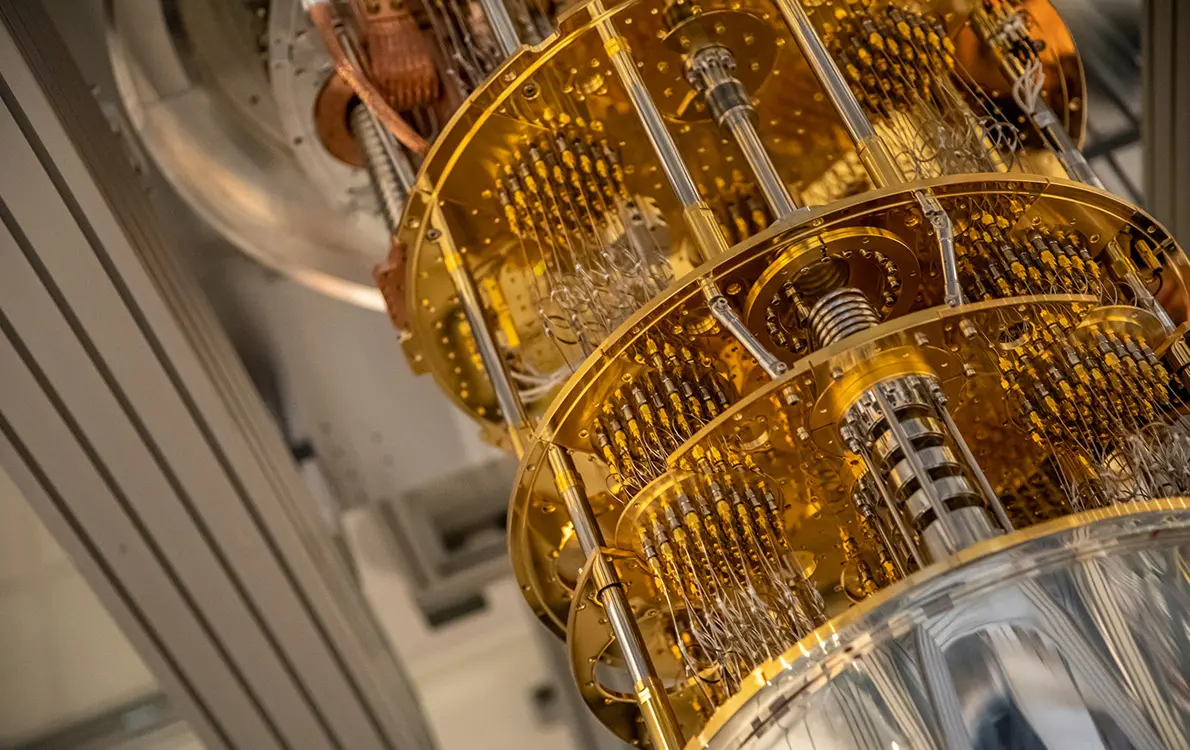
Researchers are pushing the boundaries of quantum computing by maintaining superconducting quantum processing units at a frigid 20 millikelvin, a temperature colder than outer space and just 0.02 degrees above absolute zero. This extreme cooling, achieved using dilution refrigerators that resemble golden chandeliers adorned with cables, is crucial for preserving the delicate quantum information stored within qubits. These refrigerators don’t simply chill the processors; they act as a conduit, sending control microwaves down to the qubit level and relaying information back from the millikelvin regime. “Making a functional quantum computer requires much more than qubits alone. It takes an entire technology stack that can harness quantum science for real-world applications,” explains Chris Spitzer, operations lead at the Advanced Quantum Testbed (AQT) at Lawrence Berkeley National Laboratory. This integrated approach, encompassing hardware, software, and controls, is essential to realizing the potential of quantum computation.
Superconducting QPU and Cryogenic System for Quantum Control
Maintaining qubits at 0.02 degrees above absolute zero is not simply about lowering the temperature, but about actively preserving the delicate quantum states essential for computation. The technology enabling this feat is the dilution refrigerator, described as resembling “a golden chandelier with cables running up and down,” which serves as both a thermal insulator and a crucial conduit for control signals. These cables are integral to the system’s functionality, transmitting microwave pulses from room temperature down to the millikelvin regime to manipulate the qubits, and simultaneously relaying information back upwards. The precision of these signals is paramount; any noise or unwanted heat introduced during transmission can disrupt the quantum information. Consequently, significant research focuses on optimizing the “cold stage” of the dilution refrigerator to ensure only the intended signals reach the processor.
Scalability also presents a challenge, as current wiring configurations, with one or more wires per qubit, become impractical with processors exceeding a few thousand qubits. This drives innovation in low-noise wiring technologies to maintain coherence. The holistic development of the entire quantum computing stack is vital, as any single component can limit overall performance. At AQT, researchers are striving for performance increases of roughly 1,000 times compared to existing processors, focusing on optimizing operation within the complete stack and applying these advancements to solve real-world scientific problems.
QubiC System Optimizes Microwave Pulses & Quantum Gating
Central to this effort is QubiC, an open-source superconducting qubit control system originating from the Accelerator Technology & Applied Physics Division (ATAP), designed to refine the delivery of quantum instructions. The system optimizes signals for maximum fidelity, a crucial step toward reliable computation. Maintaining qubits at temperatures colder than outer space, around 20 millikelvin, just 0.02 degrees above absolute zero, is paramount for preserving quantum information, and the dilution refrigerator is responsible for this feat. The precision of microwave pulses sent through these cables is critical, as any unwanted heat or noise can disrupt the delicate quantum states. Active research centers on developing low-noise wiring technologies to maintain coherence, the stability of quantum information, even with increased qubit density. The team is exploring the integration of artificial intelligence with QubiC, developing QubiCML, an AI-assisted readout system intended to enhance quantum error correction and facilitate more complex hybrid algorithms. This holistic strategy, encompassing hardware, software, and controls, is considered essential for building large-scale, error-corrected quantum systems capable of surpassing the limitations of classical supercomputers.
Making a functional quantum computer requires much more than qubits alone. It takes an entire technology stack that can harness quantum science for real-world applications.
Chris Spitzer, operations lead at the Advanced Quantum Testbed (AQT)
First-Generation Limits & Second-Generation Error Correction
Current first-generation quantum computers, possessing only a few dozen to a few hundred qubits, are limited in their ability to outperform classical supercomputers, but serve as vital stepping stones. A key component underpinning these systems is the dilution refrigerator, maintaining the quantum processing unit below 20 millikelvin, a temperature 0.02 degrees above absolute zero and colder than outer space. This extreme cooling isn’t merely about achieving low temperatures; it’s essential for preventing environmental interference and preserving the superconducting state necessary for quantum information storage. Researchers are actively investigating low-noise wiring technologies to maintain coherence and quantum information lifetime. The ultimate goal is to build second-generation systems with thousands of qubits and, crucially, robust error correction capabilities, requiring substantial classical computing power to detect and correct errors as they arise. “Figuring out what the error was and what you need to do as the corrective step is a very computationally intensive task,” Spitzer adds, outlining the complex interplay between quantum and classical processing needed to realize truly large-scale, error-corrected quantum computers.
Figuring out what the error was and what you need to do as the corrective step is a very computationally intensive task.
Berkeley Lab’s Integrated Approach to Stack Performance Increases
This approach acknowledges that bottlenecks can emerge anywhere within the system, limiting overall performance. Scalability presents another significant hurdle. Berkeley Lab leverages its diverse facilities, including the Molecular Foundry, Advanced Light Source, and National Energy Research Scientific Computing Center, to study materials, simulate processors, and develop advanced control electronics. “There are challenges across the stack to getting to the next generation of quantum computers,” Spitzer concludes, “from scaling up a quantum processor and cryogenic infrastructure to designing low-noise materials and error-corrected QPUs.”



See today’s quantum computing news on Quantum Zeitgeist for the latest breakthroughs in qubits, hardware, algorithms, and industry deals.