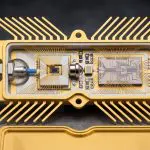
An error rate as low as one in ten thousand represents key progress in quantum information science. A new method devises ways to create entangled states, known as Bell states, using superconducting circuits alongside colleagues from Universitat de Barcelona. For the first time, this analogue technique matches the speed and fidelity of standard digital methods; it now reaches infidelities on the order of 10-4 within approximately 100 nanoseconds.
An alternative method for creating entangled quantum states, essential resources for future computation, uses analogue circuits instead of conventional digital ones. This technique prepares these paired states, known as Bell states, with competitive accuracy; errors reduced to one in ten thousand within approximately one hundred nanoseconds. By controlling the system’s fundamental properties directly, this approach expands options beyond current methods used in building advanced quantum technologies and offers a distinct route to entanglement generation.
A novel technique for generating entangled quantum states, key components for future computing technologies, researchers have unveiled it. This analogue method creates what are known as Bell states, perfectly correlated pairs of qubits akin to two coins flipped simultaneously that always land on opposite sides, using superconducting circuits; it achieves an impressively low error rate of one in ten thousand within roughly one hundred nanoseconds.
Unlike traditional digital methods which rely on sequences of operations, this approach directly controls the system’s fundamental properties through a process called adiabatic interpolation, gently morphing the system from one stable state to another without disruption. Following this initial step, resonant population transfer employs precise ‘tuning’ of energy levels to move all members of a group between them at once, completing the entanglement generation.
Analogue Bell State Preparation Yields Order-of-Magnitude Reduction in Quantum Circuit
Error rates dropped to one in ten thousand, an improvement of an order of magnitude over existing digital methods, using a new analogue protocol developed by Jordi Comelles and colleagues at Universitat de Barcelona for preparing singlet Bell states within superconducting circuits. Typical digital preparation techniques usually require approximately eighty to one hundred and thirty nanoseconds and yield errors around 10-3. The desired entangled state is naturally the first excited state of a specifically engineered Hamiltonian family, sharply simplifying the process.
Comelles’ team achieved analogue preparation times comparable to those typically required for digital methods, between eighty and one hundred and thirty nanoseconds; however, their protocol demonstrated infidelities reaching 10-4 with a slightly extended duration. Direct control terms within the Hamiltonian, a mathematical description of the system’s energy, facilitate preparation, rather than relying on discrete gate operations common in digital quantum computing. Exploiting that the singlet Bell state exists as the first excited state within a carefully designed family of Hamiltonians further simplifies this approach.
Defining operational boundaries for scalable analogue entanglement generation
This analogue method offers an alternative to building entanglement using sequences of digital operations, avoiding precise calibration of numerous individual gates, but it does have caveats. While performance relies on “realistic parameters”, these are not fully defined and establishing those limits is vital for assessing scalability beyond small systems or maintaining fidelity with increased complexity. Carefully controlling interactions within a superconducting circuit, mimicking natural physical processes instead of relying on discrete steps, allowed researchers to create a novel technique for generating entanglement.
The research demonstrated the preparation of singlet Bell states utilising an analogue protocol in a superconducting platform, achieving infidelities as low as 10-4. Researchers analysed robustness against control errors and suggest further work will focus on defining operational boundaries for scalability beyond small systems.
👉 More information
🗞 Preparation of a Bell state in an analogue device hosting the transverse-field Ising model
✍️ Ana Palacios
🧠 ArXiv: https://arxiv.org/abs/2609.09013



See today’s quantum computing news on Quantum Zeitgeist for the latest breakthroughs in qubits, hardware, algorithms, and industry deals.