Researchers at the University of Illinois Urbana-Champaign (UIUC) and the Institute of Science and Technology Austria (ISTA) have independently achieved a significant advance in sustaining entanglement, a crucial link between quantum bits, without relying on the complex, precisely timed control pulses typically required for remote entanglement generation. These teams demonstrate methods for maintaining a continuous entangled link between qubits, potentially enabling new quantum interconnects and distributed quantum computing architectures. Research outlining the findings indicates the ultimate goal is creating a system where multiple quantum processors can be interconnected rather than relying on single, monolithic units. Both experiments leverage stable, “dark states” protected from signal loss via quantum interference, achieving modest state fidelity between distant qubits.
Driven Dissipation & Dark States Enable Steady-State Entanglement
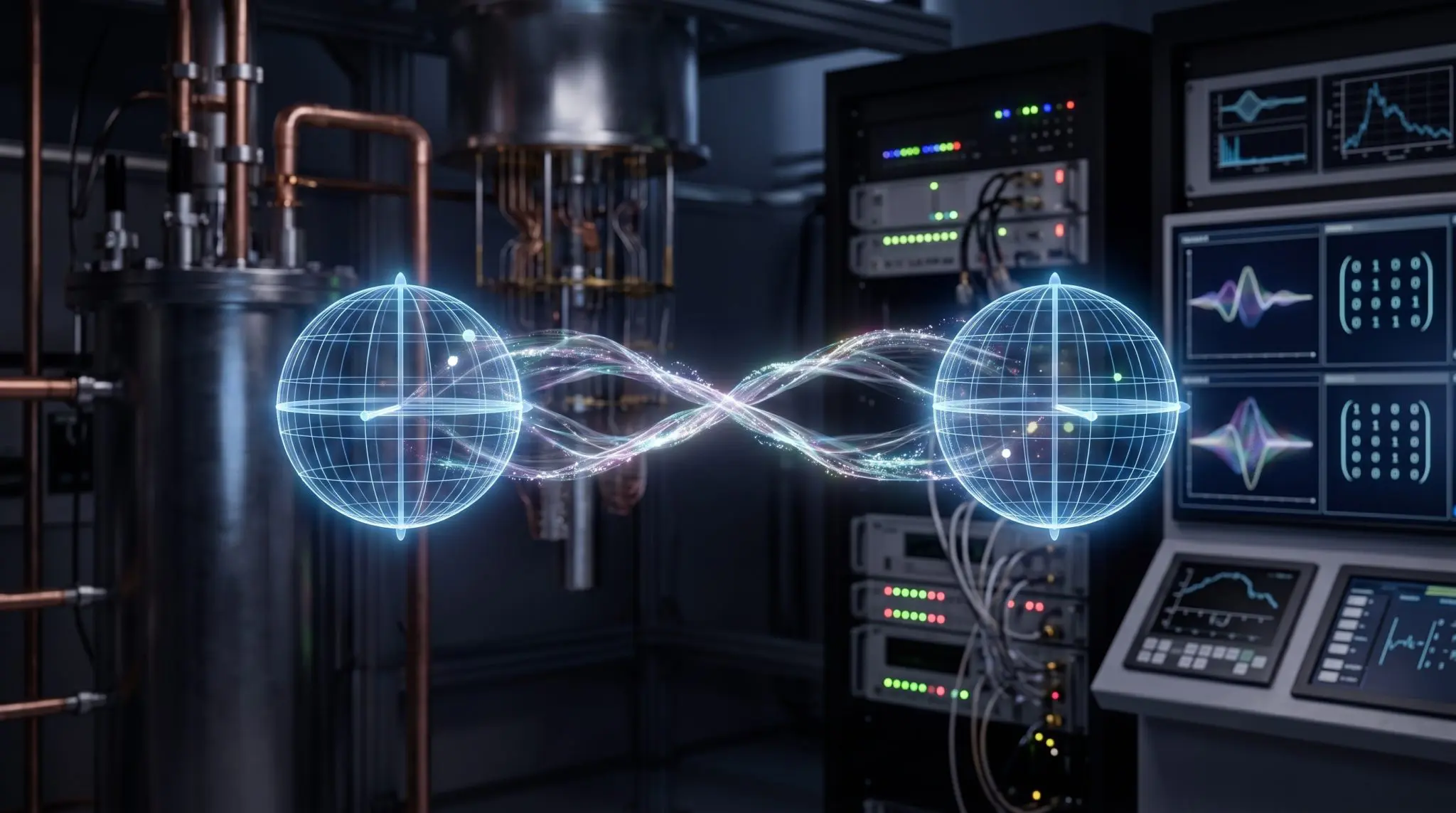
Maintaining entanglement, the quantum link between particles, no longer demands the precision of a finely tuned orchestra. This parallel advancement is notable; breakthroughs are often attributed to a single team, suggesting multiple viable pathways toward scalable quantum systems. Both groups employed a technique called driven dissipation, utilizing superconducting qubits and manipulating light-matter interactions to achieve what is termed driven, dissipative entanglement. Rather than orchestrating qubit dynamics with complex pulse sequences, these approaches leverage a continuous microwave driving field combined with qubit relaxation and photon emission. “Both systems were arranged such that a stable dark state emerged, protecting the entanglement from decay into the waveguide,” the research explains. The UIUC team created a unidirectional system by coupling qubits to a waveguide and adding a microwave circulator to ensure that photons travel only in one direction.
By tuning the driving signals, they induced destructive interference, suppressing photon emission and locking the qubits into an entangled state, achieving driven, dissipative entanglement independent of distance. The ISTA team, meanwhile, utilized a squeezed field, a quantum state of light with modified uncertainty, and a parametric amplifier to generate entangled photon pairs sent to the qubits via separate waveguides. Similar to the UIUC approach, overlapping emission pathways underwent destructive interference, maintaining stable entanglement. Although the underlying principles differ, both schemes yielded comparable results, generating entangled states with modest state fidelity. The ultimate aim is to enable a large modular quantum system that performs better as a whole than the sum of its parts. Whether this steady-state entanglement can remain active during computation is still under investigation, but these demonstrations represent a valuable proof of principle for future quantum interconnects.
The pursuit of stable quantum entanglement currently focuses heavily on overcoming the inherent fragility of the connection between qubits, a challenge demanding increasingly sophisticated control mechanisms. Existing methods for generating remote entanglement typically rely on precisely timed interactions between qubits and photons, creating a significant engineering bottleneck as systems scale. These parallel advancements suggest multiple viable paths toward building robust quantum networks are not merely theoretical exercises. Two qubits, positioned on separate platforms, were connected via a common waveguide, which was made unidirectional by the addition of a microwave circulator. This configuration allowed microwave photons from the driving field to propagate through the waveguide in only one direction. Researchers engineered a scenario where two distinct photon emission pathways existed, one from the downstream qubit through the waveguide, and another from the upstream qubit in the same direction. This destructive quantum interference, according to the team, resulted in driven, dissipative entanglement generation independent of distance.
ISTA Approach: Squeezed Fields Generate Correlated Photons
This cancellation forced the qubits into a stable entangled state, a phenomenon the team terms “driven-dissipative entanglement generation independent of distance.” Similar to the work conducted concurrently at the University of Illinois Urbana-Champaign, the ISTA scheme relies on establishing a stable dark state. This dark state, populated gradually through continuous qubit driving, facilitates steady-state remote entanglement without the need for precise timing.
The pursuit of scalable quantum computing received a boost with the independent demonstration of continuous entanglement between distant qubits, sidestepping a major engineering challenge. This is particularly significant as accurate pulse timing introduces considerable complexity into quantum systems. This resulted in driven, dissipative entanglement generation independent of distance. The ISTA team took a different approach, utilizing squeezed light, a quantum state with modified uncertainty properties, to drive the qubits. They generated entangled photon pairs, sending individual photons to each qubit via separate waveguides. The ISTA team’s approach is detailed in a recent publication in Phys. X on July 13, 2026. Both experiments achieved modest state fidelity.


See today’s quantum computing news on Quantum Zeitgeist for the latest breakthroughs in qubits, hardware, algorithms, and industry deals.