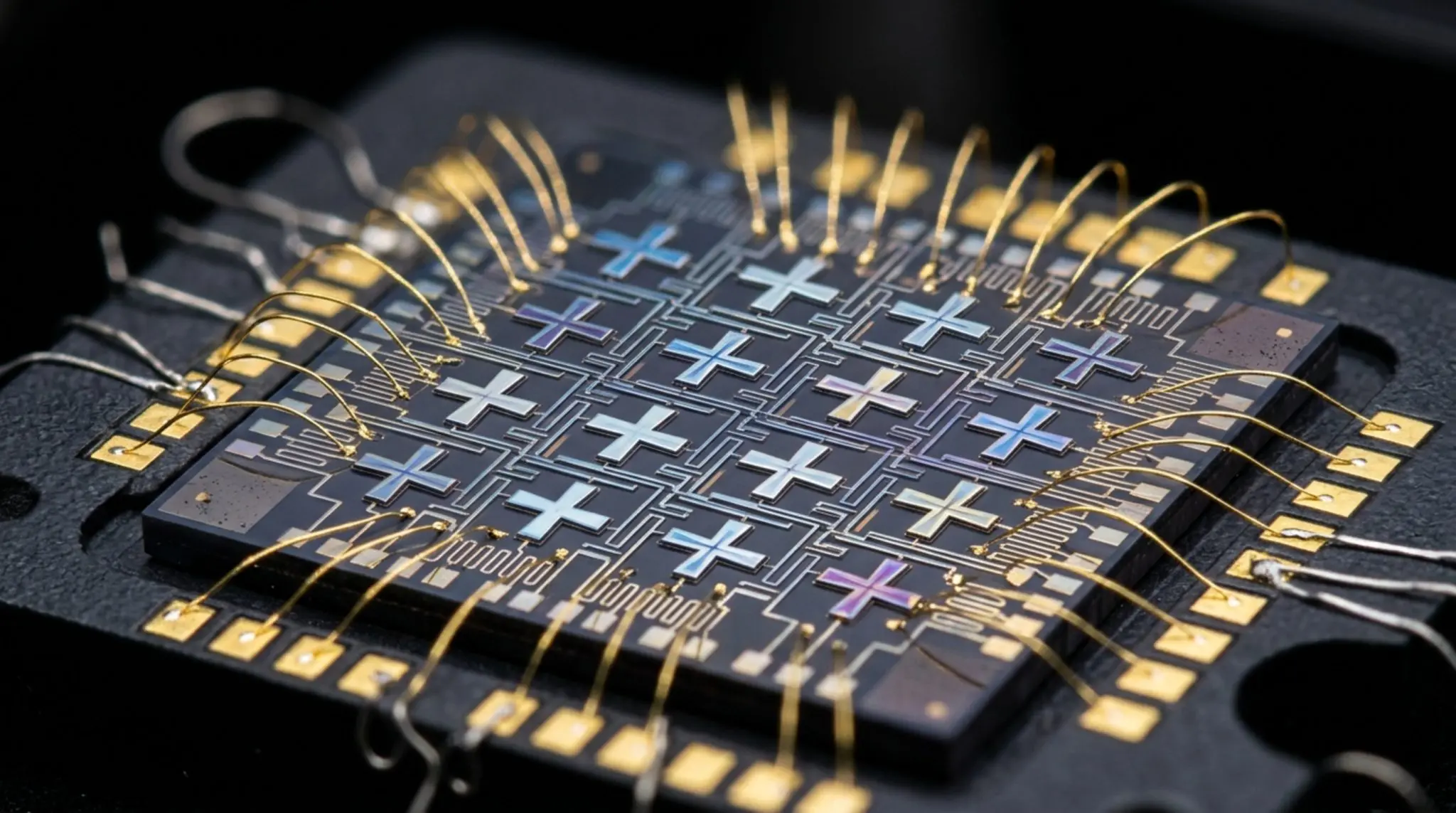
Researchers at the University of South Dakota have completed a comparative assessment of four distinct germanium-based spin-qubit designs: donor, acceptor, gate-defined hole, and gate-defined electron platforms. The work, published in Quantum Science and Technology on September 1, 2026, establishes a common framework for evaluating these competing quantum computing approaches, each making unique trade-offs between coherence, controllability, and scalability. This detailed analysis considers germanium’s material properties, including isotopic purification and strain, to estimate relaxation rates across the different qubit modalities.
Germanium’s Resurgence as a Quantum Semiconductor Platform
High-purity germanium is experiencing a revival as a leading material for building spin-based quantum computers, driven by its unique combination of established manufacturing processes and potential for scalable qubit designs. The work addresses a critical bottleneck in quantum computing: scaling up from single, high-performing qubits to a functional, fault-tolerant architecture. The central challenge, according to the study, is not simply achieving high qubit fidelity, but realizing a hardware architecture that balances error reduction with long-term stability, qubit connectivity, and manageable cryogenic infrastructure.
Semiconductor spin qubits, with their nanoscale footprints, offer a compelling path toward meeting these demands by leveraging the existing semiconductor industry’s expertise in miniaturization and mass production. Ge, specifically, benefits from compatibility with advanced processing, the availability of spin-free isotopes, and strong, tunable spin-orbit coupling. While germanium presents a versatile platform, the researchers emphasize that germanium qubits are not a monolithic technology.
Each of the four modalities, donor, acceptor, hole, and electron, operates on different principles and presents unique trade-offs between coherence, control, fabrication complexity, and scalability. Donor qubits, for example, offer strong tunability and potential for hybrid registers, but are limited by comparatively strong spin-lattice relaxation. Acceptor qubits, utilizing spin-3/2 physics, exhibit unusual functionality but remain sensitive to their microscopic environment and are less experimentally mature. Gate-defined hole qubits in germanium nanostructures and Ge/SiGe heterostructures currently appear to offer the most promising combination of all-electrical control, demonstrated multiqubit functionality, and architectural scalability.
Donor Spin Qubits: Confinement and Relaxation Trade-offs
The University of South Dakota’s detailed assessment of germanium-based spin qubits reveals inherent trade-offs within the donor qubit modality, specifically concerning confinement and relaxation times. While donor qubits benefit from atom-like confinement of the electron spin, a characteristic that simplifies device design, this same localization contributes to increased susceptibility to spin-lattice relaxation. This relaxation, a primary source of qubit decoherence, arises from interactions with the surrounding nuclear and electronic environment, limiting the time a qubit can reliably hold quantum information.
The study highlights that comparatively strong spin-lattice relaxation represents a key limitation for donor qubit performance. Further analysis indicates that the tunability of donor qubits, achieved through Stark shifts, modifications to energy levels by electric fields, is a significant advantage. This tunability facilitates the creation of hybrid registers, combining electron and nuclear spins for enhanced quantum information storage and processing.
However, the researchers found that achieving optimal Stark control requires precise manipulation of the electric field environment, a challenge complicated by the need to maintain strong confinement. The team’s framework for estimating relaxation rates considers the influence of phononic crystals, structures designed to modify vibrational modes within the material, and their potential to suppress unwanted relaxation pathways. This estimation combines a calibrated reference rate with geometry-specific strain suppression factors and parasitic relaxation channels introduced during nanofabrication.
The work also addresses the complex interplay between material properties and qubit performance. Isotopic purification, a process of removing unwanted isotopes from the germanium lattice, is crucial for minimizing nuclear spin noise, a major source of decoherence. The multivalley L-point conduction band structure of germanium, while offering unique opportunities for qubit control, also introduces complexities in electron confinement and exchange interactions.
Acceptor Qubits: Functionality and Environmental Sensitivity
Unlike donor qubits which utilize bound electron spins, acceptor qubits possess a spin-3/2 characteristic, introducing unique quadrupolar couplings and a heightened responsiveness to both strain and the symmetry of surrounding interfaces. This sensitivity, while presenting challenges, also unlocks unusual functionality not readily available in other qubit designs, prompting detailed investigation into its origins and mitigation. The team’s work reveals acceptor qubits are comparatively immature experimentally, despite offering electrically active spin physics.
This developmental stage necessitates a deeper understanding of how microscopic environmental factors impact performance, a focus reflected in the comprehensive assessment of four distinct germanium qubit platforms. This detailed approach aims to establish a framework for predicting and ultimately controlling the behavior of acceptor qubits within complex device architectures.
A key consideration for acceptor qubit viability is their susceptibility to environmental noise. The research highlights that these qubits exhibit a pronounced sensitivity to their immediate surroundings, demanding precise control over material quality and device fabrication.
This sensitivity stems from the acceptor’s inherent properties; the spin-3/2 nature introduces quadrupolar interactions, while the hole’s spatial distribution makes it particularly vulnerable to fluctuations in the electric field caused by interface defects or strain variations. The ongoing work at the University of South Dakota contributes to a growing body of knowledge aimed at realizing the full potential of germanium as a versatile platform for quantum information processing, even as other approaches gain prominence.
Gate-Defined Electron Qubits: Complexity of Multivalley Bands
The University of South Dakota’s detailed analysis of germanium-based quantum computing platforms reveals a significant challenge for gate-defined electron qubits: navigating the intricacies of germanium’s multivalley conduction band. While these qubits offer the simplicity of spin-1/2 encoding, their performance is fundamentally linked to the complex electronic structure of germanium, a factor that currently limits their development compared to other approaches. Specifically, the anisotropic L valleys within germanium’s conduction band introduce complexities for electron-based qubits, impacting confinement, exchange interactions, and ultimately, the reproducibility of device characteristics.
This multivalley structure, while offering potential for novel qubit designs, demands precise control over electron behavior within the nanostructure. The study highlights that achieving this control requires a deep understanding of how the unique band structure influences qubit performance, a challenge not present in platforms utilizing hole spins.
Gate-Defined Hole Qubits: Scalability and Electrical Control
While donor, acceptor, and gate-defined electron qubits each offer unique advantages, the assessment, published in Quantum Science and Technology, indicates that hole qubits currently balance electrical control with the architectural requirements for dense integration. This conclusion stems from a comparative examination of four distinct germanium-based spin-qubit designs, a relatively uncommon level of direct benchmarking within the field. Hole qubits distinguish themselves through a combination of features absent in other approaches; the study highlights that these qubits avoid the valley-degeneracy issues that complicate electron-spin platforms, and experience suppressed hyperfine coupling due to their p-like orbital occupancy.
This suppression is critical for maintaining coherence, as hyperfine interactions can introduce noise and decoherence. The lighter in-plane effective mass of holes supports strong electrostatic confinement alongside high mobility, enabling tighter qubit spacing and potentially increasing processor density.
Researchers found that this combination allows for all-electrical control, a significant advantage for scalability as it simplifies the control infrastructure needed for large qubit arrays. The assessment goes beyond simply identifying advantages; it also establishes a common framework for estimating the primary decoherence mechanism, T1 relaxation, across all four qubit modalities. By applying this consistent metric, the team could objectively compare the performance potential of each qubit type, revealing that gate-defined hole qubits consistently demonstrated the most favorable trade-offs between coherence and controllability.
Despite the promising characteristics of hole qubits, the researchers acknowledge that challenges remain. The study notes that achieving optimal performance requires careful control of material quality and device fabrication, particularly in managing strain and interface effects. However, the demonstrated multiqubit functionality and architectural scalability of these qubits position them as a leading contender in the race to build a practical quantum computer.
Phononic-Crystal Modification of Ge Spin Qubit T1
A unified framework for estimating spin qubit coherence times in germanium has been established, allowing for objective comparison of four distinct qubit designs. This comparative approach, unusual in a field often focused on optimizing single qubit modalities, signals a serious effort to benchmark competing technologies and identify the most promising path toward scalability. The team’s methodology centers on phononic-crystal modification of the T1 relaxation time, a critical measure of qubit coherence.
This allows for a consistent metric to evaluate performance potential across the different qubit types, moving beyond simply identifying advantages to quantifying them. Gate-defined electron qubits, though appealing for their spin-1/2 encoding, inherit the complexities of germanium’s multivalley conduction band and are currently underdeveloped. The central challenge, the team notes, is no longer demonstrating a high-performance qubit in isolation, but realizing a hardware architecture capable of scaling to fault-tolerant operation.
This requires simultaneously reducing physical error rates while maintaining long-term stability, sufficient qubit connectivity, and a classical control infrastructure that minimizes heat load and crosstalk within cryogenic systems. The team’s framework provides a valuable tool for navigating these complex trade-offs and accelerating the development of germanium-based quantum computing.
Framework for Estimating Relaxation Rates in Germanium
The University of South Dakota’s Department of Physics recently completed a detailed analysis establishing a common framework for evaluating the performance potential of four distinct germanium-based spin qubit designs. The team’s work underscores that the most promising qubit platform is not simply the one that performs best at the few-qubit level, but the one that offers a credible path to dense integration, low-power control, manufacturable device layouts, and compatibility with cryogenic electronics.



See today’s quantum computing news on Quantum Zeitgeist for the latest breakthroughs in qubits, hardware, algorithms, and industry deals.