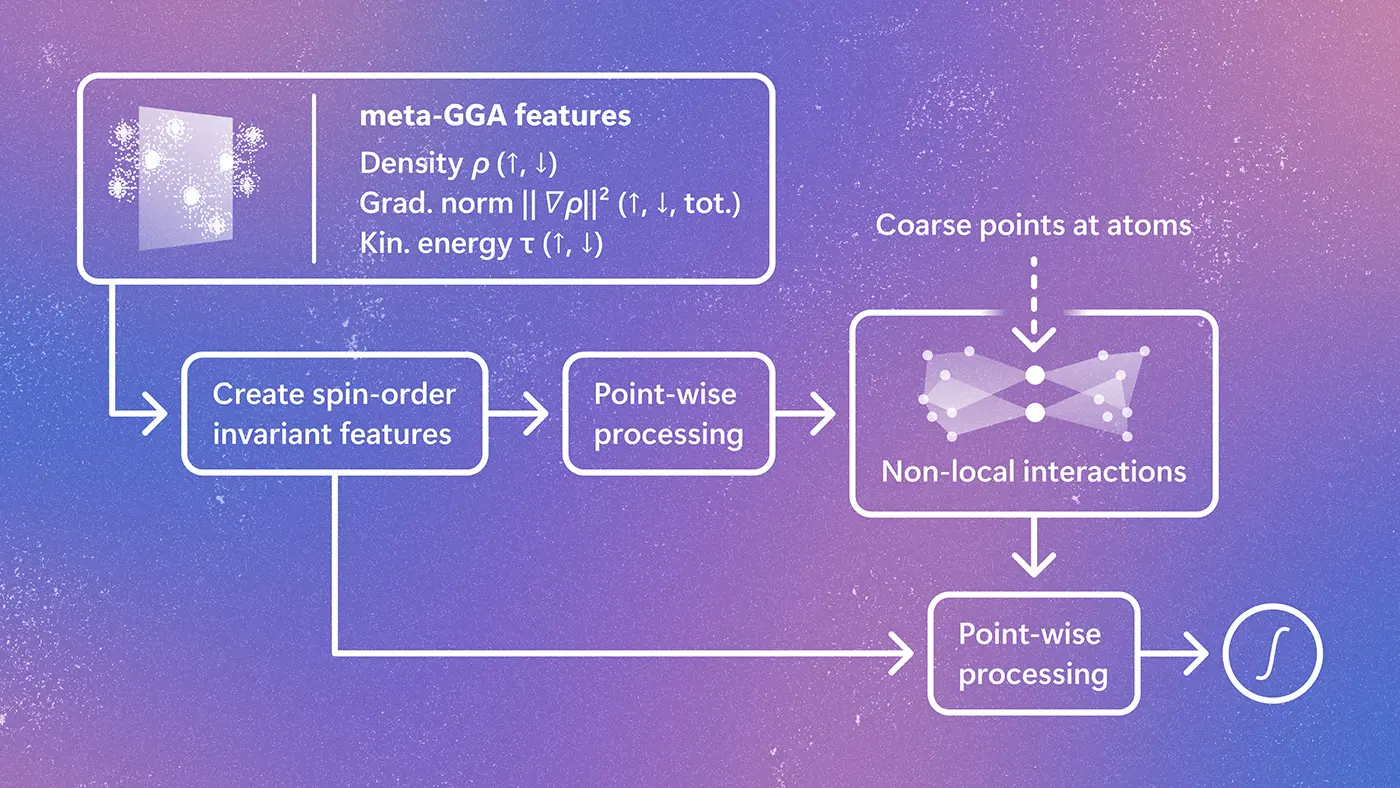
Microsoft Research has broadened access to Skala 1.1, a deep-learning approach to density functional theory (DFT), after training the updated model on 2.5 times more data than its predecessor. This increased dataset delivers improvements across crucial molecular simulation challenges like thermochemistry, reaction kinetics, and molecular structure prediction.
Skala is now available within the CP2K code, with integration planned for Psi4, FHI-aims, ORCA and VASP; Microsoft Research is also introducing a living benchmark to track and accelerate the performance of future Skala releases. These developments aim to make computational chemistry simulations both predictive and widely accessible for scientific and industrial applications.
Skala 1.1 Achieves Higher DFT Accuracy with Expanded Data
Skala 1.1 surpasses leading global hybrid functionals in accuracy while maintaining the efficiency of semi-local functionals. This improvement is enabled by a major expansion of the Microsoft Research Accurate Chemistry Collection (MSR-ACC). This leap in performance isn’t simply about adding more data; the increased diversity of the training set allows Skala to systematically improve with each generation, moving closer to a scalable and predictive density functional theory framework.
Unlike the conventional approach where new functionals accumulate without replacing older ones, Skala follows a continuous-improvement paradigm. Each release is designed to supersede the previous one, ensuring that users benefit from the latest advancements without incurring additional computational cost. Skala 1.1 achieves a weighted average error of 2.8 kcal/mol on GMTKN55, a widely used benchmark suite encompassing 55 categories of chemistry, including thermochemistry, reaction barriers, and noncovalent interactions.
Beyond energies, the model also provides highly accurate electron densities, dipole moments, and molecular geometries, demonstrating a comprehensive enhancement in predictive power. To ensure real-world impact, Microsoft Research is actively integrating Skala into prominent electronic-structure software packages. “Molecular Implementation of the Machine-Learned Skala Exchange-Correlation Functional in CP2K through GauXC” details the successful integration with CP2K and the rigorous testing framework employed to validate its accuracy.
The team developed a comprehensive suite of integration tests to verify that Skala produces numerically correct and reliable results, with the CASUS team’s expertise proving instrumental in the process. By providing a transparent and continuously updated reference across software packages and hardware platforms, this resource will empower the community to measure and accelerate progress toward even greater accuracy and efficiency.
This commitment to open development and community involvement underscores the long-term vision for Skala as a cornerstone of predictive computational chemistry and materials science, marking another milestone toward simulations that are both predictive and accessible across relevant scientific and industrial workflows.
Skala Integration Expands Across Key Computational Chemistry Codes
The initial integration within CP2K, a powerful tool for DFT simulations particularly suited for large-scale systems, serves as a case study for this validation process. Further integrations are underway with Psi4, FHI-aims, ORCA, and VASP, extending Skala’s reach to a broader range of scientific and industrial workflows. Together, these developments represent another milestone toward a future where computational chemistry simulations are both predictive and accessible.
GMTKN55 Benchmark Demonstrates Skala-1.1’s Performance Gains
Stephanie Marisa Lanius, Senior Research Software Engineer at Microsoft Research, and colleagues have detailed performance gains achieved with Skala-1.1. The updated model, trained on a dataset 2.5 times larger than its predecessor, delivers substantially higher accuracy across key molecular simulation challenges. Evaluating Skala-1.1’s capabilities, the team utilized the GMTKN55 benchmark, which spans a broad range of chemical problems. Results show Skala 1.1 outperforms the best, most expensive global hybrid functionals, ranking first in 32 of the 55 categories while maintaining the computational cost of a meta-GGA functional.
The weighted average error on GMTKN55 reached 2.8 kcal/mol, retaining the efficiency of a semi-local functional. This expansion of the Skala ecosystem is intended to bring next-generation DFT accuracy to the communities already utilizing these established electronic-structure software packages. This commitment to continuous improvement distinguishes Skala from traditional DFT functionals.



See today’s quantum computing news on Quantum Zeitgeist for the latest breakthroughs in qubits, hardware, algorithms, and industry deals.