
A new blueprint for microchip encryption, detailed in Physical Review Letters, promises to dramatically accelerate data security without sacrificing signal strength. Rice University physicists, co-led by Jun-Jie Zhang and Boris Yakobson, have theoretically demonstrated a class of materials called autferroics that can speed up true random number generators, critical for encryption, by a factor of thousands. Hasselmann Professor in Engineering, detailing the research’s origins. This approach bypasses key hardware bottlenecks by using a unique interaction between electrical and magnetic properties, potentially enabling faster and more reliable data encryption.
Autferroic Materials Enable Faster, Clearer Random Number Generation
Autferroic materials demonstrate the capacity to generate over one million random bits every second, a rate achieved through computer simulations and validated against National Institute of Standards and Technology benchmarks. This speed represents a leap from under 100 flips per second observed in standard devices, effectively eliminating a long-standing bottleneck in data security systems.
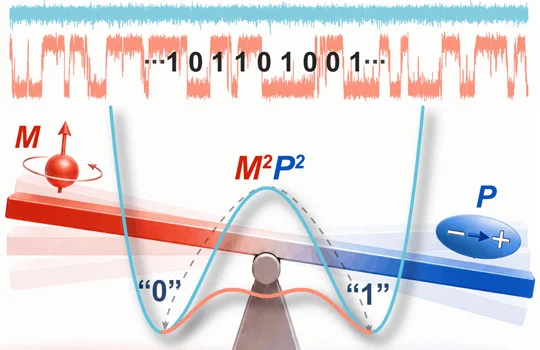
The team’s approach hinges on a unique “seesaw” interaction between electrical and magnetic properties within these materials, allowing for faster transitions without compromising signal clarity. Rather than directly flipping magnetic states, a process demanding significant energy, autferroic materials utilize an intermediate electrical step, reducing the energy barrier by nearly two-thirds.
This innovative pathway maintains a strong magnetic signal, important for reliable data reading and preventing errors, and ensures the generation of truly random numbers essential for robust encryption. “Seesaw magnetoelectricity makes low-energy switching easier without weakening the magnetic state, thereby keeping the readout signal strong,” explained Jun-Jie Zhang, a postdoctoral research associate in Rice’s Department of Materials Science and Nanoengineering. The ability to maintain signal strength at such high speeds addresses a critical flaw in previous attempts to accelerate random number generation.
Beyond speed, these autferroic materials offer the potential for increased data density within microchips; four stable states exist within the material, rather than the standard binary 0 and 1. This multistate capability allows a single component to perform the functions of multiple conventional transistors, opening avenues for advanced computing architectures.
Researchers demonstrated that connecting two of these units with simple circuits enables the processing of multistate data and the simulation of quantum computing through parallel testing of multiple outcomes. “Four-state autferroic devices can represent more information in a single device,” Zhang said. For example, these multistates allow complex numbers, a combination of a real and an imaginary number, to be encoded directly in hardware.
The theoretical foundation for this technology stems from an exploration of entropy extraction, initially focused on charge fluctuations within field-effect transistors. Yakobson, the Karl F. “Our broader interest in TRNG, or how to extract entropy from physical behavior and convert it into random bits, focused mostly on charge-fluctuating entities in field-effect transistors,” Yakobson said.
However, while investigating the energy landscape of autferroics, Zhang proposed that their unique properties could facilitate faster TRNGs, leading to a collaborative shift in focus. “But when exploring the energy landscape of autferroics, especially the lower barrier separating opposite polarizations, Jun-Jie proposed this might lead to faster TRNG. It turned into a very fruitful collaboration with our recent report dovetailing with our previous one.” The team’s simulations also revealed that applying a constant electric field further accelerates the random number generation process.
This field enhances switching speed without introducing bias, ensuring a perfect 50/50 balance and producing genuinely random outputs. This balance is critical; any bias in the random number stream could create vulnerabilities in encryption algorithms. The resulting devices provide clear “yes” or “no” signals, eliminating ambiguity and enhancing the reliability of the generated numbers. “It provides clear ‘yes’ or ‘no’ signals, not a ‘maybe’,” Zhang stated.
While the current findings are based on theoretical models of a 2D nanomaterial, titanium germanium selenide, the research provides a practical blueprint for manufacturing real-world applications. Structural imperfections in fabricated devices may slightly reduce switching speeds, but the established theoretical framework offers a solid foundation for future development. This research could be useful for computing, data encryption and processing, and other information technologies, Zhang noted.
Seesaw magnetoelectricity makes low-energy switching easier without weakening the magnetic state, thereby keeping the readout signal strong.




See today’s quantum computing news on Quantum Zeitgeist for the latest breakthroughs in qubits, hardware, algorithms, and industry deals.