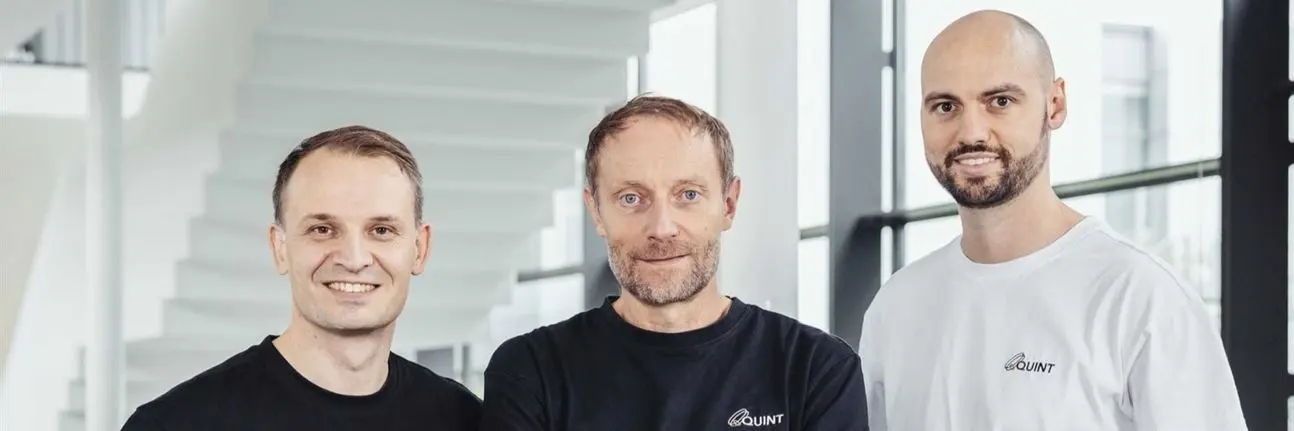
Erlangen-based quantum computing firm Quint Computing has secured €9.1 million in its first funding round, the largest initial investment to date for a German quantum computing company. Led by Vsquared Ventures, the funding will enable Quint to expand its team to approximately 40 people by 2028 and accelerate development of its superconducting chip architecture for quantum error correction, Quint Computing says.
The company, a spin-off from Friedrich-Alexander-Universität Erlangen-Nürnberg, aims to reduce hardware overhead, complexity, and energy consumption by a factor of 100. Bavarian State Minister for Science and the Arts, Markus Blume, congratulated the team, stating, “Bavaria is a quantum pioneer, from research all the way to application!”
Quint Computing Secures €9.1 Million in Initial Funding
Vsquared Ventures spearheaded the funding, with participation from Quantonation, Nucleus Capital, Faber, Vanagon Ventures and ZOHO VC, alongside quantum industry experts including Prof. Mikko Möttönen, founder of QMill. Complementing this private investment, the company also secured a €2.2 million Pathfinder grant from the European Innovation Council (EIC), bolstering its financial resources for development, according to Quint Computing. Founded in October 2025, Quint Computing originated as a spin-off from Friedrich-Alexander-Universität Erlangen-Nürnberg (FAU) and operates within the Munich Quantum Valley ecosystem.
The company focuses on quantum error correction, a critical challenge hindering the scalability of quantum computers. Quint’s patented superconducting chip architecture distinguishes itself by suppressing errors directly at the hardware level, a departure from conventional methods that rely on complex post-processing algorithms.
Bavarian State Minister for Science and the Arts, Markus Blume, congratulated the team and emphasized the importance of translating excellent science into industrial practice. He expressed confidence in quantum computing’s potential as a historic turning point. Quint’s advisory board includes Prof. Florian Marquardt ( for the Science of Light), Dr. Reinhard Ploss (former CEO of Infineon Technologies) and Dr. Markus Hoffmann (formerly). Munich Quantum Valley also extended its congratulations to the Quint team on reaching this milestone, signaling broad support for the company’s advancements in quantum technology., the company says.




See today’s quantum computing news on Quantum Zeitgeist for the latest breakthroughs in qubits, hardware, algorithms, and industry deals.