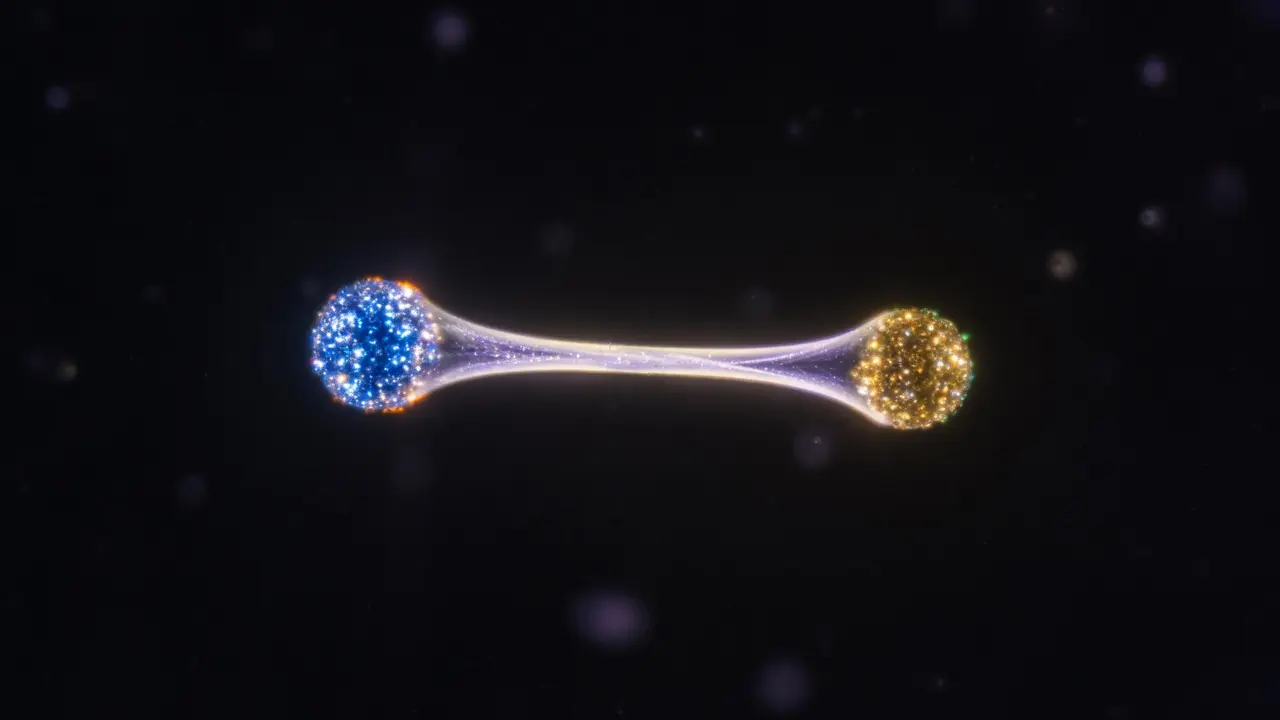
Initial state preparation dramatically influences qubit entanglement within fluctuating optical cavities. Starting conditions have a key impact on how long qubits remain entangled, a vital factor for quantum technologies. Analysis reveals strong entanglement can be generated from specific states in low-excitation Fock cavities, while noise with lasting effects can repeatedly restore connections even as they begin to degrade, offering new ways to engineer more resilient quantum systems.
The team discovered that carefully controlling initial conditions within specialised cavities improves qubit “entanglement,” a vital connection for future technologies. Their analysis shows certain types of noise, those retaining “memory” of past interactions, can repeatedly restore entanglement as it fades, effectively counteracting degradation. This resilience depends on both the starting properties of light inside the cavity and characteristics of environmental disturbances.
Researchers at Stevens Institute of Technology and Zhejiang University uncovered how initial conditions impact qubit entanglement within fluctuating optical cavities, a vital consideration as scientists build future quantum technologies. They found that carefully chosen starting states generate strong connections between qubits housed inside these specialised cavities; think of it like flipping two coins simultaneously to always land on opposite sides, this is a special connection beyond random chance. The team distinguished between different ways to shine light into the cavity: individual flashes (Fock states) versus a steady beam (coherent states), finding each behaves differently under disturbance.
Environmental memory sustains qubit entanglement against non-Markovian decoherence
Entanglement measures now demonstrate repeated revivals under strong non-Markovian noise with long correlation times; previously, such connections were expected to succumb to sudden death, a complete loss of quantum link. The durability arises when environmental “memory” counteracts decay in a two-qubit system interacting within an optical cavity, as discovered by scientists and Zhejiang University. These findings establish photon statistics and environmental memory as key control parameters, sharply contrasting systems experiencing white noise where entanglement invariably diminishes over time.
Coherent cavities revealed a critical photon-number threshold influencing oscillation frequencies, transitioning from low to high frequency oscillations before universal entanglement loss occurs, something not observed prior to this work. Examining these coherent cavities (those emitting light in a specific phase relationship) pinpointed the point where oscillations shift from lower to higher frequencies before complete entanglement loss; this transition hadn’t been previously observed.
Repeated revivals were demonstrated under strong non-Markovian noise, environments retaining memory of past interactions, challenging expectations of inevitable ‘sudden death’. Strong entanglement generated from single-excitation Fock states, cavity modes with just one photon, persists within “decoherence-free subspaces”, areas shielded from environmental noise; however, starting with entangled states possessing double excitation invariably leads to decay without such protective symmetries.
Initial Qubit Settings And Noise Govern Entanglement Preservation
Theoretical durability against entanglement loss is demonstrated through careful initial state preparation and noise engineering by researchers and Zhejiang University. A key hurdle remains: the analysis deliberately sidesteps practical challenges in *implementing* these techniques beyond this idealised two-qubit setup. While providing valuable insight, the team’s focus on analytical solutions doesn’t address imperfections inherent to real devices or limitations in controlling qubit interactions with sufficient precision.
Even acknowledging that this work focuses on a simplified two-qubit system, it establishes important principles for building more complex quantum technologies. Initial conditions within an optical cavity profoundly influence qubit entanglement; specifically, cavities populated by single photons generate more durable connections than those beginning with multiple excitations. In particular, research reveals strong “non-Markovian” noise, where past interactions affect present behaviour, can repeatedly restore fading entanglement previously expected to vanish completely, challenging established understanding of quantum information loss. These findings establish control parameters poised to shape more resilient systems over the next decade.
This research demonstrated that initial conditions and the type of environmental noise significantly impact qubit entanglement in a two-qubit cavity system. The study also revealed that certain types of fluctuating coupling strength, specifically strong “non-Markovian” noise exhibiting memory of past interactions, can revive fading entanglement instead of allowing it to vanish completely. This work establishes cavity photon statistics and environmental correlation time as key factors governing quantum information preservation.
👉 More information
🗞 Noise-Assisted Quantum Entanglement: Memory-Enhanced Coherence in Stochastic Jaynes-Cummings Dynamics
✍️ Fang Wang, Quanzhen Ding and Ting Yu (Stevens Institute of Technology); Jun Jing (Zhejiang University)
🧠 ArXiv: https://arxiv.org/abs/2610.31947
See today’s quantum computing news on Quantum Zeitgeist for the latest breakthroughs in qubits, hardware, algorithms, and industry deals.