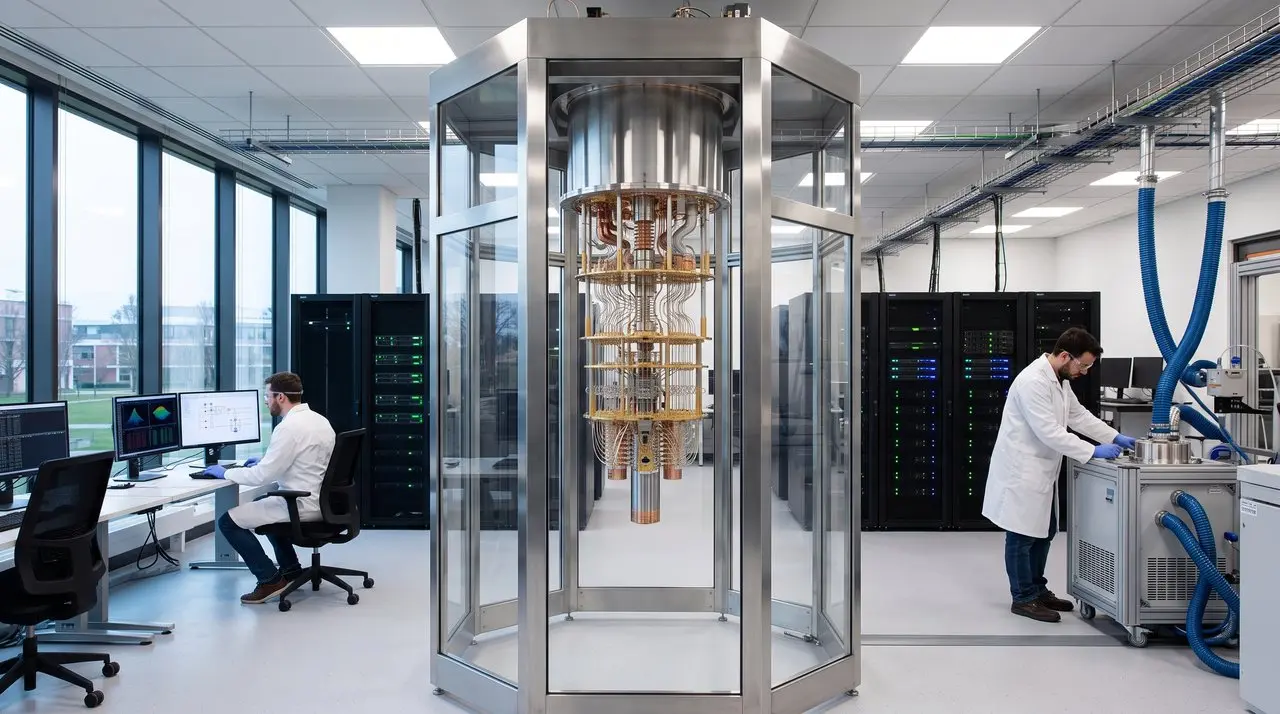
Current Noisy Intermediate-Scale Quantum (NISQ) devices function best as coprocessors alongside existing computers; classical systems continue handling pre-and post-processing tasks while specialised computations occur on quantum processors. This provides computer scientists and software engineers working within hybrid environments with a thorough system level perspective. Despite current enthusiasm surrounding quantum computers, they will not replace traditional technology; instead, these machines function as specialised tools working alongside existing systems.
Today’s “Noisy Intermediate-Scale Quantum” (NISQ) devices face hurdles like maintaining stable information, known as coherence, and limited capacity for storing data. Successfully integrating them requires rethinking how computations are structured, with classical computers handling preparation and analysis while quantum processors perform focused tasks. Researchers at Newcastle University emphasise that today’s “Noisy Intermediate-Scale Quantum” (NISQ) devices, think of them as early model cars, demonstrate potential but are limited by their capabilities, functioning best not as replacements for existing computers, but as specialised coprocessors working alongside them.
This means classical systems continue handling pre- and post-processing tasks while these quantum processors tackle focused computations; it’s like having both an artist who excels at creative work and an accountant who handles precise calculations on a team project. A key challenge is maintaining the stability of quantum information, which can be lost due to environmental disturbances, a phenomenon akin to losing details in a whisper as it travels further from its source.
Successfully integrating this technology requires rethinking how we structure computation, demanding new software infrastructure and hybrid orchestration techniques. But overcoming these hurdles truly unlock practical “quantum advantage” for real-world applications?
Microsecond Qubit Coherence Achieved Via Hybrid Classical-Quantum Computation
Storage times for quantum memory at Newcastle University now reach microseconds, a sharp improvement over previous nanosecond limitations. This leap enables more complex calculations before decoherence occurs, previously an insurmountable barrier. Adopting hybrid quantum-classical computation made this possible; classical computers manage pre- and post-processing while specialised operations run on a quantum processor, effectively dividing labour based on each system’s strengths.
Such an approach circumvents the inherent instability of current Noisy Intermediate-Scale Quantum (NISQ) devices, allowing them to function as coprocessors rather than replacements. Maintaining qubit coherence, the ability of a bit to represent multiple values simultaneously, for these durations extends beyond simple data storage, enabling more computational steps before errors accumulate. Successful entanglement between photons over 25 kilometres of fibre optic cables was also achieved, important for building distributed quantum networks.
Rethinking traditional computing principles is now necessary alongside integrating both quantum and classical workflows. The team successfully implemented complex multi-qubit operations using existing NISQ hardware without significant upgrades or modifications.
Data movement limitations constrain hybrid quantum algorithm performance
Hybrid quantum-classical computation offers exciting possibilities by dividing labour based on processor strengths; however, it doesn’t erase fundamental limitations. Maintaining qubit coherence remains exceptionally difficult as computations scale up, even for brief periods. Optimising data transfer rates between classical CPUs and Quantum Processing Units (QPUs) is crucial yet complex, potential bottlenecks could negate any speed advantage gained from offloading tasks to the quantum side.
Swiftly moving data presents real hurdles, making this work vital for charting a course towards useful quantum computation. By pinpointing these architectural bottlenecks now, Newcastle University can proactively develop solutions to maximise future hybrid machine performance. Even modest gains matter when tackling currently impossible calculations. Overcoming such integration challenges will define progress: future systems could unlock presently intractable problems within the decade as developers refine data pathways and system architecture to begin realising quantum’s potential. Current hardware functions optimally as a specialised co-processor alongside existing classical infrastructure; each system focuses on its strengths, precision calculations for conventional computers versus focused computations for quantum processors.
This research examined current quantum computing capabilities from a practical, system-level perspective. It demonstrates that while quantum computers do not surpass classical computers in all tasks, they can function effectively as specialized co-processors working alongside traditional IT infrastructure.
The authors identified limitations in data transfer rates between standard CPUs and Quantum Processing Units (QPUs) which could hinder performance gains in hybrid systems, even with successful entanglement over 25 kilometres of fibre optic cables and complex multi-qubit operations using existing hardware. Understanding these architectural bottlenecks is now essential to maximizing the potential of future hybrid quantum-classical computation.
👉 More information
🗞 Entangled Futures: Quantum Computing’s Potential and Challenges in Computer Science
✍️ Devki Nandan Jha, Jonte R. Hance, Tomasz Szydlo, Nick Chancellor, Omer F. Rana and Rajiv Ranjan
🧠 DOI: https://doi.org/10.1109/MITP.2026.3739898



See today’s quantum computing news on Quantum Zeitgeist for the latest breakthroughs in qubits, hardware, algorithms, and industry deals.