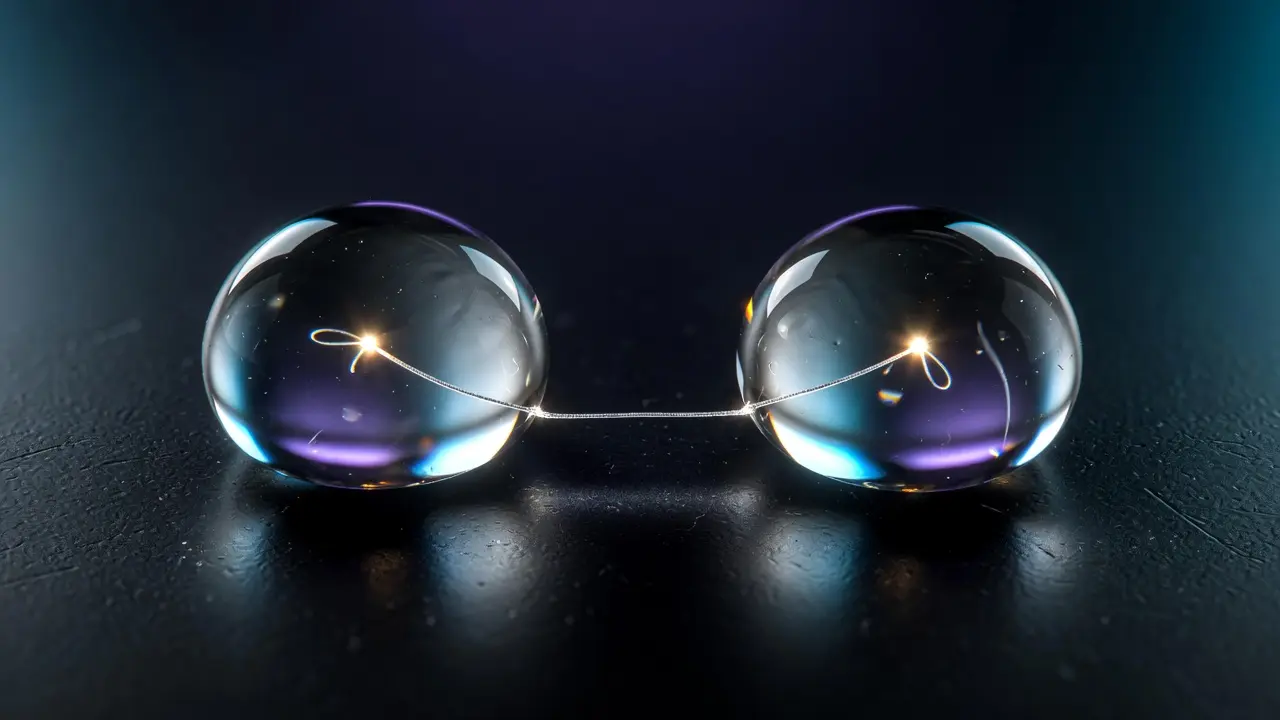
Asymptotic quantum many-body scars (AQMBS), stable, non-thermal states within quantum systems, directly link to quantum phase transitions; these scars emerge as remnants of gapless excitations found at critical points between different phases of matter. These excitations persist even when transformed into “scarred” Hamiltonians, remaining identifiable through bounded energy variance. Modelling this behaviour in chains and two-dimensional models reveals exponentially stable AQMBS exhibiting volume-law entanglement, a characteristic previously unseen in known scarred states.
A direct connection exists between unusual, long-lasting quantum states called asymptotic quantum many-body scars (AQMBS) and fundamental shifts known as quantum phase transitions; these scars originate from energy fluctuations present when systems change phases. The team at The University of Tokyo and collaborating institutions have established a direct connection between stable quantum states called asymptotic quantum many-body scars (AQMBS) and quantum phase transitions; these shifts represent sudden changes in material properties akin to water freezing into ice.
AQMBS are non-thermal states whose stability increases with size, originating from low-energy disturbances, imagine ripples on a pond versus lifting something heavy, present when systems change phases. Modelling this behaviour reveals exponentially stable AQMBS exhibiting volume-law entanglement, where every part of the system needs to communicate with every other for complete information transfer; previously unseen in known scarred states. This raises an important question: can we predict the longevity and connectivity of these unusual quantum states based solely on understanding the transitions that birthed them.
Volume Law Entanglement Arises From Gapless Excitations At Quantum Phase Transitions
Entanglement measures now demonstrate volume-law scaling, a property unattainable in known scarred states, thanks to exponentially stable asymptotic quantum many-body scars (AQMBS). This represents a leap beyond prior AQMBS which exhibited only area law entanglement. Originating from gapless excitations at quantum phase transitions, these AQMBS survive deformation into “scarred” Hamiltonians as states whose energy variance is bounded by the excitation gap itself. The connection allows prediction of scar stability based on how quickly gaps close during phase changes and establishes a direct link between critical points within frustration-free systems and long-lived non-thermal states.
For example, in a Fredkin spin chain exhibiting an entanglement transition, gaps closed at approximately N⁻³·² for certain excited states, a rate directly correlating with corresponding AQMBS stability. Numerical evidence revealed volume law scaling of bipartite entanglement entropy in exponentially stable AQMBS derived from a deformed Motzkin model; this behaviour mirrors ground state behaviour and indicates strong, long-lived states.
Simplified Models Define Scope of Quantum Phase Transition Linkages
Stable quantum states are now convincingly linked to transitions between material phases, offering potential control over these unusual systems. However, the research remains firmly rooted in frustration-free Hamiltonians, models lacking inherent internal conflicts. Exploring whether similar connections exist within *non*-frustration free scenarios presents a significant challenge, raising questions about how widely applicable their findings might be. Understanding AQMBS formation outside idealised conditions could unlock entirely new avenues for using non-thermal behaviour or reveal previously unknown constraints on its emergence.
This discovery offers a route to finding these unusual states even within systems previously thought incapable of sustaining them, opening up new possibilities here. By demonstrating that low-energy disturbances present during phase changes persist after transformation into “scarred” Hamiltonians, mathematical descriptions of systems with altered energy levels, the team has linked AQMBS stability to gap closure rates at critical points, offering a way to predict their longevity.
This research demonstrated that asymptotic quantum many-body scars, stable, non-thermal states, arise from certain quantum phase transitions in frustration-free models. The study proved that gapless excitations surviving deformation become these scars and established that their stability is related to how quickly gaps close during those phase changes; for example, some excited states in Fredkin spin chains exhibited gap closures around N⁻³·² correlating directly with scar stability.
This connection provides insight into identifying long-lived quantum states and suggests the dynamic scaling of the excitation gap determines AQMBS fidelity relaxation time. Researchers observed volume law entanglement within exponentially stable AQMBS derived from a Motzkin model, mirroring ground state behaviour.
👉 More information
🗞 Asymptotic scars arising from the remnants of quantum phase transitions
✍️ Leonard Logarić and Nobuyuki Yoshioka (The University of Tokyo); Shane Dooley (Affiliation: Dublin Institute for Advanced Studies); Tsuyoshi Okubo (Niigata University)
🧠 ArXiv: https://arxiv.org/abs/2610.32037
See today’s quantum computing news on Quantum Zeitgeist for the latest breakthroughs in qubits, hardware, algorithms, and industry deals.