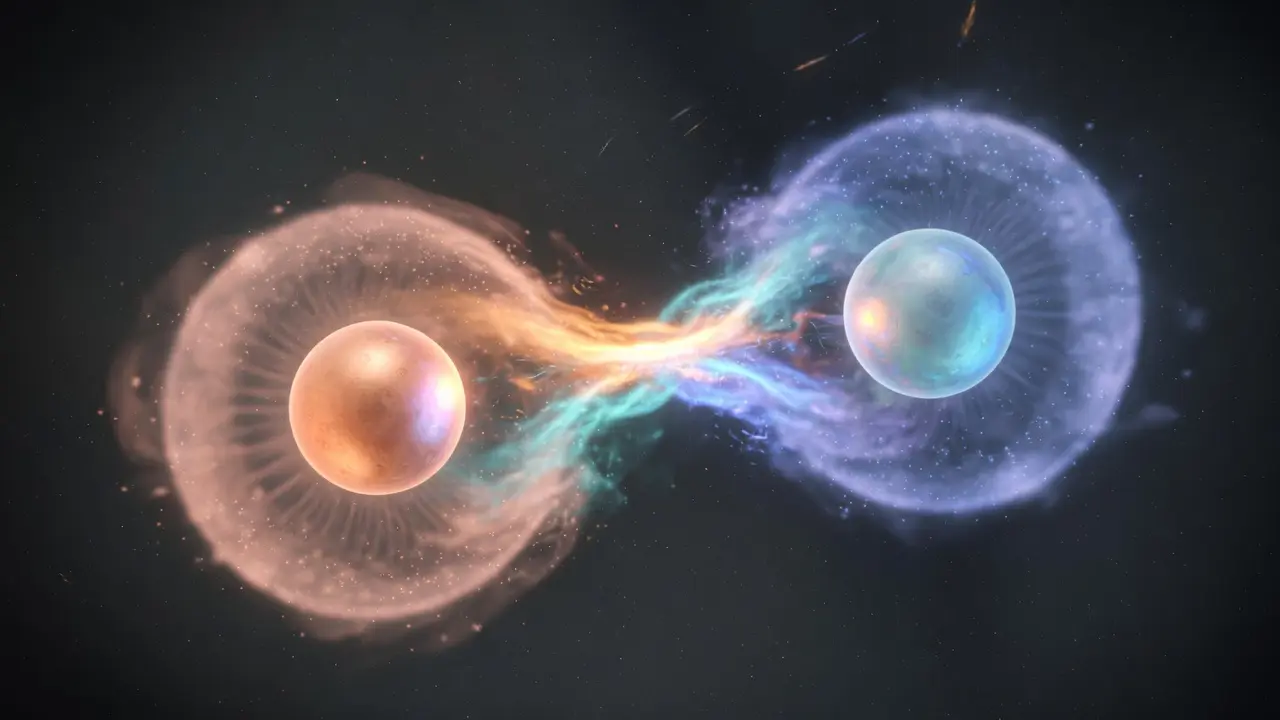
New classes of nonlinear modes exist within Bose-Einstein condensates shaped like spherical shells; these states expand understanding of how matter behaves on curved surfaces compared to flat planes. The work reveals two distinct types of mode: one extending established spherical harmonics, and another arising from interactions that break symmetry. A dynamic oscillation between an unstable soliton and a stable vortex necklace state was also observed, representing a previously unobserved phenomenon in this context.
Newly discovered behaviours occur within Bose-Einstein condensates shaped like spherical shells; these states differ markedly from those observed in flat systems. Two classes of energy configurations were identified: some extent known mathematical descriptions of wave behaviour on spheres, while others emerge solely due to the curved geometry. A dynamic oscillation between an unstable soliton, a self-reinforcing wave packet, and a stable vortex necklace state was revealed, representing a previously unseen phenomenon.
The team at Universität Ulm uncovered new behaviours within Bose-Einstein condensates shaped like spherical shells; these differ sharply from those seen in flat systems. Notably, they also found dynamic oscillations between stable waves called Townes solitons (think of a self-reinforcing ripple) and vortex necklaces (swirling eddies), representing an entirely novel phenomenon. The research reveals that subtle changes, like balancing a pencil upright where any disturbance causes it to fall one way or another, can create distinct outcomes within this system; however, further details regarding specific modes and their stability are detailed below.
Enhanced Nonlinearity Enables Novel Modes and Soliton Dynamics in Spherical Condensates
The dimensionless effective nonlinearity, a key metric for understanding these systems, now reaches values of approximately 4πaN/∆R, exceeding previous limitations imposed on curved geometries where such high levels were unattainable. This threshold allows observation of entirely new modes impossible to achieve within planar configurations. Two distinct classes of nonlinear mode have been identified: one extends established spherical harmonics and their superpositions, while the other originates from symmetry-breaking bifurcations driven by repulsive interactions, a phenomenon absent in simpler flat systems.
Known spherical harmonics, mathematical descriptions of wave behaviour on spheres, are directly extended along with their combinations; this mirrors Townes solitons and vortices previously observed only in flat systems but now stabilised even with attractive interactions or through three-particle effects. Atom repulsion drives the emergence of a second type via symmetry-breaking bifurcations, impossible in planar configurations.
Achieving approximately 4πaN/∆R represents a leap beyond what’s possible in traditional flat geometries, revealing continual energy exchange between an unstable soliton and a stable vortex necklace during oscillations that demonstrate ‘breathing’ dynamics not seen before, suggesting these states are more active than initially anticipated.
Geometry fundamentally alters quantum wave behaviour
This work offers new ways to visualise how quantum particles behave when trapped on curved surfaces, marking an important step towards controlling matter at tiny scales; however, fully charting the stability of these newly discovered states remains challenging. Successful demonstration of oscillating dynamics between unstable solitons and stable vortex necklaces (an unseen ‘breathing’ effect) leaves open whether other oscillatory patterns exist or if this is merely one example within a wider range of behaviours. Despite uncertainty around the breadth of this behaviour, these findings demonstrate that quantum waves on curved surfaces differ from those in flat spaces.
Bose-Einstein condensates shaped like spherical shells reveal how curvature shapes quantum behaviour differently than studies on flat systems where geometry serves as background context. Experiments identified two classes of nonlinear wave configurations: analytical continuations using established mathematical descriptions with spherical harmonics and entirely new states originating from shell curvature alongside atom interactions. This suggests manipulating matter at tiny scales by exploiting geometry; future work will focus on directly observing these unusual wave patterns within Bose-Einstein condensates, exploring potential applications in technologies, and examining whether this ‘breathing’ dynamics represents other oscillatory behaviours.
This research revealed several distinct types of nonlinear modes arising in a spherical Bose-Einstein condensate due to both repulsive and attractive interactions between atoms. These findings demonstrate that the behaviour of quantum waves is fundamentally different on curved surfaces compared to flat systems, for example, some solutions resemble Townes solitons or vortices while others originate from shell curvature itself.
The study observed an oscillating dynamic where energy exchanges between unstable soliton and stable vortex necklace states, demonstrating “breathing” dynamics not previously seen. Researchers intend to directly observe these wave patterns experimentally as they continue exploring potential behaviors within condensates.
👉 More information
🗞 Bose-Einstein condensate in a shell: nonlinear modes and symmetry breaking
✍️ Alexander Wolf and Maxim A. Efremov (Institute of Quantum Technologies); Vladimir V. Konotop (Universidade de Lisboa)
🧠 ArXiv: https://arxiv.org/abs/2610.32249

See today’s quantum computing news on Quantum Zeitgeist for the latest breakthroughs in qubits, hardware, algorithms, and industry deals.