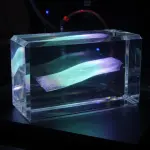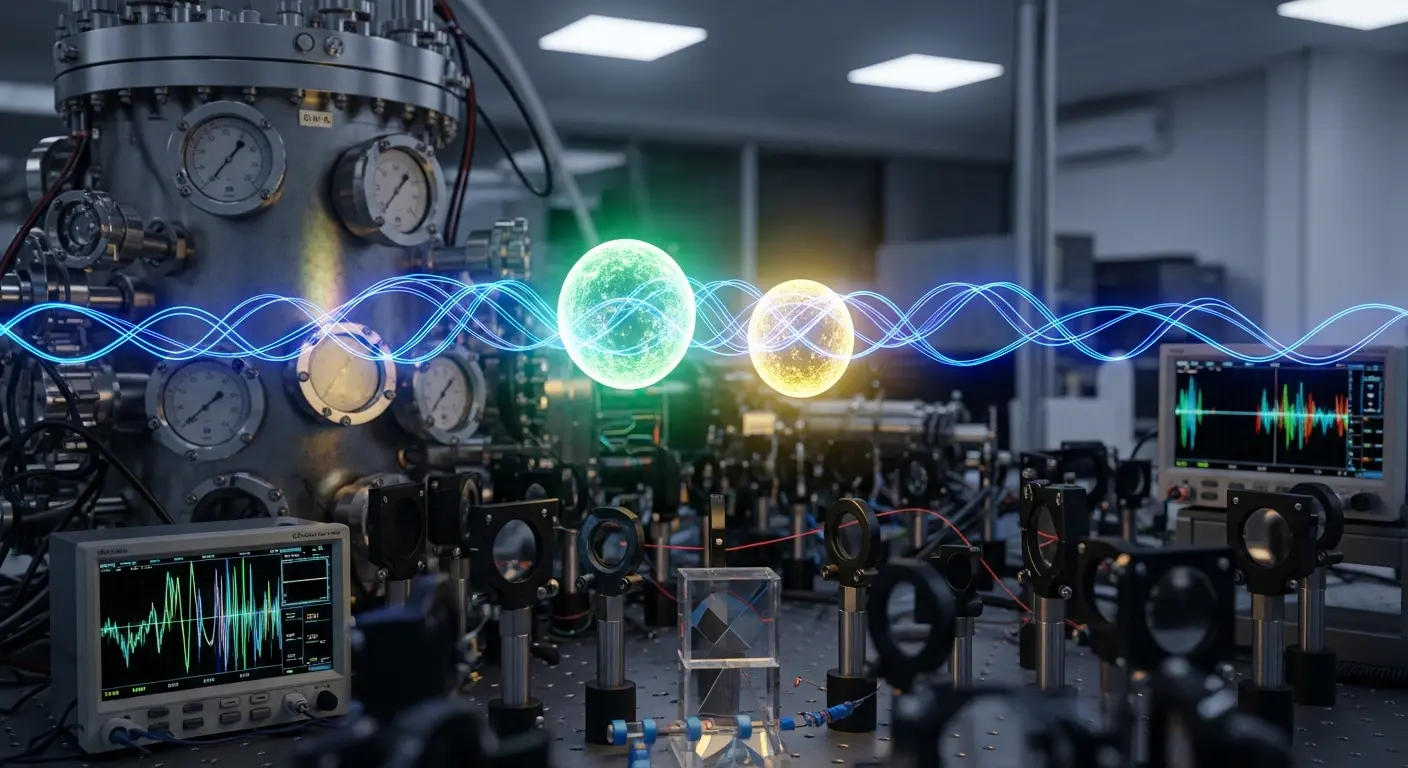
Researchers have achieved an advance in the study of quantum spin liquids, directly observing coherence across approximately 100 lattice sites, a scale previously challenging to attain in these complex systems. The team created a quantum spin liquid spanning over 3000 sites using ultracold atoms meticulously arranged within a two-dimensional optical superlattice, allowing for the exploration of emergent behavior arising from constrained gauge theories. A novel microscopy technique was central to this work, enabling the verification of Gauss’s law through the detection of doubly occupied sites in a “quench experiment.” These findings establish new protocols for simulating and probing highly entangled quantum states, demonstrating large-scale coherence between many-body configurations, according to published research from Simon Karch and colleagues.
2D Optical Superlattices Realize U(1) Quantum Spin Liquids
This achievement addresses a longstanding challenge in the field: the difficulty of detecting the fragile coherences necessary to confirm the existence of quantum spin liquids, which are characterized by extensive superpositions of many-body configurations. The team’s approach leverages locally constrained gauge theories, foundational to understanding particle interactions and the behavior of complex quantum materials, to engineer this exotic state. Demonstrating coherence across approximately 100 lattice sites, the researchers employed round-trip interferometric protocols, directly observing large-scale coherence and providing evidence for extended quantum spin liquid regions. The team reports observing characteristic real-space correlations and momentum-space pinch points, hallmarks of the emergent U(1) gauge structure.
This work, detailed in a recent publication led by Simon Karch, Melissa Will, and colleagues, establishes non-equilibrium quantum simulation as a viable pathway for accessing and investigating highly entangled states that are not readily achievable through systems in thermal equilibrium, opening new avenues for exploring complex quantum phenomena. The findings suggest a powerful method for probing exotic states beyond those dictated by the engineered Hamiltonian, potentially advancing the understanding of fundamental interactions in quantum materials.
Round-Trip Interferometry Confirms Large-Scale Coherence (~100 Sites)
Researchers have moved beyond creating quantum spin liquids to directly verifying their coherent nature across a large scale, utilizing a novel interferometric approach. Previous experiments struggled to detect the fragile coherences necessary to confirm these exotic states, but the team successfully demonstrated coherence extending across approximately 100 lattice sites, a substantial leap in experimental capability. A key innovation was the development of a new microscopy technique designed to validate Gauss’s law within the quantum spin liquid; this was accomplished by specifically detecting doubly occupied sites following a “quench experiment.” Confirming fundamental physical laws within this emergent state provides crucial validation of the underlying theoretical framework, as the researchers report, “We demonstrate Gauss’s law validity in a quench experiment.”
Our results establish non-equilibrium quantum simulation protocols as a powerful route for accessing and probing exotic, highly-entangled states beyond those hosted by the engineered Hamiltonian in thermal equilibrium.
Monika Aidelsburger



See today’s quantum computing news on Quantum Zeitgeist for the latest breakthroughs in qubits, hardware, algorithms, and industry deals.