
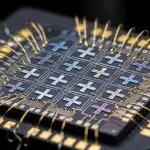
A $37.5 million grant renewal will propel the University of Maryland-led NSF Quantum Leap Challenge Institute for Robust Quantum Simulation into a new five-year research phase, building on an initial $25 million award from 2021. The funding supports work like that of physicist Alicia Kollár, who developed a quantum chip central to the institute’s efforts to model complex quantum systems beyond the reach of conventional computers.
University of Maryland President Darryll J. Pines describes the campus and surrounding region as a hub for quantum technology and economic growth, highlighting the institute’s role in this developing area. This sustained investment positions NSF RQS to expand its scientific agenda and strengthen partnerships with academia, federal labs, and industry.
NSF RQS Advances: Initial Achievements in Fault-Tolerant Simulation
A $37.5 million renewal award from the U.S. National Science Foundation builds on an initial $25 million investment from 2021. This sustained funding underscores the federal commitment to advancing quantum simulation as a practical tool for scientific discovery, a field where progress requires both technological innovation and a skilled workforce. During its first funding cycle, NSF RQS researchers achieved breakthroughs in fault-tolerant quantum simulation using neutral atoms, alongside new methods for verifying quantum advantage on analog simulators.
These advances have brought robust quantum simulation closer to practical application, evidenced by the collective output of over 600 papers generating nearly 17,000 citations from NSF RQS researchers. Childs is stepping down, with Mohammad Hafezi of the University of Maryland assuming the director role, and Michael Gullans of NIST serving as deputy director. The renewed funding will support a shift toward focusing on scalability and addressing significant scientific problems.
Researchers will concentrate on three themes: simulating interacting fermions, fermion-boson interactions, and dissipative quantum systems, studying how quantum systems interact with their environments. Hafezi said, “We are at the cusp of determining exactly what quantum computers can and cannot do in the near future.” Realizing that potential will require vibrant partnerships among universities, federal laboratories and private industry, and we’re grateful for this renewed support to help lead that effort.
Beyond research, the institute will expand its educational mission, building on programs that have already reached 75 K-12 teachers and introduced over 2,000 students to quantum concepts. Gretchen Campbell, associate vice president for quantum research and education at UMD, emphasized the importance of workforce development, stating, “By connecting students, educators and researchers across that entire pipeline, we can help ensure the talent needed to advance quantum science and technology is ready when the next breakthroughs arrive.”
Our researchers in quantum simulation are an important part of the vibrant quantum ecosystem we’ve built.
Darryl J. Pines, UMD President
$37.5M Award Fuels Quantum Simulation Engineering & Workforce Development
This sustained funding recognizes the institute’s progress in developing methods to verify quantum systems and reduce errors in increasingly sophisticated simulations, essential for modeling complex quantum phenomena beyond the reach of conventional computers. Harvard University joins the consortium, expanding collaboration with UMD, Duke University, Princeton University, Yale University, and the National Institute of Standards and Technology (NIST). NSF RQS has already demonstrated tangible results, producing over 600 research papers garnering nearly 17,000 citations during its first funding cycle.
Beyond research output, the institute trained more than 400 graduate students and postdoctoral researchers, simultaneously establishing programs to bolster the national quantum workforce. Andrew Childs, who directed NSF RQS for its first five years, said, “NSF’s investment in the QLCIs established hubs for research on critical topics in quantum information science at a time when the field is rapidly advancing.” The renewed funding signals a shift toward concentrating on scalability and tackling significant scientific challenges.
The institute’s work is supported by the University of Maryland Institute for Advanced Computer Studies (UMIACS), which coordinates research across partner institutions. UMD President Darryll J. Pines noted, “Our researchers in quantum simulation are an important part of the vibrant quantum ecosystem we’ve built.” Campbell added, “Preparing the future quantum workforce means creating opportunities at every stage—from K-12 classrooms to graduate education and professional careers.”
For more than four decades, NSF has been laying the foundational groundwork of research and discovery that is powering today’s modern quantum computing, sensing and communication.
Brian Stone, performing the duties of the NSF director


See today’s quantum computing news on Quantum Zeitgeist for the latest breakthroughs in qubits, hardware, algorithms, and industry deals.