Four-level atoms within a specially designed cross-cavity system are now achieving steady-state superradiance without relying on traditional, high-quality cavity conditions. Jarrod T. Reilly of JILA and the University of Colorado, along with colleagues, demonstrate this phenomenon using collective dissipative dynamics, a method where atoms synchronize light emission. The resulting superradiant states exhibit unusual super-Poissonian photon statistics, necessitating a complex description beyond standard physics. Because superradiant decay imparts a momentum impulse to the atoms, the system generates substantial hybrid entanglement linking the atoms’ spin and their motion, with potential for improved acceleration sensing.
Bad-Cavity Setup Enables Steady-State Superradiance
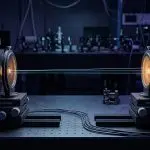
Steady-state superradiance, achieved in a novel cross-cavity system, now occurs without reliance on traditional high-finesse, or “good,” cavity conditions. This system symmetrically couples four-level atoms using transitions between electronic and motional states along perpendicular axes, establishing a new pathway to sustained superradiance. The configuration uses one cavity for collective atomic decay and another, coupled with a coherent drive, for collective pumping through an off-resonant Raman transition.
A complete quantum description is therefore required to identify genuinely beyond-mean-field effects and to fully uncover the quantum potential of dissipatively generated many-body states, according to the researchers. To address this complexity, the team developed an exact master equation simulation technique, capitalizing on the strong symmetries present in the system’s jump operators.
This approach allows for a more accurate understanding of the quantum phenomena at play, moving beyond approximations. This means the emission of light isn’t merely an energy release, but also a physical nudge to the atoms, linking their internal spin state to their movement. “Spin-momentum hybrid entanglement is minimized near W~ while entanglement with the environment is maximized, indicating that spin-momentum correlations may play a key role in the system’s sensitivity to acceleration,” the researchers note.
They suggest this connection could be important for developing highly sensitive acceleration sensors, though further investigation is planned to explore this feature fully. The intensity of the x-cavity and z-cavity both signify superradiance when proportional to O(N^2).
Four-Level Atoms Drive Collective Dissipative Dynamics
Researchers demonstrated this phenomenon by using solely collective dissipative dynamics within a cross-cavity system, a departure from traditional methods requiring good-cavity conditions for superradiance. Analysis of the system’s dynamics reveals the presence of nonclassical properties within the steady-state superradiant states. Specifically, the observation of super-Poissonian photon statistics indicates a need for a theoretical description extending beyond standard mean-field physics.
The master equation central to the theoretical analysis describes the interplay between the atoms’ internal and external degrees of freedom. Its complexity stems from the scaling of the Hilbert space with the number of atoms. For instance, simulations become computationally challenging as the Liouville space scales with 16 raised to the power of the number of atoms, limiting exact numerical simulations to small ensembles.
Exact Master Equation Simulation Captures System Symmetries
An exact master equation simulation technique reveals how symmetries within a cross-cavity system allow for analysis of superradiance beyond standard approximations. Researchers developed this method to address the complex dynamics arising from the interplay of atomic internal and external degrees of freedom, a challenge that quickly overwhelms conventional computational approaches. The simulation demonstrates a transition in the superradiant light output, shifting from near-coherence to highly bunched emission as the collective pump rate surpasses the collective decay rate in one cavity, with the opposite occurring in the other.
This behavior arises from higher-order correlations inaccessible to mean-field techniques. The team’s ability to directly access all-order steady-state moments through this simulation provides an accurate description of light emitted from these nonclassical many-body states, confirming the inadequacy of simpler models.
Super-Poissonian Statistics Signal Beyond-Mean-Field Effects
Steady-state superradiance achieved in a newly designed cross-cavity system exhibits photon statistics exceeding those expected from classical light sources, specifically displaying super-Poissonian behavior where photons arrive in noticeable bunches. This observation indicates that standard theoretical approaches, relying on mean-field physics, are insufficient to fully describe the system’s quantum properties, demanding a more comprehensive quantum description. The system uses four-level atoms coupled within cavities operating in the bad-cavity regime, a departure from traditional superradiance setups that typically require good-cavity conditions.
The research team developed a fully quantum model using the inherent symmetries within the collective spin model to accurately capture the system’s behavior. This model details how the two cavities, operating along perpendicular axes, not only drive transitions between atomic states but also generate both interparticle entanglement and a unique spin-momentum entanglement. The critical point at W = marks a phase transition where light intensity, fluctuations, atomic inversion and quadratic Casimir operators all exhibit altered behavior.
Spin-Momentum Entanglement Arises from Superradiant Decay
The observed shrinking of superradiant components in the x- and z-cavities occurs as collective pumping rates surpass collective decay rates, a phenomenon detailed in accompanying visualizations. The superradiant decay process itself directly links the spin and momentum of the atoms, as each spin flip induced by the collective lowering operator simultaneously imparts a momentum kick along the corresponding cavity axis. The team’s work suggests the potential to harness these entangled states for quantum-enhanced acceleration sensing, and even to “steer” the system towards dark states to further amplify the fraction of trajectories exhibiting significant entanglement.
“We also found that the superradiant bursts and associated momentum kicks generate both interparticle and spin-momentum entanglement, which can potentially be harnessed for quantum-enhanced sensing and quantum information processing,” the researchers report, highlighting the practical implications of their findings. The researchers note that maintaining spin-momentum entanglement requires careful consideration of potential decoherence mechanisms, such as spontaneous photon emission that could remove atoms from the relevant quantum subspace.
Heralded Measurements Generate Particle-Particle Entanglement
Superradiant decay within a newly realized cross-cavity system directly prepares atoms in an entangled state with measurable particle-particle correlations, a phenomenon demonstrated through an exact master equation simulation technique. This preparation opens avenues for potential applications in quantum-enhanced acceleration sensing, capitalizing on the linked spin and momentum states.
“Addressing these issues will help establish a clear pathway toward quantum technologies that can be realized in state-of-the-art laboratory platforms,” the researchers state. Beyond the creation of entangled states, the work looks at the fundamental requirements for generating true quantum entanglement, a question increasingly relevant as quantum technologies mature.
Hybrid Entanglement Links Spin and Motional Degrees of Freedom
Superradiant decay imparts a physical momentum to atoms, creating a direct link between their spin and motion. Researchers have now demonstrated substantial hybrid entanglement between these degrees of freedom. This entanglement arises even within a system where energy is lost to the environment, a fully dissipative system, challenging conventional expectations for maintaining quantum coherence. The observed effect stems from the momentum impulse accompanying each emission of light, physically nudging the atoms as they transition between energy levels.
This approach became necessary because the system’s properties extend beyond what standard, simplified models can accurately predict. Analysis of the steady-state coherent information, a measure of quantum correlations, reveals that the spin and x-momentum degrees of freedom are demonstrably entangled. Because superradiant decay is accompanied by a momentum impulse along the corresponding cavity axis, the system exhibits substantial hybrid entanglement between the atoms’ spin and motional degrees of freedom at steady state.
Cross-Cavity System for Quantum-Enhanced Acceleration Sensing
Using symmetries within its jump operators to enable an exact master equation simulation technique, the design of this system moves beyond approximations needed for typical superradiance studies. This momentum transfer, generated by the superradiant bursts, creates both interparticle and spin-momentum entanglement, a phenomenon that persists even within this fully dissipative system. Heralded measurements of the two cavity outputs prepare a state with significant particle-particle entanglement with prospects for quantum-enhanced acceleration sensing.
The emergence of a subspace of dark states, atomic configurations that do not radiate, creates nontrivial interference patterns that could be exploited for improved accelerometry with postselection techniques. Future work will focus on “steering” the system towards these dark states to maximize the spin-momentum entanglement available for sensing applications, potentially enhancing the sensitivity of future devices.
👉 More information
🗞 Nonclassical many-body superradiant states with interparticle and spin-momentum entanglement
✍️ Jarrod T. Reilly, Gage W. Harmon, John Drew Wilson, Murray J. Holland and Simon B. Jäger
🧠 DOI: http://link.aps.org/doi/10.1103/q6wz-7by8

See today’s quantum computing news on Quantum Zeitgeist for the latest breakthroughs in qubits, hardware, algorithms, and industry deals.