

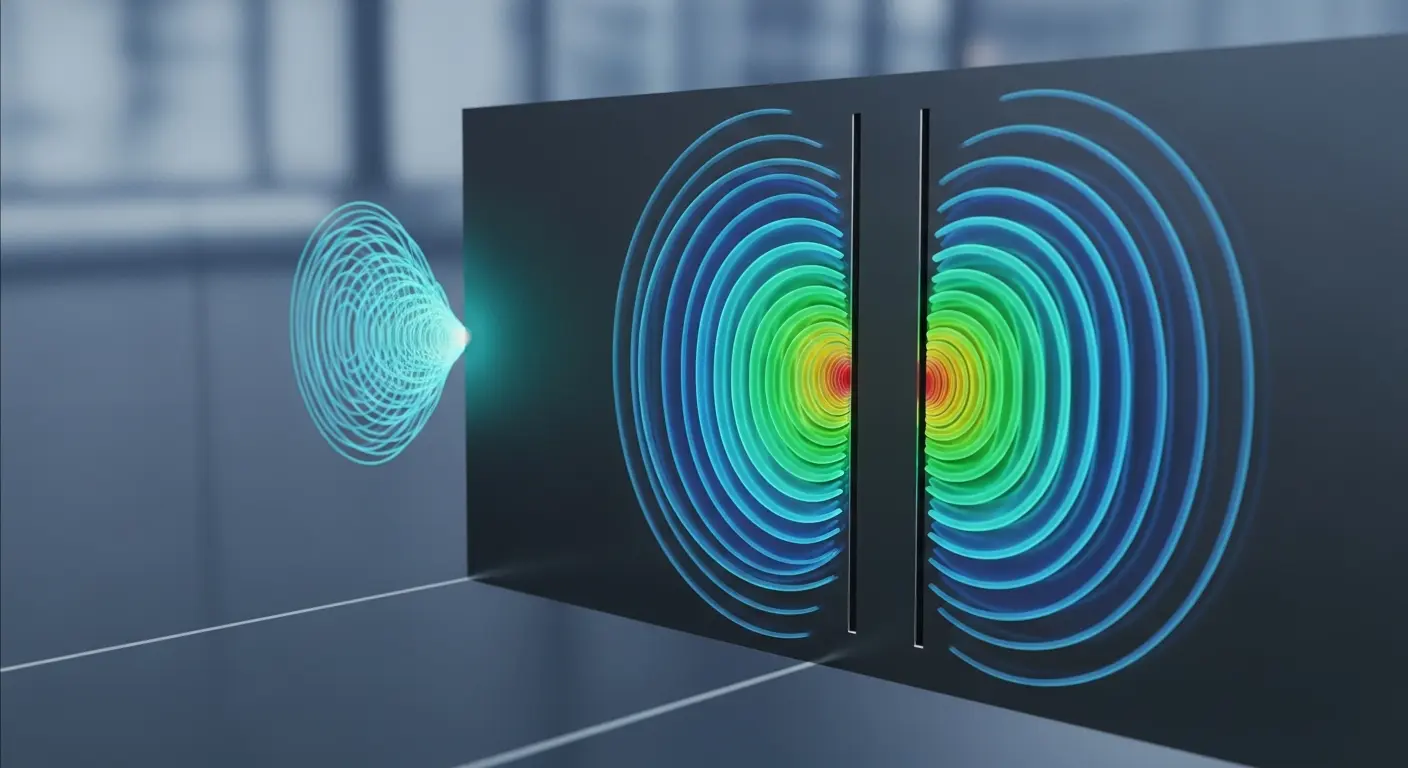
Hans Maassen and Burkhard Kümmerer of the Institut für Theoretische Physik, Universität Göttingen, have proven the no-broadcasting theorem, defining conditions for perfect quantum state copying. The proof clarifies the link between broadcasting and the established no-cloning theorem using quantum probability theory and C-star-algebras, providing key insights into the fundamental principles of quantum information processing.
Density matrix commutation clarifies no-cloning and no-broadcasting theorem proofs
A key advancement in quantum information theory has been achieved, increasing the clarity of proofs for fundamental concepts. Previously, establishing the no-broadcasting theorem required proofs described as “quite nontrivial”; the new approach offers a more transparent and detailed demonstration of this theorem, alongside a refined proof of the no-cloning theorem. Quantum states can only be copied if their density matrices, mathematical representations of the states, belong to a specific family of commuting matrices, dictating the possibility of perfect replication. The density matrix, denoted by ρ, is a Hermitian matrix that completely describes the quantum state of a system. Its elements represent the probabilities of observing specific outcomes when measuring the system. Commutation, in this context, means that if ρ1 and ρ2 are two density matrices, then ρ1ρ2 = ρ2ρ1. This condition is crucial because it ensures that measurements performed on the copied states do not disturb each other, a prerequisite for perfect replication.
This discovery strengthens the theoretical foundations of quantum information science and opens avenues for future exploration. Establishing clearer, more accessible foundations for established quantum principles aids wider understanding and enables further exploration of quantum information technologies. Any quantum operation, such as evolving a system or discarding information, can be broken down into a combination of coupling to an auxiliary system, free evolution, and restriction to a subsystem. This decomposition is based on the Stinespring theorem, a cornerstone of quantum operator algebras, which allows for a systematic analysis of quantum operations. Understanding these fundamental building blocks is essential for designing and implementing complex quantum algorithms and protocols. The implications extend to areas such as quantum cryptography, where secure communication relies on the impossibility of perfectly copying quantum information.
Framing these theorems within quantum probability theory strengthens the theoretical foundations of quantum information science. Quantum probability theory replaces classical probability with a framework based on C-star-algebras and unital completely positive maps. A unital completely positive map is a mathematical function that preserves the positivity of quantum states and acts on the entire algebra. This approach allows for a more rigorous and general treatment of quantum phenomena, extending beyond the limitations of classical probability. A solid, rigorously defined basis for investigating the no-broadcasting theorem and its implications for secure communication and computation is now available, although a broader mathematical framework remains a goal. This work clarifies the relationship between quantum operations and their fundamental components, providing a more intuitive understanding of quantum processes. The use of C-star-algebras provides a powerful tool for analysing the structure of quantum states and operations, enabling a deeper understanding of their properties.
The work establishes a clear link between the mathematical structure of quantum states and the possibility of perfect replication, a process called broadcasting. Copying multiple quantum states simultaneously requires a specific compatibility; specifically, their density matrices must ‘commute’, meaning the order of multiplication is irrelevant, when modelled using C-star-algebras, a complex branch of mathematics. This refined proof of the no-broadcasting theorem, alongside a strengthened no-cloning theorem, clarifies fundamental limits on manipulating quantum information and highlights the constraints imposed by the mathematical description of quantum states. The findings provide a more robust understanding of these limitations, crucial for developing future quantum technologies. The no-cloning theorem, a related result, states that it is impossible to create an identical copy of an arbitrary unknown quantum state. Both theorems are fundamental to the security of quantum key distribution protocols, such as BB84, which rely on the impossibility of eavesdropping without disturbing the quantum state.
Simplified no-broadcasting theorem proofs enhance quantum information foundations
Technische Universität Darmstadt scientists have refined proofs of fundamental quantum limits, strengthening the theoretical foundations of quantum information science. Their work addresses a persistent challenge in demonstrating the no-broadcasting theorem, establishing conditions for perfectly copying quantum states, which previously relied on mathematically complex arguments. The team acknowledges that while offering greater clarity, their approach remains confined to the specific mathematical framework of C-star-algebras, prompting questions about its broader applicability and potential extensions to other quantum models. C-star-algebras provide a powerful and versatile framework for describing quantum systems, but alternative mathematical formalisms, such as those based on operator systems or quantum categories, may offer different perspectives and potentially lead to new insights.
The researchers at Darmstadt have further refined proofs of established principles, clarifying the no-broadcasting theorem, important for secure communication, within a specific mathematical framework, and exploring the implications of these findings for future quantum technologies. These refinements contribute to a more complete understanding of quantum information limits. The team’s work provides a valuable contribution to the field, paving the way for further advancements in quantum communication and computation. The no-broadcasting theorem, in particular, has implications for quantum network design, where the ability to reliably distribute quantum information is crucial. Understanding the limitations imposed by this theorem is essential for developing efficient and secure quantum communication protocols. The use of quantum repeaters, which overcome the limitations of signal loss in long-distance quantum communication, relies on the ability to perform certain types of quantum operations without violating the no-broadcasting theorem. Further research could explore the extent to which these theorems hold in more general quantum models, such as those incorporating noise or decoherence, which are inevitable in real-world quantum systems. Investigating the robustness of these theorems under realistic conditions is crucial for developing practical quantum technologies.
The researchers successfully clarified the no-broadcasting theorem, a principle governing the limits of copying quantum information, within the mathematical framework of C-star-algebras. This work offers a more accessible understanding of why perfectly copying unknown quantum states is impossible, which is fundamental to the security of quantum communication. The team acknowledges that extending these findings to broader quantum models remains an open question. Their refinements contribute to a more complete understanding of quantum information limits and have implications for the design of quantum networks.
👉 More information
🗞 Copying Quantum States
✍️ Hans Maassen and Burkhard Kümmerer
🧠 ARXIV: https://arxiv.org/pdf/2607.02408



See today’s quantum computing news on Quantum Zeitgeist for the latest breakthroughs in qubits, hardware, algorithms, and industry deals.



