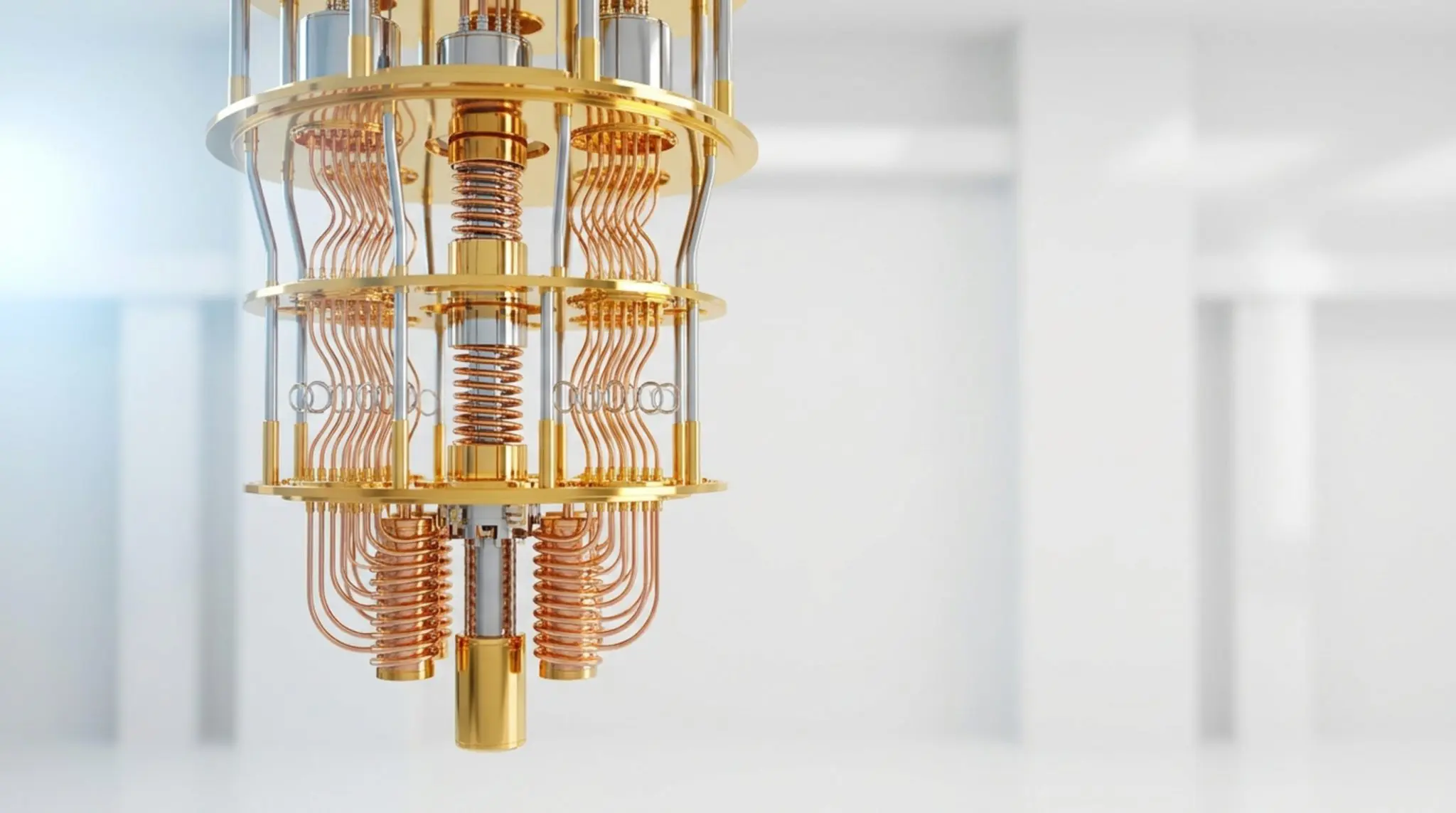
Quantum Machines and Academia Sinica have dramatically accelerated a critical step in quantum computing, reducing two-qubit gate calibration from approximately 15 minutes to just 25 seconds. This speed-up, achieved by directly connecting Quantum Machines’ OPX1000 controller to a classical GPU accelerator via OPNIC, enables real-time hardware feedback for a reinforcement learning agent, the company says. Beyond single gates, the agent simultaneously optimized all parameters of a five-qubit circuit to prepare a GHZ state, demonstrating a path toward continuous calibration for larger quantum processors.
Reinforcement Learning Achieves 25-Second Two-Qubit Gate Calibration
This speed-up addresses a critical bottleneck in scaling quantum processors, where maintaining calibration across hundreds or even thousands of qubits demands faster, more autonomous routines capable of optimizing numerous parameters simultaneously. The core of this advancement lies in the direct connection of Quantum Machines’ OPX1000 controller to the GPU via OPNIC, a technology that enables the rapid exchange of data crucial for the agent’s learning process, according to the company.
Traditional control hardware often struggles to keep pace with the dynamic drifts inherent in quantum processors; OPNIC circumvents this limitation by allowing high-compute tasks to occur within the calibration loop on microsecond timescales. This is particularly important because the optimal operating regime for a QPU is not static, influenced by both fabrication imperfections and environmental fluctuations that necessitate frequent recalibration.
As the demand for utility-scale quantum computing increases, with recent progress suggesting fewer qubits are needed for fault tolerance but requiring millions to billions of gates, this responsiveness becomes paramount. Academia Sinica’s tunable qubits with tunable couplers served as the testbed for this accelerated calibration process.
Each qubit’s frequency and gate operations are controlled through OPX1000 microwave FEM drives, and the architecture’s tunability, while enabling rapid operation, also contributes to parameter drift requiring constant adjustment. The team focused on calibrating the controlled-Z (CZ) gate, a fundamental operation in quantum computing, which relies on manipulating the interaction between qubits via a coupler.
The process of bringing up a single CZ gate manually involves a sequential series of steps, including coupler-versus-qubit flux sweeps, CZ phase calibration, leakage checks, single-qubit phase compensation, and a final confusion matrix analysis, each contributing to the overall 15-minute timeframe, the company says.
According to source material detailing the manual process, “The flux sweeps to find the operating point is the longest, requiring five minutes.” The reinforcement learning agent, however, streamlines this process by continuously learning from the QPU itself, generating its own data through interaction and adapting to the changing environment in real time. Unlike conventional machine learning models that require pre-labeled data, reinforcement learning is well-suited to this dynamic scenario.
The agent explores the parameter space, iteratively refining its control settings until an optimal configuration is found, and then works to maintain high fidelity as parameters inevitably drift, Quantum Machines reports. “What changes is how quickly they can be recovered,” emphasizing the shift from lengthy manual recalibration to a rapid, automated response. The implications of this work extend to the broader challenge of operating larger quantum processors.
Maintaining fidelity requires not just achieving initial calibration but also continuously tracking and correcting for drifts that can reduce performance by 5 to 15 percent, particularly in sensitive Z-phases. The team’s approach offers a pathway towards continuous, multi-qubit calibration routines essential for stable, long-running quantum computations.
Quantum Machines fabricates its QPUs on a wafer-scale semiconductor process, aiming to create a platform for industrial-scale algorithm development. “Deployment at that scale requires control that is in situ, fast, and at high fidelity, continuously, while it computes,” highlighting the need for adaptive control systems that can respond to environmental changes as they occur. This closed-loop system, facilitated by OPNIC and the reinforcement learning agent, represents a step towards realizing that vision.
The ability to rapidly retune parameters and maintain high fidelity is not merely an incremental improvement, but a fundamental requirement for scaling quantum computing beyond the limitations of manual calibration. “Fidelity can fall by 5 to 15 percent depending on how far the parameters have wandered. You see it most directly in the Bell-state fidelity after a CZ,” underscoring the tangible impact of this technology on computational quality.
CZ Gate Calibration: Flux Control and Phase Correction
The process of calibrating a two-qubit gate, a foundational step before executing any quantum algorithm, has been dramatically accelerated through a novel application of reinforcement learning. This speed-up isn’t simply a matter of convenience, but a necessity for scaling quantum processors to the size and stability required for practical computation. This advancement stems from a tightly integrated quantum-classical system, which enabled a reinforcement learning agent to continuously tune the gate parameters based on immediate measurements from the quantum processor itself, bypassing the limitations of slower, manual calibration loops.
The core challenge in calibration lies in identifying and maintaining a narrow operating regime where the quantum processor delivers reliable gate performance. This requires navigating a high-dimensional parameter space encompassing pulse amplitudes, frequencies, phases, timings, and coupler settings. However, this optimal operating point isn’t static; device imperfections and environmental fluctuations cause parameters to drift over time, transforming the calibration process into a continuous, moving-target optimization problem.
The team focused specifically on the controlled-Z (CZ) gate, recognizing its hardware dependence and the frequency with which it requires adjustment. Correcting these phases involves a complex sequence of steps, each a multi-dimensional optimization in itself, often requiring iterative adjustments as the system drifts, the company’s account states. The reinforcement learning agent, in contrast, learns to explore the parameter space and converge on optimal settings through repeated interactions with the QPU, effectively automating and accelerating this entire sequence.
The implications of this automated approach extend beyond simply reducing calibration time. In superconducting circuits, relevant parameters can drift on timescales far shorter than the duration of complex algorithms. A 15-minute recalibration is impractical during computation, and without rapid adaptation, gate quality and computational integrity degrade in tandem. The team’s system addresses this by continuously tracking and correcting residual Z-phases, which are particularly sensitive to parameter changes and directly impact computation quality.
Academia Sinica’s in-house fabrication of QPUs, utilizing a wafer-scale semiconductor process, has been instrumental in enabling this level of control. The agent generates its own data by interacting with the QPU, learning from the environment itself, and adapting to changing conditions in real time.
Multi-Parameter Drift Challenges Manual QPU Calibration
Manual calibration of a single high-fidelity two-qubit gate routinely requires approximately 15 minutes, a bottleneck that becomes increasingly problematic as quantum processors expand in size and complexity. This lengthy procedure limits the potential for long-running workloads and hinders the development of stable, reliable quantum computations. Each QPU exhibits unique imperfections stemming from its fabrication, and its operational environment is subject to constant drift. Calibration, therefore, isn’t a one-time optimization but a continuous process of finding and updating optimal control settings.
The team demonstrated a solution by implementing a reinforcement learning agent to automate and accelerate this calibration process, achieving a dramatic reduction in tuning time, Quantum Machines claims. This configuration allows for a closed-loop system where measurements from the quantum chip are processed rapidly, informing the agent’s next adjustment. “The parameters still drift,” and the result is a calibration time of roughly 25 seconds for a two-qubit gate, a nearly six-fold speedup over manual methods.
This capability signifies a crucial step toward scaling calibration routines to handle the complex interactions within larger quantum systems. The team’s approach differs from traditional machine learning methods, which typically require extensive pre-training data. The intricacies of calibrating a controlled-Z gate, a key component in many quantum algorithms, further illustrate the complexity of the task. The team identified residual Z-phases as a primary source of error, noting that their sensitivity to parameter changes necessitates continuous tracking and correction.
As quantum processors move toward utility-scale computing, the demand for continuous, in-situ control is becoming increasingly critical. The team’s system addresses this by enabling rapid retuning, allowing the system state to be brought back up to date in a very short time.
Five-Qubit GHZ State Optimization with Continuous Tuning
The ability to maintain quantum coherence during computation received a boost as Quantum Machines and Academia Sinica demonstrated a system capable of optimizing a five-qubit circuit simultaneously. Beyond accelerating calibration of individual qubit interactions, the team’s approach successfully prepared a GHZ state, a crucial entangled state for quantum information processing, by optimizing all circuit parameters at once, Quantum Machines says. This signifies a move toward handling the complex interplay of multiple qubits, a necessary step for scaling quantum processors.
This speed-up isn’t merely about faster individual gate calibration, but about maintaining performance over time. Parameters within quantum processors inevitably drift due to environmental factors and device imperfections. “The parameters still drift.” The tunable couplers, adjusted by flux lines, control the strength of the interaction between neighboring qubits, effectively switching the CZ gate on or off. The team’s system leverages this tunability, not just for initial calibration, but for continuous, in-situ control.
The reinforcement learning agent doesn’t rely on pre-existing datasets for calibration. This approach is particularly advantageous because it avoids the need for extensive pre-training, which can be computationally expensive and may not accurately reflect the specific characteristics of a given quantum processor. This capability is essential for maintaining the integrity of quantum computations over extended runtimes, minimizing downtime, and tightly integrating classical compute for decoding, feedback, and further calibration. The system’s ability to optimize a five-qubit GHZ state demonstrates its potential to scale to even more complex quantum circuits and architectures.
Source: https://www.quantum-machines.co/resources/blog/reinforcement-learning-two-qubit-gate-calibration/


See today’s quantum computing news on Quantum Zeitgeist for the latest breakthroughs in qubits, hardware, algorithms, and industry deals.