After nearly 40 years since the discovery of cuprates, copper-based compounds promising lossless electricity transmission, the mechanisms behind their superconductivity remain elusive. Researchers at the Institut national de la recherche scientifique (INRS), led by Professor Fabio Boschini, have now published findings in Nature Physics revealing a competition between superconductivity and the pseudogap, a mysterious quantum state.
“The pseudogap is one of the greatest mysteries in condensed-matter physics,” says Professor Boschini, a specialist in ultrafast spectroscopy of quantum condensed matter at INRS, adding that understanding its interaction with superconductivity is essential to explaining high-temperature superconductivity. The INRS team used a pulse of light to temporarily suppress superconductivity, observing how the material responded in real time and uncovering previously hidden electronic states.
INRS TR-ARPES Reveals Competition Between Pseudogap and Superconductivity
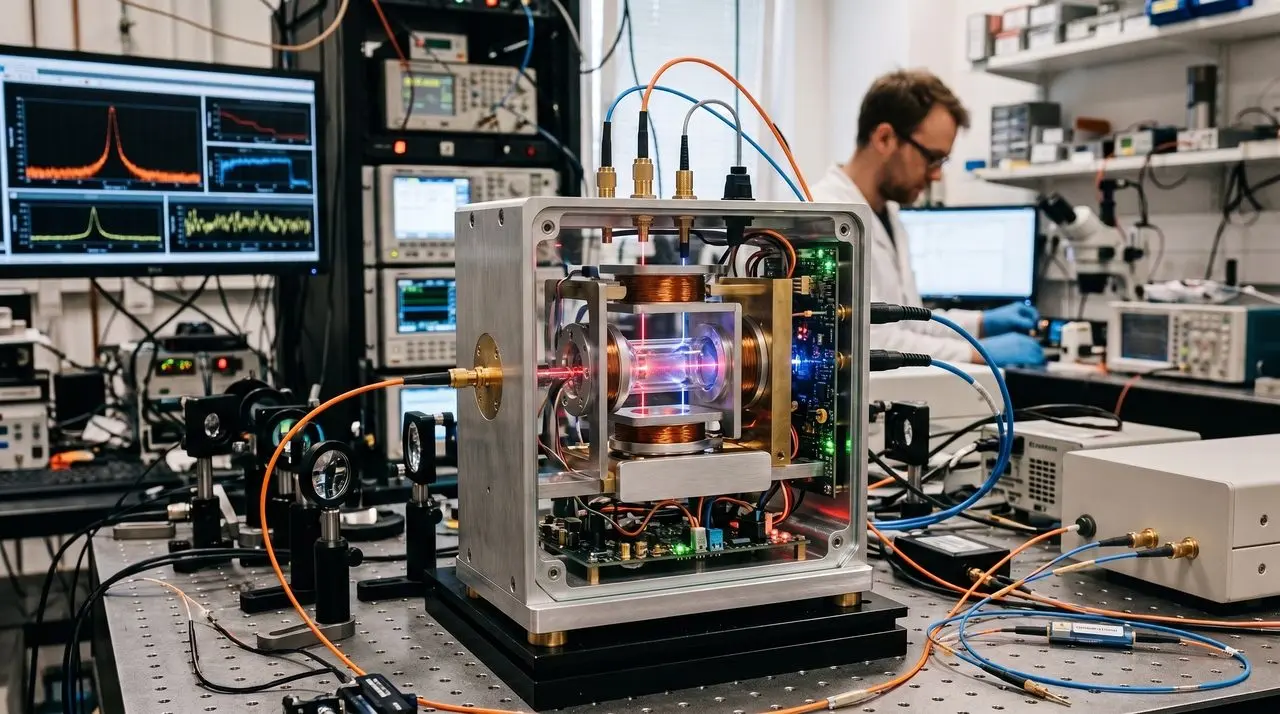
The INRS team directly observed the re-emergence of superconductivity after temporary suppression, a feat enabled by the time- and angle-resolved photoemission spectroscopy (TR-ARPES) system at the Advanced Laser Light Source (ALLS) laboratory. This observation revealed a competitive relationship between superconductivity and the pseudogap, a quantum state that has puzzled physicists for decades. When superconductivity was suppressed using a pulse of light, the pseudogap immediately appeared, and conversely, the pseudogap diminished as superconductivity returned; this dynamic challenges the previous idea that the pseudogap might enable superconductivity.
Researchers also accessed previously hidden electronic states through this light-induced manipulation, providing a new window into the behavior of these complex materials. “Thanks to the unique capabilities of the TR-ARPES system at the ALLS laboratory at INRS, we were able to directly observe what happens when superconductivity temporarily disappears and then re-emerges.
It is a bit like uncovering missing frames from a film that scientists have been trying to piece together for decades,” said Dario Armanno, a PhD student at INRS and first author of the study. The findings have implications for the development of future quantum technologies, and contribute to Canada’s National Quantum Strategy.
Olivier Gingras, Associate Research Scientist at the Flatiron Institute’s Center for Computational Quantum Physics, said the pseudogap and superconducting states in cuprates are among the most complex phenomena to reproduce theoretically and that their study reveals they compete with one another and provides new insight into their behavior when both are excited simultaneously. Professor Fabio Boschini emphasized the importance of understanding this interplay, noting, “Understanding how it interacts with superconductivity is essential if we want to explain why these materials can carry electricity without energy loss at unusually high temperatures.”
The pseudogap is one of the greatest mysteries in condensed-matter physics. Understanding how it interacts with superconductivity is essential if we want to explain why these materials can carry electricity without energy loss at unusually high temperatures.
Fabio Boschini, Professor at INRS, Canada Research Chair in Quantum Materials’ Dynamics and recipient of an Alfred P. Sloan Research Fellowship
Light-Induced Suppression Confirms Rivalry in Cuprate Materials
The ability to manipulate quantum states within cuprates offered the INRS team a novel way to probe their interplay. By temporarily lifting superconductivity with a pulse of light, researchers directly observed the immediate emergence of the pseudogap, confirming a competitive relationship previously theorized but unproven. This observation, detailed in Nature Physics, moves beyond correlation to demonstrate that the two states actively suppress each other. The experiment not only confirmed the rivalry but also unveiled previously inaccessible electronic states.
“Our study reveals that they compete with one another and provides new insight into their behavior when both are excited simultaneously.” The team’s approach offers a new method for accessing and studying these elusive states, circumventing limitations of conventional techniques. The research builds on the foundation laid by the 1986 discovery of cuprates, materials that hold the potential for lossless electricity transmission.
Funding from the Canada Foundation for Innovation’s Major Science Initiatives Fund, the Alfred P. Sloan Foundation and the Natural Sciences and Engineering Research Council of Canada, among others, supported the work at ALLS. The precise mechanisms governing cuprate superconductivity remain a challenge, but this light-induced manipulation provides a clearer perspective for viewing the problem.
The pseudogap and superconducting states in cuprates are among the most complex phenomena to reproduce theoretically. Our study reveals that they compete with one another and provides new insight into their behavior when both are excited simultaneously.
Olivier Gingras, Associate Research Scientist at the Flatiron Institute’s Center for Computational Quantum Physics
See today’s quantum computing news on Quantum Zeitgeist for the latest breakthroughs in qubits, hardware, algorithms, and industry deals.