Holographic bit thread trajectories map directly to pathways for quantum data. The theoretical lines, arising from connections between gravity and entanglement, correspond to flows of quantum information within holographic systems represented as tensor networks. Bit threads are not simply geometrical shapes but directly represent flows of quantum information. These pathways adhere to conditions ensuring efficient transfer without losing density or diverging into irrelevant directions.
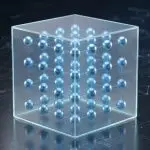
Abstract theoretical lines, termed ‘bit threads’, link to actual pathways for quantum data transfer within holographic systems resembling Lego constructions where each brick signifies quantum data and connections represent interactions. Initially proposed to connect gravity with quantum entanglement, the precise meaning of these bit threads remained elusive until now; the team has demonstrated that these paths ensure efficient information transmission without loss or divergence.
Key to this is a definition of quantum information flow (QIF) as mathematically tracing the journey of a message through this complex network, revealing multiple valid routes can exist for transferring identical amounts of quantum data.
Quantum information flow clarifies entanglement routing and capacity limitations
An improvement in defining edge capacity within holographic tensor networks increases resolution from log 2 χ e, enabling detection of finer entanglement structures beyond standard measures. Identifying specific pathways for quantum data flow, known as ‘bit threads’, was previously limited by ambiguity, but these paths are now pinpointed using a technique called quantum information flow and confirmed to adhere to established physical limits governing density and divergence. Multiple valid routes exist for transferring identical amounts of quantum data through complex network configurations; this explains the nonuniqueness observed in a bit thread formations.
Coecke’s concept of quantum information flow validated these newly defined edge capacities, tracing pathways for data within quantum protocols applied to holographic setups. This revealed adherence to density and divergence limits expected of ‘bit threads’, which represent channels for quantum data transfer. ZX string diagrams, a visual language representing quantum processes, demonstrated that QIF trajectories could identify entanglement structures beyond those detectable with standard measures of entanglement entropy alone. Differing distillation tasks generate distinct paths, extending previous discrete formulations detailed in earlier work with a framework better suited to comparison against these information flows.
Visualising entanglement pathways using quantum information dynamics
A novel method offers a new way to visualise ‘bit threads’, theoretical lines connecting gravity and quantum entanglement; previously defining them precisely proved difficult due to their ambiguous nature. Applying this framework universally presents challenges because current analysis relies on specific types of holographic tensor networks where complex structures resembling connected Lego bricks represent quantum data. It remains unclear whether findings extend seamlessly to all possible network arrangements or resource states within holography despite success with stabilizer configurations.
Valuable insight into understanding complex quantum systems has nonetheless been delivered, even considering limitations regarding universal applicability across all holographic network types. Visual tools such as ZX string diagrams, a graphical representation for quantum processes, revealed finer details of entanglement than standard measurements allow. The team at Fudan University, alongside collaborators at BIMSA and SIMIS, clarified the behaviour of ‘bit threads’, lines representing connections between gravity and quantum entanglement by tracking how data moves within a calculation; this demonstrates these theoretical pathways adhere to physical limits governing density and direction.
The research demonstrated that bit threads, lines linking gravity and quantum entanglement, follow expected rules regarding information flow within holographic systems. This means differing methods of performing calculations on quantum networks produce different paths for data transfer, which explains previous ambiguity surrounding their precise definition. Using tools like ZX string diagrams, researchers visualised finer details of entanglement than previously possible with standard measurements. The study clarifies how these ‘bit threads’ behave when tracking data movement in a calculation, offering insight into the structure of complex quantum systems.
👉 More information
🗞 Holographic Bit Threads from String-Diagrammatic Quantum Information Flow
✍️ Yi-Yu Lin and Song Cheng
🧠 ArXiv: https://arxiv.org/abs/2608.19428


See today’s quantum computing news on Quantum Zeitgeist for the latest breakthroughs in qubits, hardware, algorithms, and industry deals.