

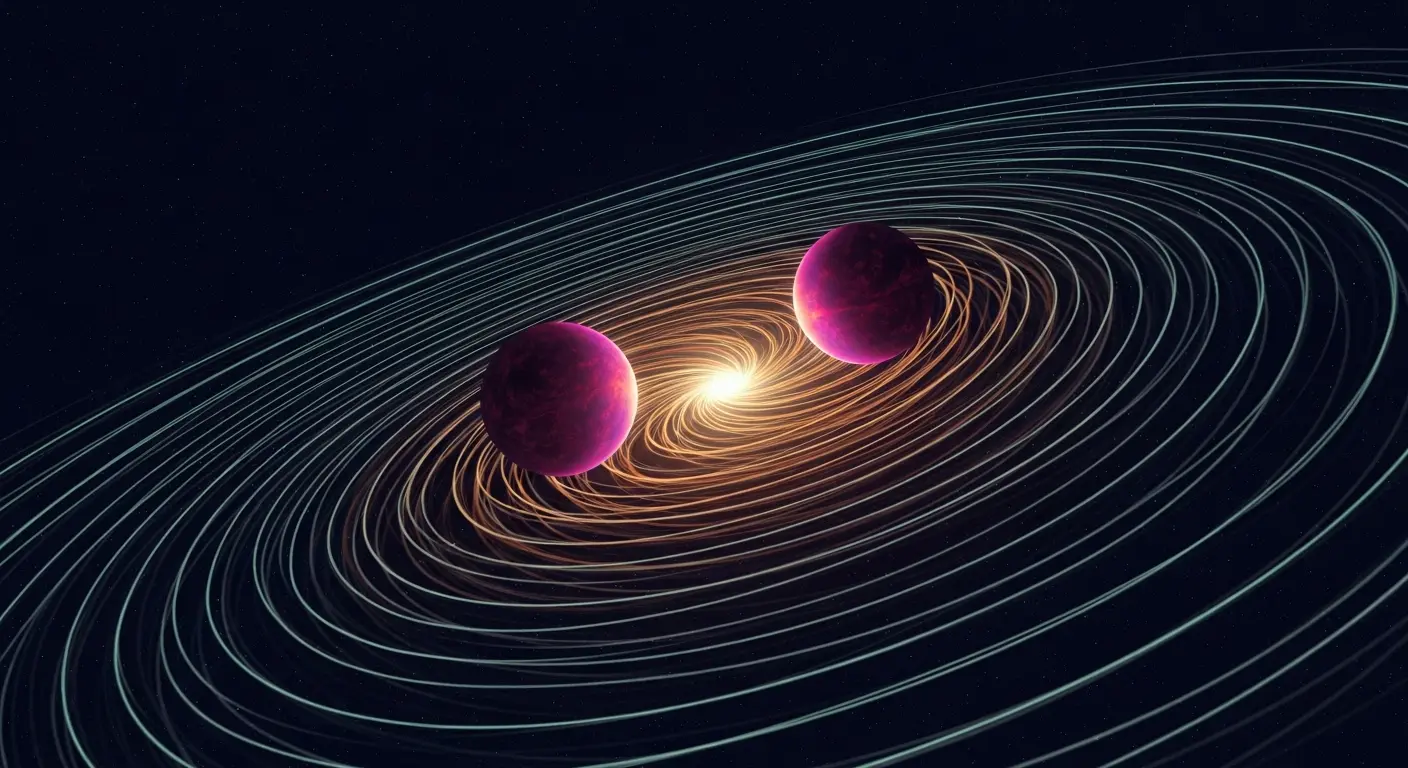
Sergio Carrasco and Dominique Spehner, at University of Concepción, have derived the explicit form of Bures geodesics, the shortest paths connecting non-faithful density matrices representing quantum states with differing ranks. The derivation extends existing knowledge of quantum speed limits, previously defined for pure and faithful states, and provides a condition for geodesic uniqueness. These findings have implications for understanding the key limits of how sharply quantum systems can change, mirroring the behaviour of great circles on a sphere.
Multiple shortest paths redefine quantum state evolution calculations
Bures geodesic arcs connecting non-faithful density matrices have, for the first time, been explicitly defined, revealing infinitely many shortest paths can exist where previously only one was known. This represents a shift from solely identifying single fastest routes between quantum states to acknowledging multiple equally efficient pathways, particularly for states representing incomplete information. The ability to define these arcs extends calculations of the quantum speed limit, a fundamental constraint on how quickly quantum systems can evolve, and opens new possibilities for designing faster quantum technologies.
The discovery applies specifically to non-faithful density matrices, representing quantum states with incomplete information, and extends existing knowledge of Bures geodesics, previously defined only for ‘pure’ or complete quantum states. Refined calculations of the quantum speed limit and improved modelling of quantum system evolution result from defining these pathways. The team proved a necessary condition for geodesic uniqueness; multiple arcs of equal length emerge when this condition fails, analogous to great circles connecting opposite poles on a sphere. Recent experiments utilising superconducting devices have already observed the fastest quantum evolutions, suggesting potential for practical application of these geodesic pathways. Furthermore, these geodesics could refine quantum metrology, improving precision in measurements of quantum systems, although current calculations do not yet account for the complexities of multi-particle systems or the impact of environmental noise on maintaining these optimal paths.
Infinite optimal pathways redefine quantum state transition mechanisms
Mapping the shortest routes quantum systems take when changing states seemed a settled problem, mirroring how easily we map the quickest path between cities. However, this work reveals a surprising complexity; for certain quantum states, an infinite number of equally efficient pathways exist, not just one fastest route. This multiplicity challenges the conventional wisdom of a single, definitive quantum speed limit and raises questions about how systems ‘choose’ between these optimal routes.
A richer, more subtle picture than previously assumed is revealed by identifying these multiple routes, prompting further investigation into the mechanisms governing quantum state transitions. This detailed mapping provides an important foundation for exploring complex quantum phenomena and refining theoretical models. Extending the explicit form of these shortest paths to encompass states representing incomplete information moves this advancement beyond previous calculations limited to ‘faithful’ states. This allows for a more thorough understanding of quantum evolution. In particular, the work reveals that, in certain instances, infinitely many equally short paths connect two quantum states, challenging the simple notion of a single fastest route and suggesting a more nuanced understanding of quantum state transitions.
The quantum speed limit, rooted in the principles of quantum mechanics, dictates a fundamental lower bound on the time required for a quantum system to evolve from an initial state to a final state. This limit isn’t merely a theoretical curiosity; it has profound implications for the efficiency of quantum computation and the limits of precision in quantum measurements. The original Mandelstam, Tamm bound, established in 1979, provides one such limitation, relating the minimum evolution time to the mean energy variance of the system. The bound states that the time taken for a quantum state to change is inversely proportional to the root-mean-square of the energy variance. This research builds upon this foundation by explicitly defining the geodesics, the paths that actually achieve this minimum time, for a broader class of quantum states.
Previously, the calculation of these geodesics was well-established for ‘pure’ states, where the quantum system exists in a single, definite state. Similarly, geodesics were known for ‘faithful’ density matrices, representing states where the system is known to be in one of a set of possible states with certainty. However, many real-world quantum systems exist in ‘mixed’ states, representing a probabilistic combination of multiple states, and can be described by non-faithful density matrices, where the probability of finding the system in any single state is zero. Defining geodesics for these non-faithful states proved significantly more challenging. The researchers successfully derived an explicit mathematical form for these Bures geodesics, effectively charting the fastest possible paths through the space of quantum states for systems with incomplete information. This derivation involves complex tensor manipulations and a careful consideration of the Bures metric, a measure of distance between quantum states.
The significance of finding multiple, infinitely many, shortest paths lies in the implications for how we understand quantum evolution. If multiple paths achieve the same minimum time, it suggests that the system doesn’t necessarily follow a single, predetermined trajectory. This raises questions about the underlying dynamics and whether external factors or inherent quantum randomness influence the specific path taken. The condition for geodesic uniqueness established by Carrasco and Spehner provides a crucial criterion: if this condition is not met, infinitely many shortest paths emerge. This condition relates to the rank of the density matrices involved, essentially quantifying the degree of ‘mixedness’ of the quantum state. A lower rank indicates a more mixed state and a higher likelihood of multiple geodesics.
The potential applications of this research are considerable. In quantum computation, understanding the quantum speed limit is crucial for optimising the speed and efficiency of quantum algorithms. By identifying the fastest possible routes between quantum states, researchers can design more effective quantum gates and circuits. In quantum metrology, where the goal is to achieve the highest possible precision in measurements, these geodesics can be used to optimise the evolution of quantum probes, enhancing their sensitivity. While the current work doesn’t yet address the complexities of multi-particle entanglement or the effects of decoherence (the loss of quantum information due to environmental interactions), it provides a vital theoretical foundation for future investigations in these areas. Future research will need to account for these factors to fully realise the potential of these geodesic pathways in practical quantum technologies. The team acknowledges that maintaining these optimal paths in the face of environmental noise remains a significant challenge, requiring robust quantum error correction techniques.
Researchers determined the explicit form of the shortest paths, known as Bures geodesics, connecting two quantum states, even when those states are not fully defined. This finding means that quantum systems do not always have a single, predetermined path for evolution, but can instead utilise infinitely many equally fast routes under certain conditions. The number of these paths relates to how ‘mixed’ the quantum state is, as determined by the rank of the density matrices. This work provides a theoretical basis for optimising the speed of quantum algorithms and enhancing the precision of quantum measurements.
👉 More information
🗞 Bures geodesics for non-faithful states and quantum speed limit
🧠 ArXiv: https://arxiv.org/abs/2606.06759


See today’s quantum computing news on Quantum Zeitgeist for the latest breakthroughs in qubits, hardware, algorithms, and industry deals.



