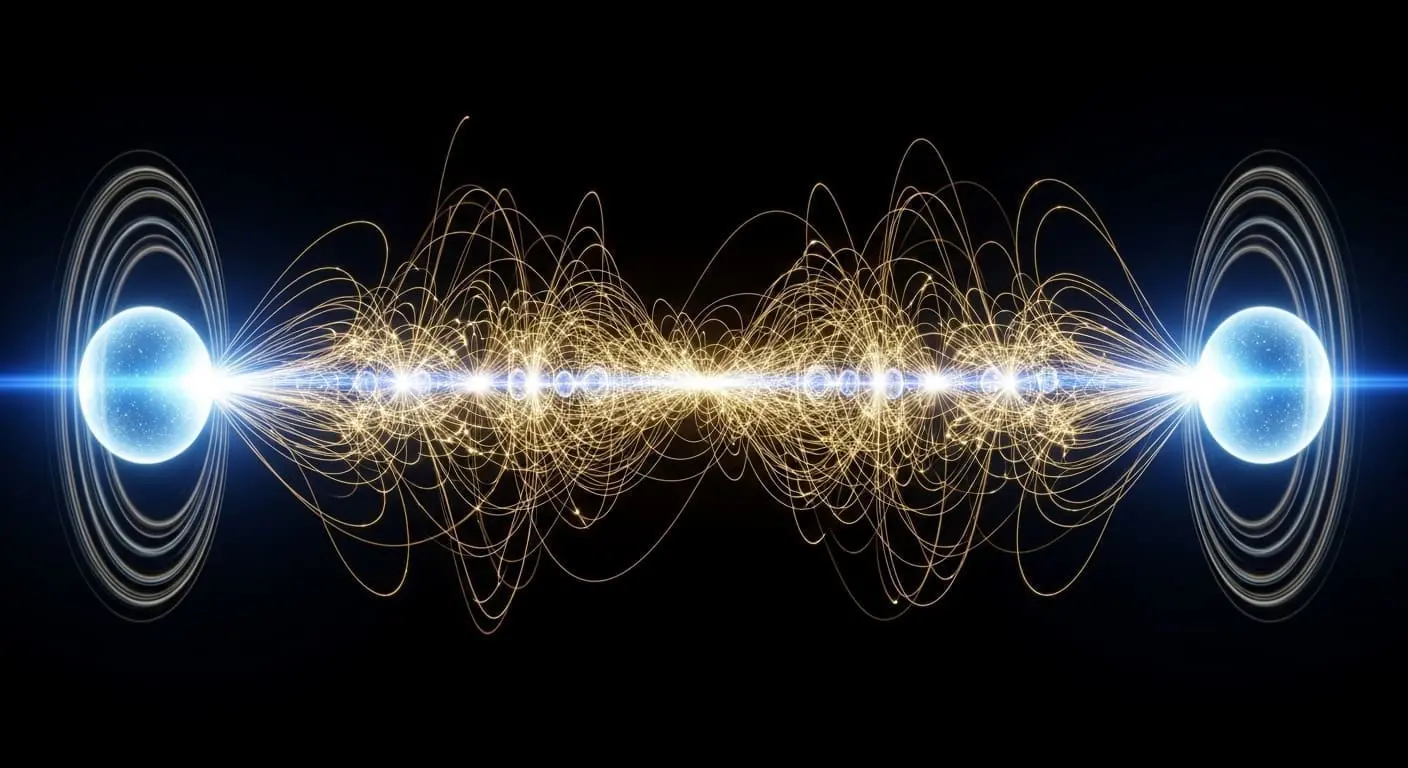
Researchers at the University of Southern California, led by Rishabh Jha, demonstrate a surprising connection between entanglement and subharmonic oscillations in periodically driven quantum systems. A distinct subharmonic signature emerges within the entanglement spectrum of a free-fermion system, specifically a two-step driven Su-Schrieffer-Heeger chain. Floquet topology, specifically a zero-π phase, is a key condition for this effect, alongside coherent nonequilibrium preparation of the system. The findings highlight entanglement spectroscopy as a strong, subsystem-resolved method for probing Floquet topological coherence, offering a new avenue for characterising these complex quantum phenomena.
Period-doubling entanglement reveals Floquet topological coherence in a driven Su-Schrieffer-Heeger
Entanglement measures now reveal a period-doubling response with Fourier weight concentrated at half the drive frequency, representing a substantial improvement over previous methods. Earlier techniques required complex interactions to detect subharmonic responses, but this work bypasses that limitation by demonstrating the effect within a simplified, number-conserving free-fermion system. Dr. Jha and colleagues investigated a two-step driven Su-Schrieffer-Heeger chain, establishing zero-π Floquet topology and coherent nonequilibrium preparation as necessary and sufficient conditions for observing this phenomenon. The Su-Schrieffer-Heeger (SSH) chain is a paradigmatic model in condensed matter physics, known for its topological properties and ability to support localised edge states when subject to specific boundary conditions. Driving this chain periodically introduces the concept of Floquet topology, where the topological properties are defined not in energy space, but in the space of quasienergies, the analogue of energy for periodically driven systems.
The chain exhibits zero-π Floquet topology, supporting distinct edge modes at quasienergies of zero and π. These edge modes are protected by symmetry and remain localised at the boundaries of the chain, even in the presence of perturbations. Analysis of subsystem correlation matrices confirmed the strong period-doubling response, revealing it emerged only when the system was prepared in a coherent superposition of the zero and π edge modes. This coherent superposition is crucial; it creates an interference pattern that manifests as the subharmonic signal in the entanglement spectrum. The signal vanished when using a stroboscopically stationary Floquet eigenstate, or when the system entered a topologically trivial phase lacking edge modes, further establishing the conditions required for observation. A stroboscopically stationary state represents the system’s response after many driving cycles, where transient effects have decayed. The absence of a signal in this state indicates that the subharmonic response is inherently dynamic and linked to the time evolution of the coherent superposition. Both coherent nonequilibrium preparation and zero-π Floquet topology are vital for this observation. The zero-π phase specifically refers to a π phase difference between the quasienergies of the edge modes, which is essential for the emergence of the subharmonic signal.
Entanglement spectra reveal dynamic responses in simplified quantum models
Researchers are refining techniques to understand how quantum systems respond to periodic driving, an important step towards controlling these systems for potential technological applications. Periodic driving is a powerful tool for manipulating quantum systems, offering possibilities for creating novel quantum states and functionalities. This research offers a new way to detect these responses, through the entanglement spectrum, rather than relying on traditional physical measurements, potentially providing a more sensitive probe of quantum coherence. The entanglement spectrum, derived from the reduced density matrix of a subsystem, provides information about the entanglement between the subsystem and the rest of the system. By analysing the entanglement spectrum, researchers can gain insights into the quantum correlations and topological properties of the system. The current work is limited to a specific, simplified model, a number-conserving free-fermion system, and extending this approach to systems with interactions presents a significant challenge. Free-fermion systems are mathematically tractable, allowing for analytical and numerical calculations, but real materials often exhibit interactions between electrons, which complicate the analysis.
Despite demonstration within a simplified model system, the technique holds considerable promise because it focuses on correlations between quantum particles, revealing subtle effects often masked in bulk properties. Traditional measurements often average over many degrees of freedom, obscuring the delicate quantum correlations that are crucial for understanding topological phenomena. The durability of the signal with increasing system size suggests scalability, opening avenues for exploring more complex quantum systems. This scalability is important for bridging the gap between theoretical models and experimental realisation in larger, more realistic systems. Entanglement spectroscopy offers a new method for probing the behaviour of periodically driven quantum systems, moving beyond reliance on direct physical measurements. A distinct subharmonic signature, an oscillation at half the driving frequency, was demonstrated within the entanglement spectrum of a Su-Schrieffer-Heeger chain engineered to support symmetry-protected edge modes. The observation of this subharmonic response at a frequency of half the driving frequency, a period-doubling effect, is a hallmark of nonlinear dynamics and indicates a strong response to the periodic drive. Observing this response requires both a specific topological arrangement and the preparation of the system in a coherent superposition state. The ability to detect this coherent superposition through entanglement measurements provides a powerful tool for characterising the topological coherence of the system and opens up possibilities for controlling and manipulating these quantum states for potential applications in quantum technologies, such as robust quantum information processing.
The research demonstrated a clear subharmonic signature, an oscillation at half the driving frequency, within the entanglement spectrum of a free-fermion system. This finding indicates that the entanglement between quantum particles can be used as a sensitive probe of how a system responds to periodic driving. The presence of this signature relies on a specific topological arrangement of the system and its initial preparation in a coherent superposition state, establishing key conditions for observing this effect. Researchers utilised a Su-Schrieffer-Heeger chain to achieve this, and suggest this method of ‘entanglement spectroscopy’ offers a new way to study these systems without relying on traditional physical measurements.
👉 More information
🗞 Locked Subharmonic Oscillations in the Entanglement Spectrum of a Periodically Driven Topological Chain
🧠 ArXiv: https://arxiv.org/abs/2604.07442


See today’s quantum computing news on Quantum Zeitgeist for the latest breakthroughs in qubits, hardware, algorithms, and industry deals.