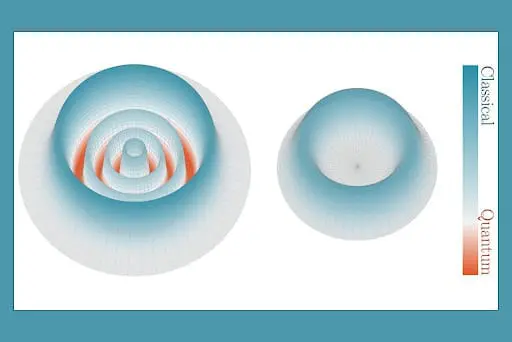
Scientists at Berkeley Lab have demonstrated that a leading dark matter candidate, the axion, could exist as a wave without leaving any detectable trace, even with the most advanced quantum detectors. Published in Physical Review Letters, the research directly addresses a growing trend of employing quantum technology in dark matter searches, revealing a surprising limitation if dark matter itself behaves quantum mechanically. Nick Rodd, a divisional fellow in Berkeley Lab’s Physics Division Theory Group, who led the study, explains, “Dark matter makes up most of the matter in the universe, but it has never been directly detected.” The team’s fully quantum model shows that effects from axion dark matter, and other ultralight wave-based candidates, can be replicated using classical waves, effectively simplifying the theoretical basis for the entire field.
Axion Dark Matter Modeled with Quantum Optics Techniques
This surprising result indicates that even with increasingly sensitive instruments, certain quantum states of dark matter would remain invisible. This simplification of the theoretical framework is significant for the field of ultralight dark matter, according to Rodd. “Although the founding principle of the field – that the axion can be treated classically – is correct, this new study places these foundations on firm ground for the first time.” The research also offers a general method for calculating the effects of exotic dark matter states, potentially benefiting gravitational wave and quantum optics researchers applying similar techniques to different phenomena, suggesting a broader applicability of their methodologies.
Classical Wave Reproduction Validates Ultralight Dark Matter Foundations
Researchers at Berkeley Lab, UC Berkeley, and the University of Chicago investigated whether axions, a leading dark matter candidate, could exist in a quantum state undetectable by current instruments. This finding addresses a growing trend within the field, where scientists are applying increasingly sophisticated quantum tools to the search, but it also highlights a potential paradox: if the target itself behaves quantum mechanically, the benefits of these tools diminish. The team employed quantum optics techniques to build a comprehensive model of axion detection, revealing that even exotic quantum states of dark matter ultimately produce signals indistinguishable from those of classical waves when observed by a realistic detector. These implications suggest that future detection strategies may need to account for the possibility of a “vanishing” signal, even with increasingly sensitive instrumentation.
Dark matter makes up most of the matter in the universe, but it has never been directly detected.



See today’s quantum computing news on Quantum Zeitgeist for the latest breakthroughs in qubits, hardware, algorithms, and industry deals.